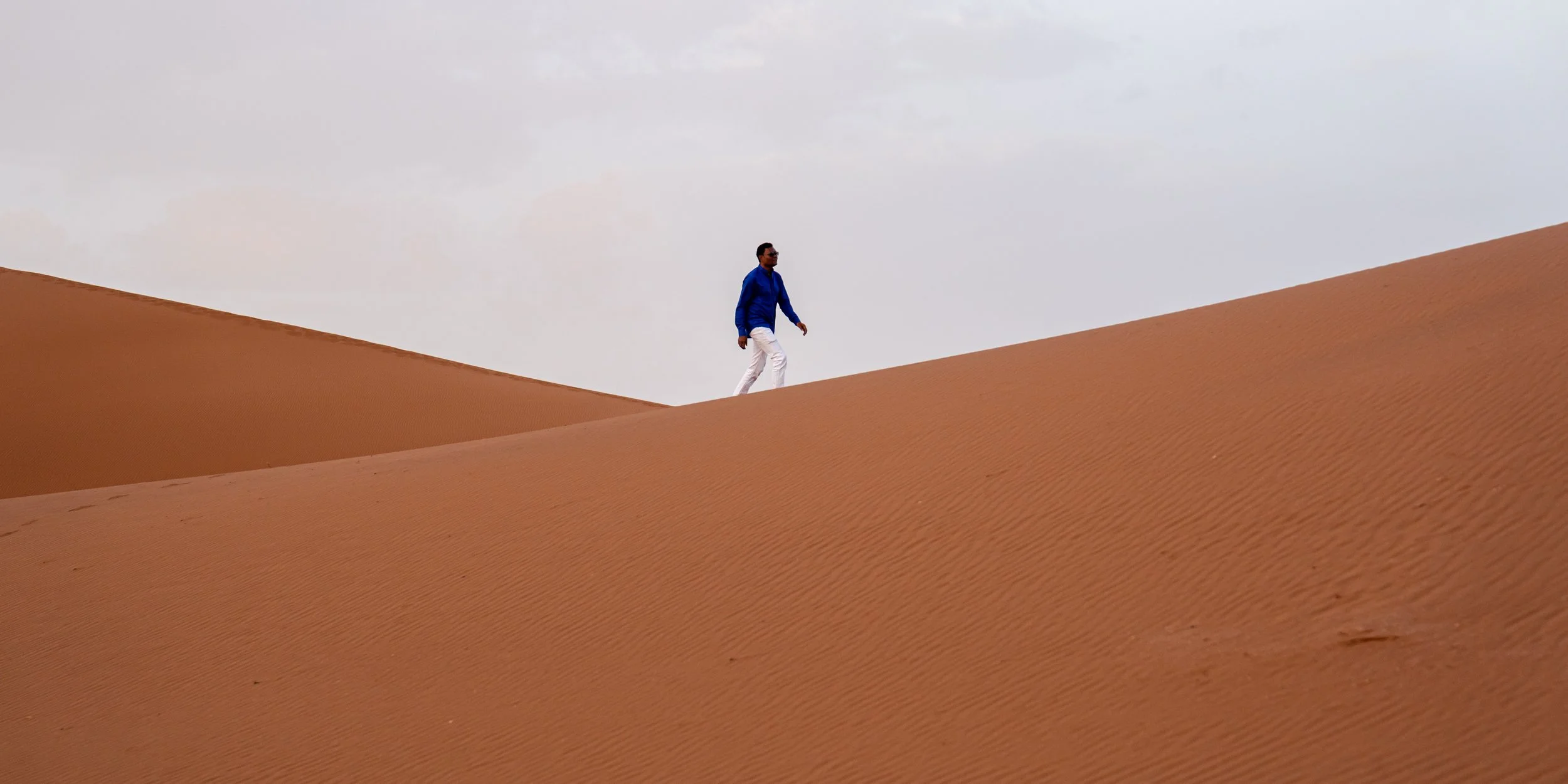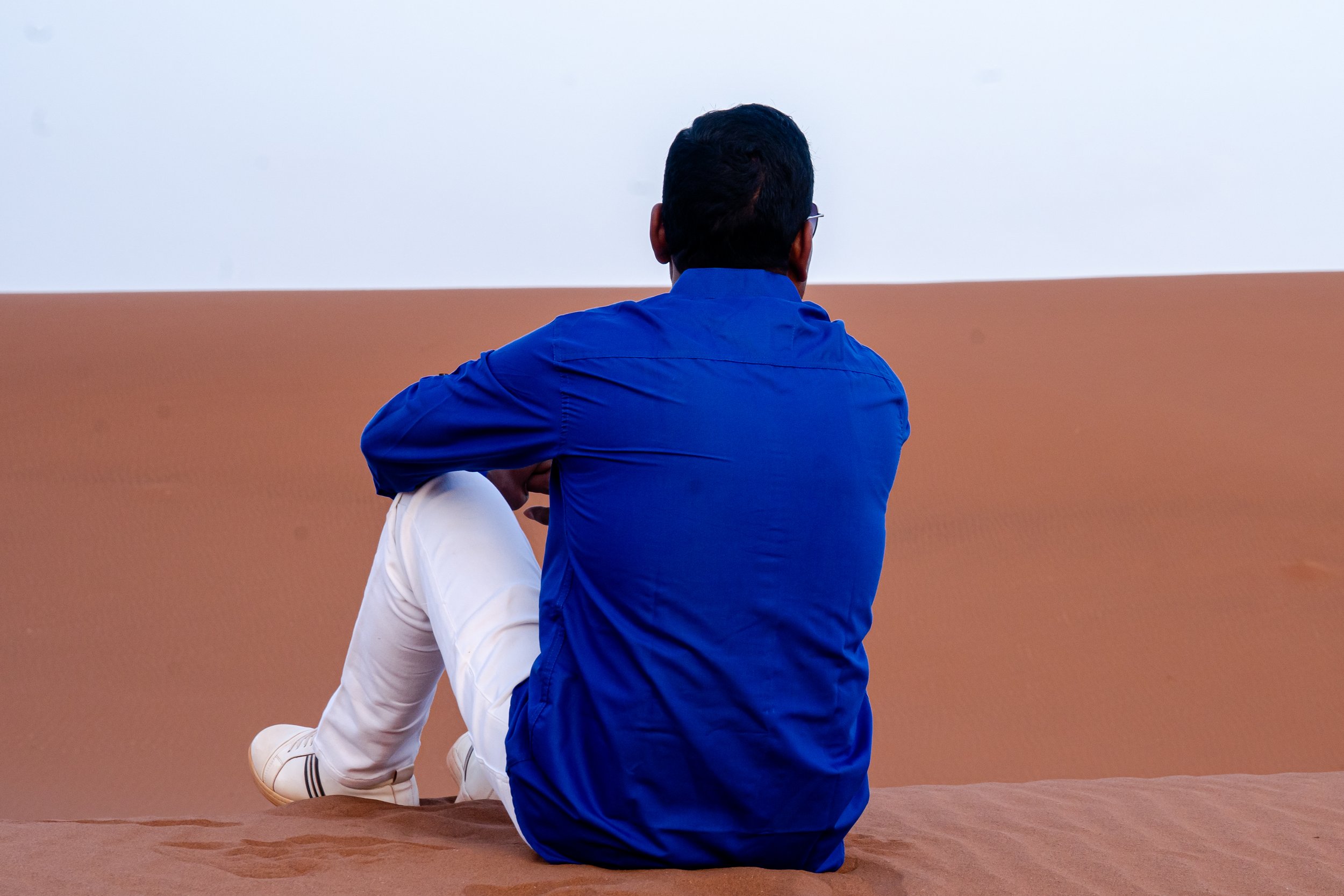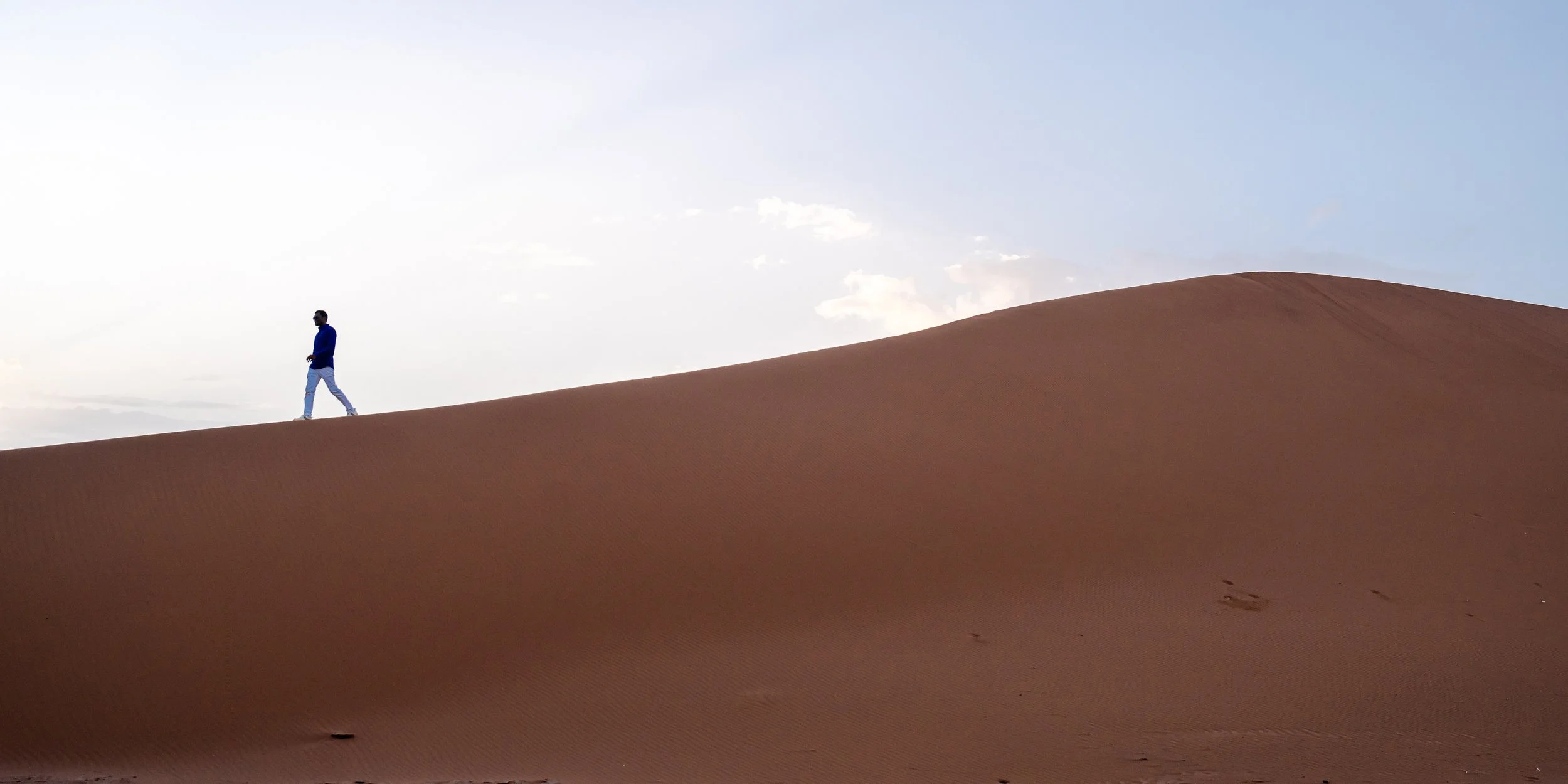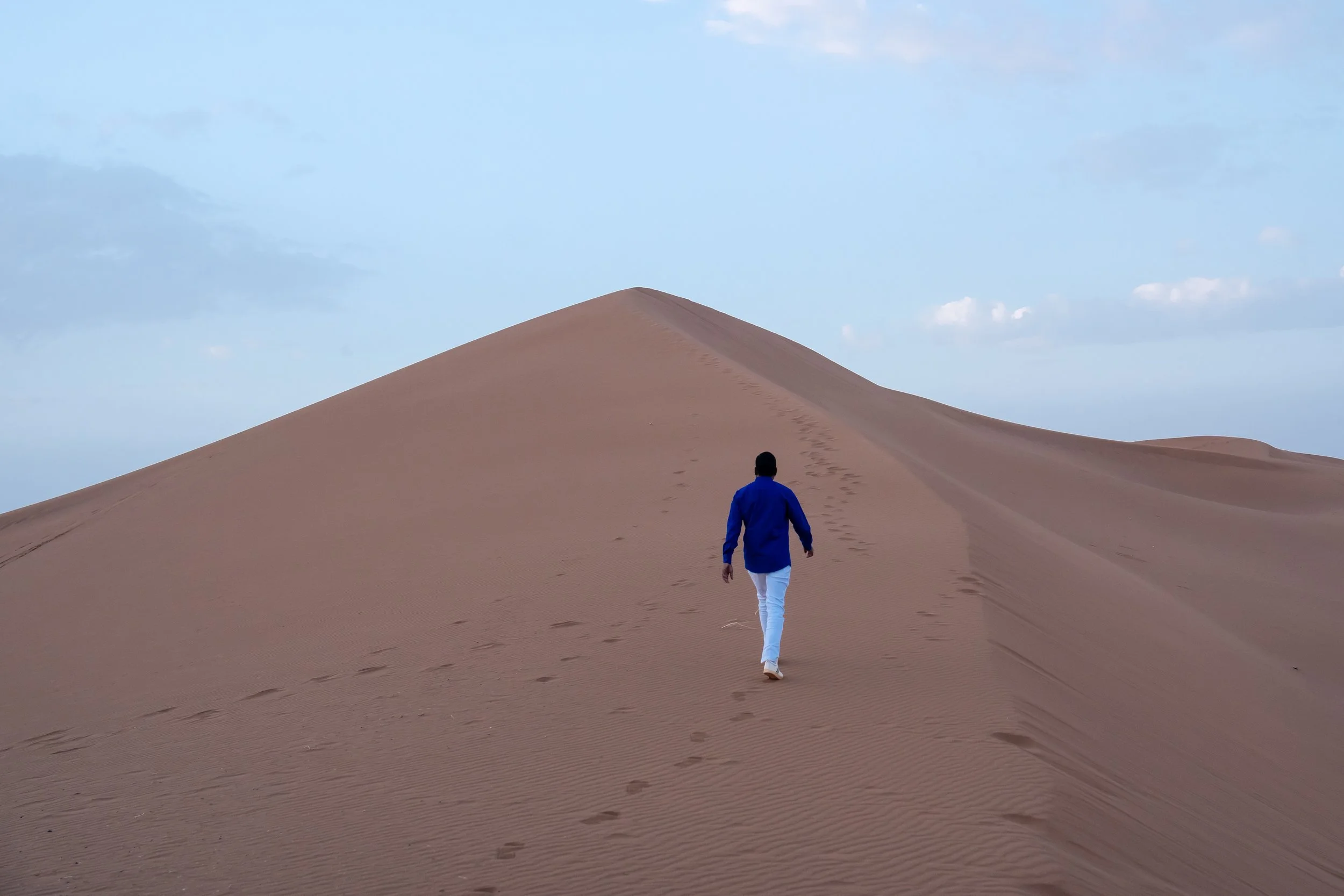
The world turned to me once more, and it was about securing hope for humanity’s future. My mission began with a search: a rare Saharan beetle lost in the endless desert sands. I ventured into the Moroccan Sahara, braving sandstorms, solitude, and the unforgiving terrain, knowing this beetle carried secrets that could restore ecological balance—or unleash devastation if misused. Finding it was only the beginning; protecting it and delivering it safely would decide the fate of our world.
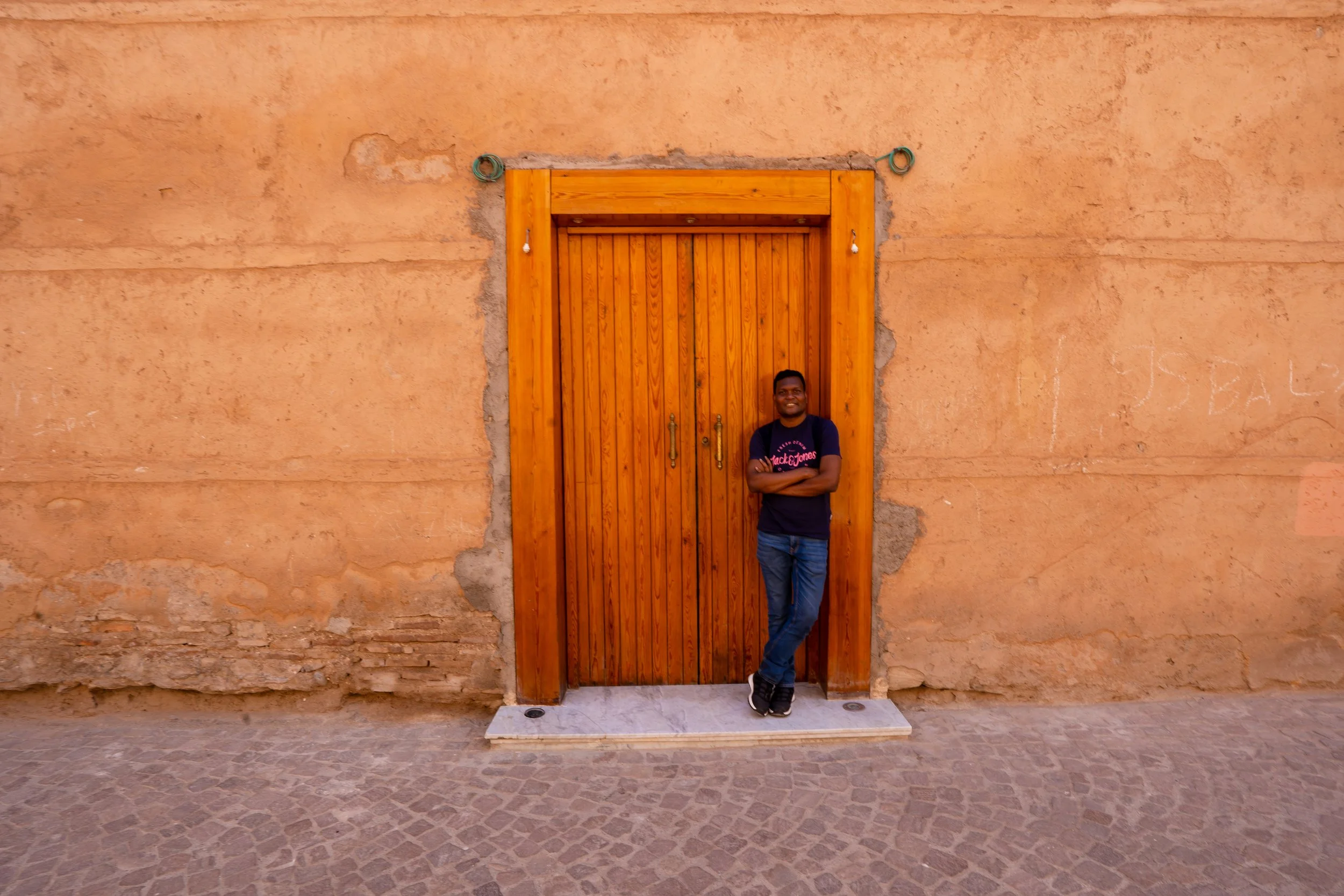
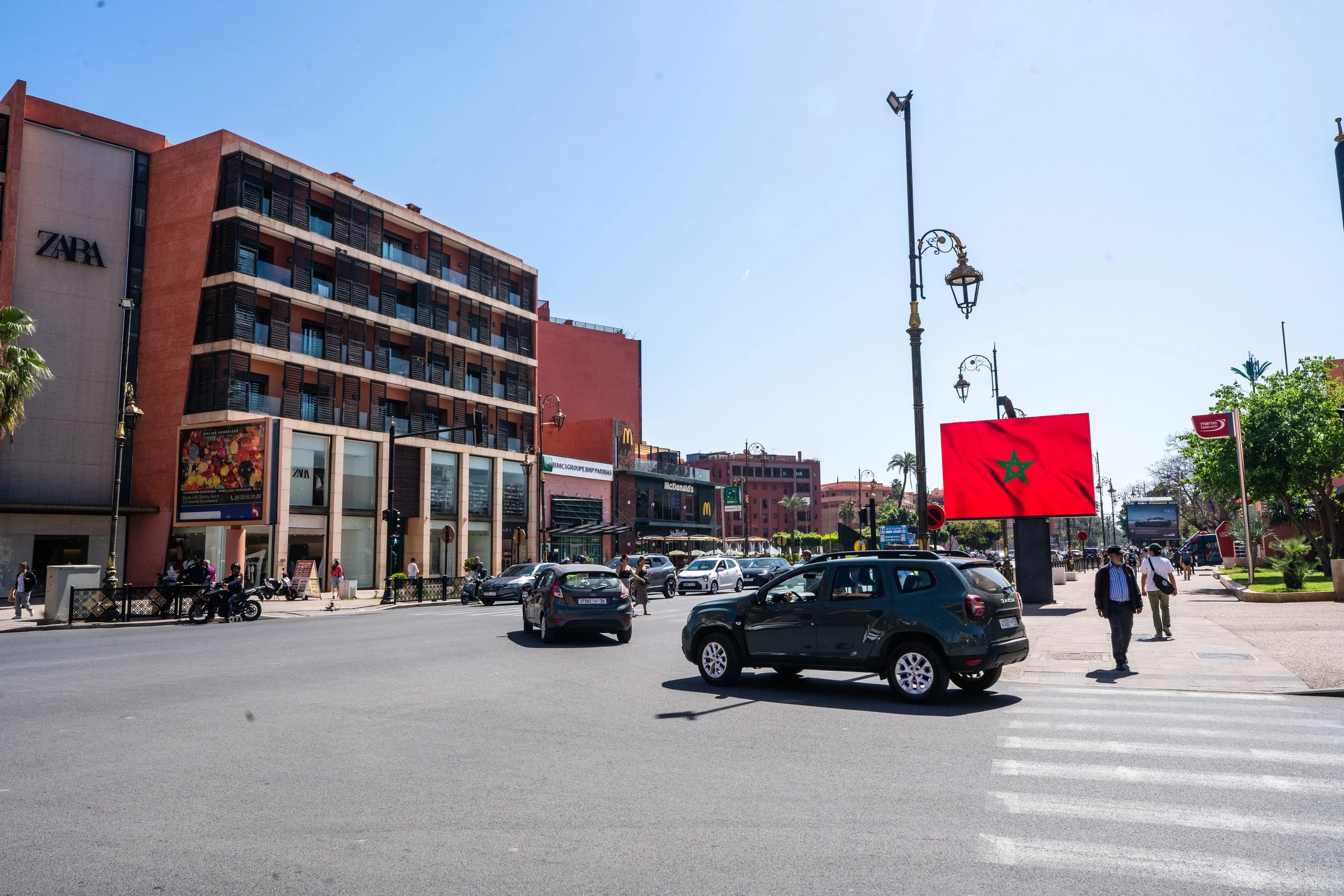
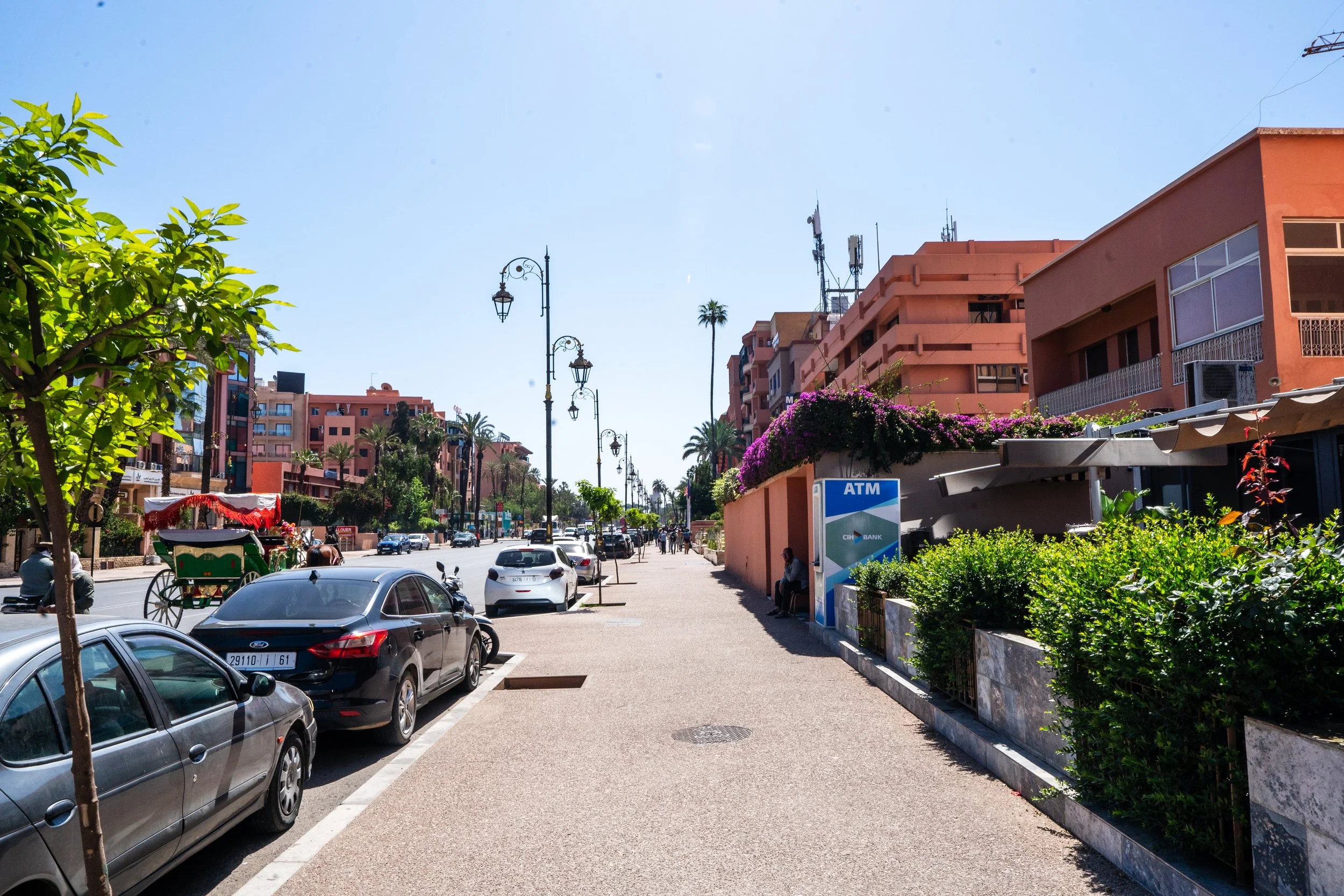
I arrived in Marrakech, a city of red walls and winding alleys alive with color, spice, and sound. The medina’s rhythm, with its markets and artisans, set the tone—vibrant yet timeless—before the weight of my mission pulled me onward.
Beyond the lively streets of Marrakech lies a nation shaped by both tradition and modern governance. Morocco is guided by King Mohammed VI under a constitutional monarchy, blending centuries of heritage with evolving democratic institutions. Its people carry a deep pride in their roots—Arab and Amazigh, known to the world as Berbers, whose history stretches back thousands of years across the Atlas Mountains and desert plains. The Berbers embody resilience and identity, preserving their language, music, and customs while standing as guardians of Morocco’s cultural soul. Together, Arabs and Berbers weave the fabric of a society renowned for warmth, hospitality, and a spirit that bridges Africa, Europe, and the Arab world…
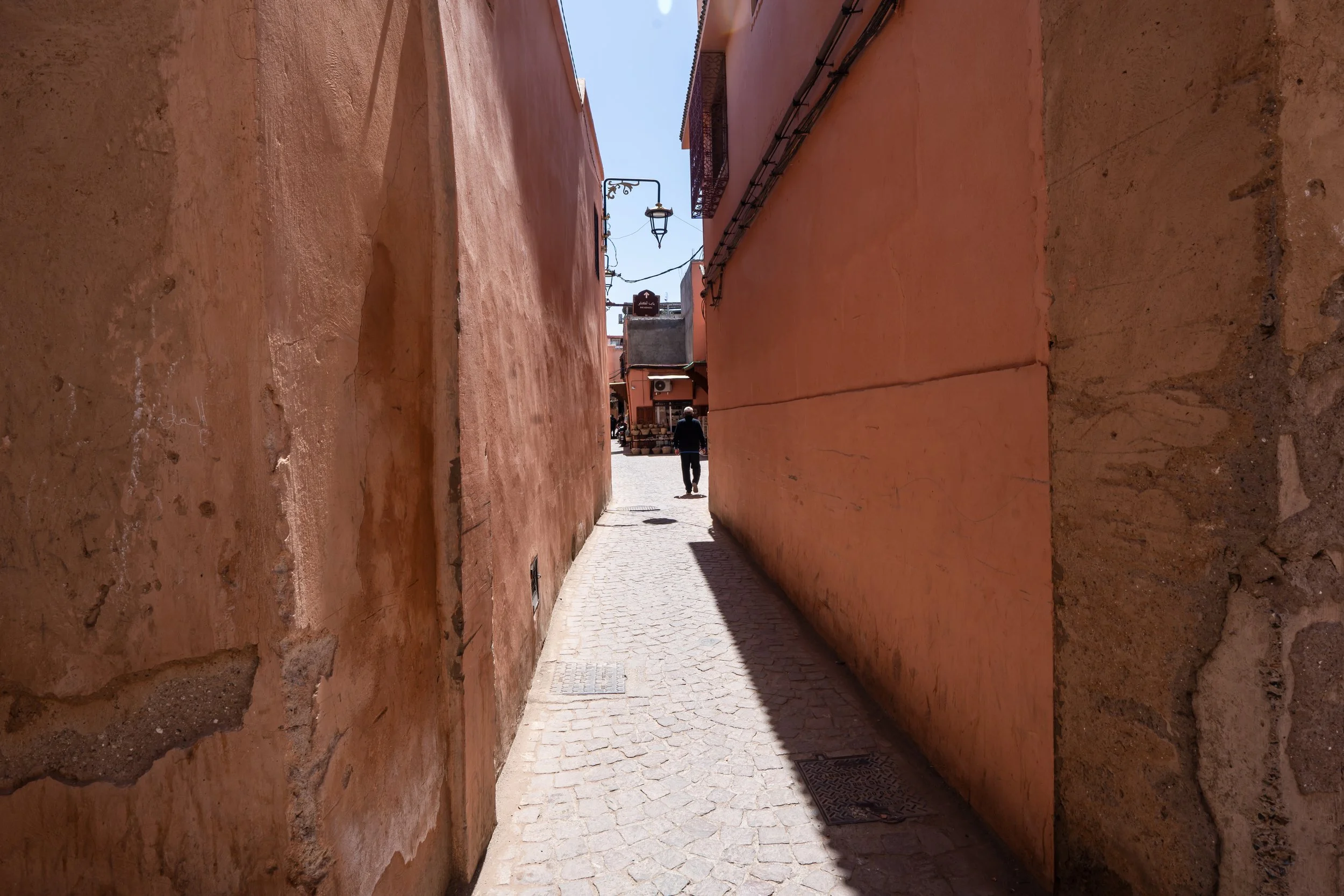
Marrakech is often called Al Hamra—the Red City—because of the distinctive clay used to build its walls and houses. The local soil, rich in red ochre, was shaped into bricks and plaster centuries ago, giving the city its warm, earthy glow. Under the Moroccan sun, those walls seem to burn with life, a reminder of how nature and tradition combine to define Marrakech’s timeless character.
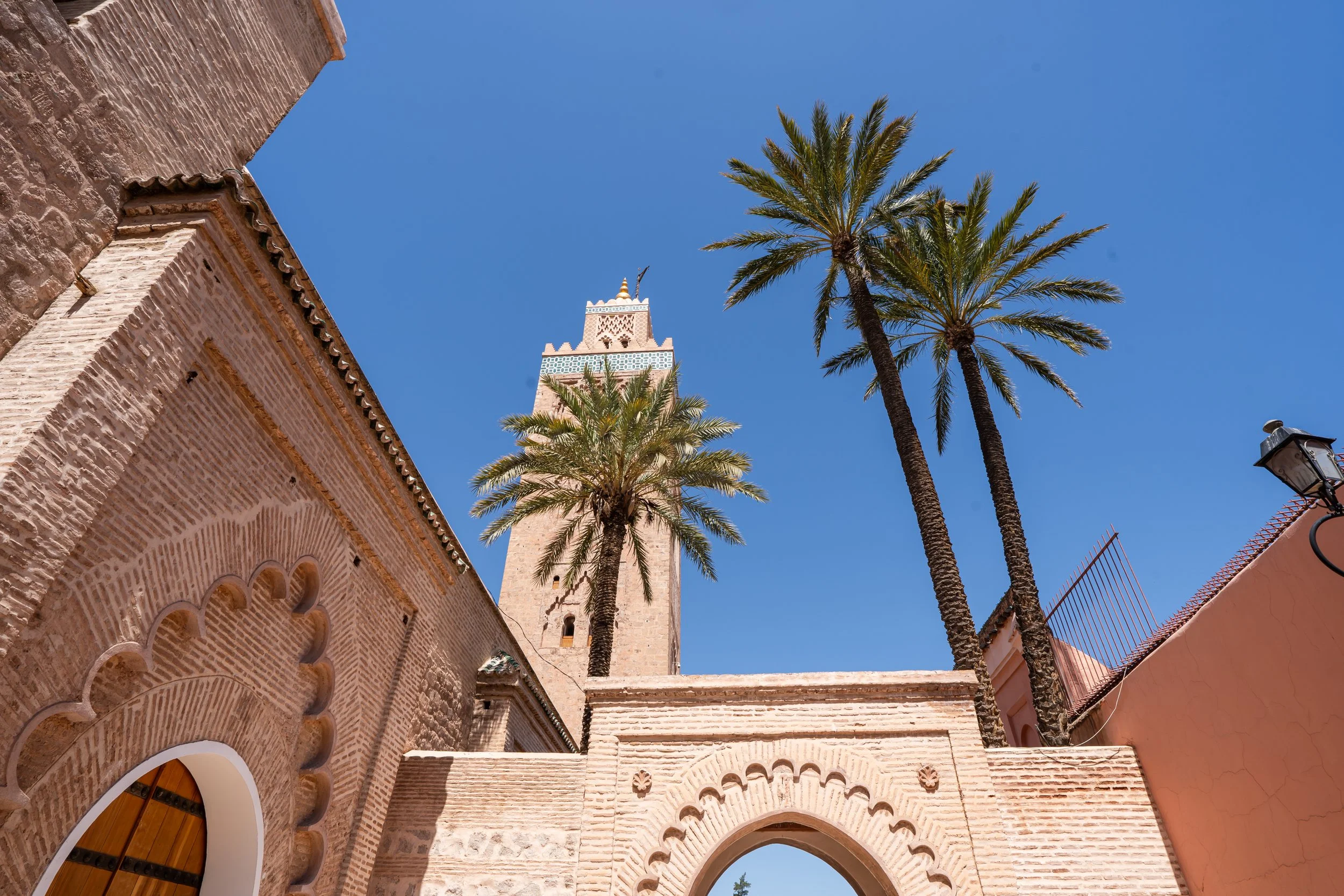
Standing tall in the heart of Marrakech, the Koutoubia Mosque is the city’s most iconic landmark. Its minaret, rising nearly 70 meters, dominates the skyline and has guided travelers for centuries. Built in the 12th century during the Almohad dynasty, the mosque is celebrated for its harmonious proportions and intricate stonework, a masterpiece of Islamic architecture. Locals often say that Marrakech’s rhythm begins here, where faith, history, and artistry converge beneath the shadow of its red-stone walls.
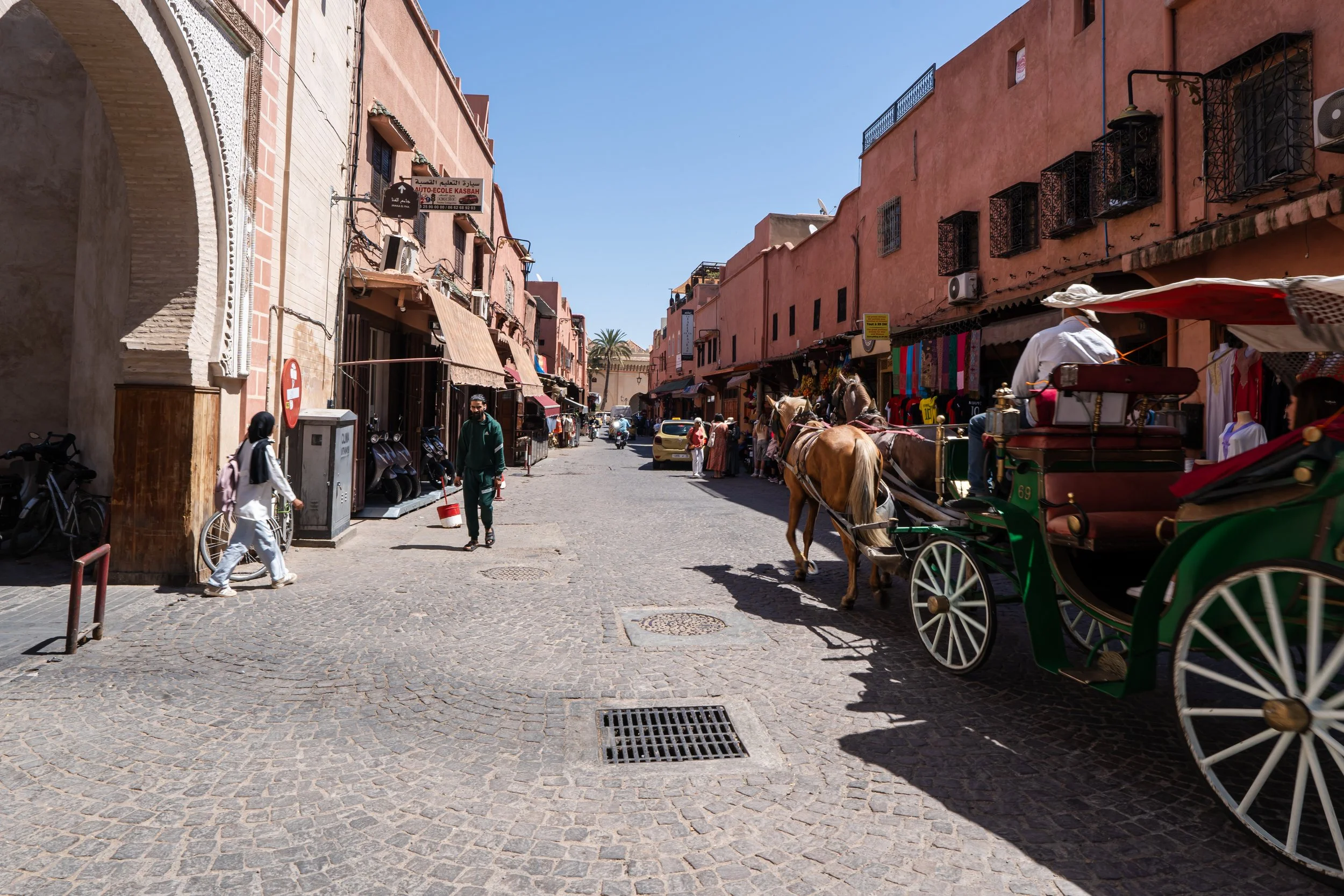
The streets of Marrakech are a living maze, where every turn reveals a burst of color and sound. Narrow alleys wind through the medina, lined with stalls overflowing with spices, textiles, and handcrafted treasures. The rhythm of daily life flows here—children weaving through crowds, artisans at work, and the scent of mint tea drifting from hidden courtyards. It is a place where history breathes in every stone, and the pulse of Morocco can be felt with each step…
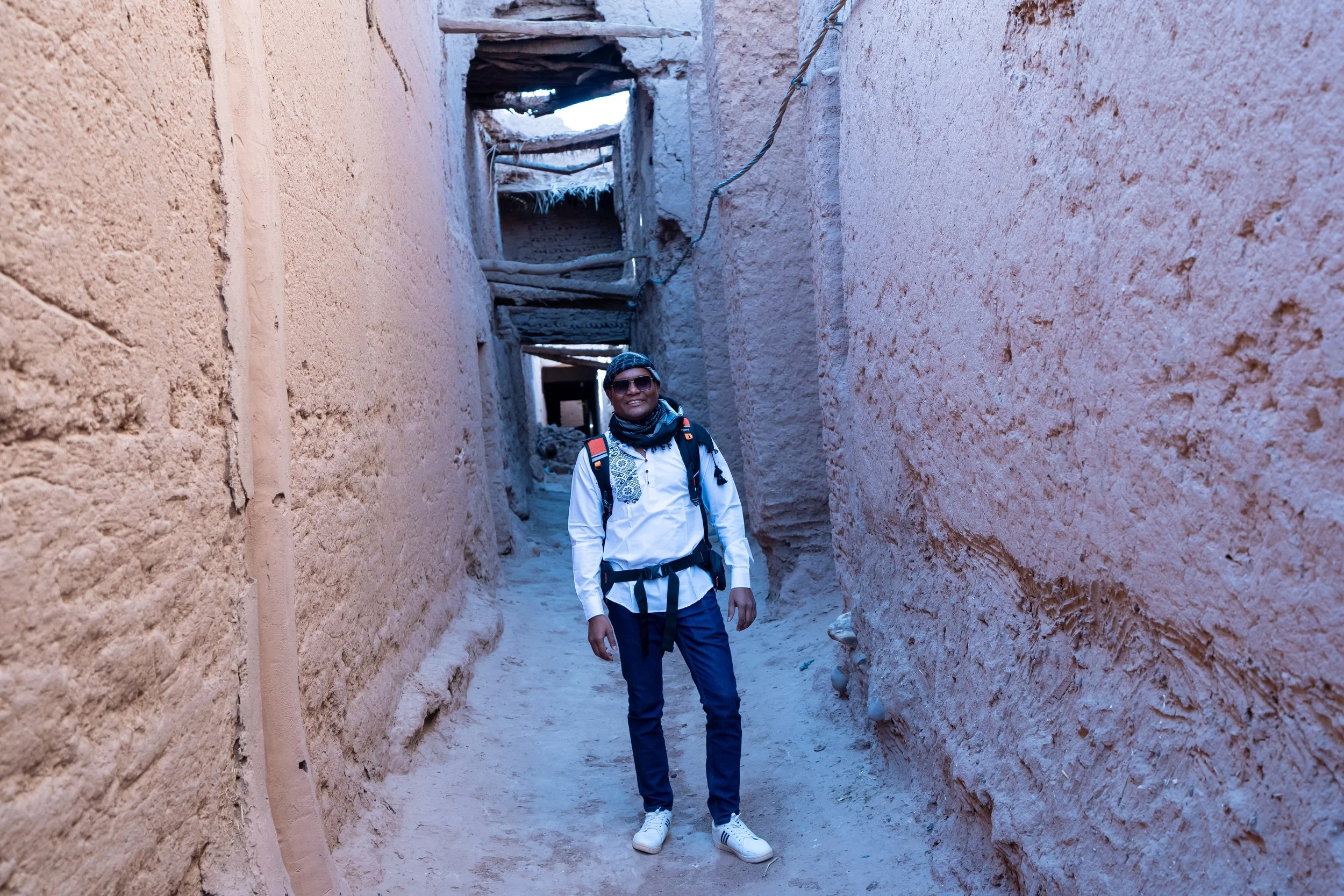
I slipped into one of Marrakech’s narrow streets, where clay walls pressed close and the light barely reached. The air carried the scent of spices and dust, while the medina’s noise faded into a hush. In that hidden stretch, the city seemed to pause, holding its breath before revealing what lay ahead.
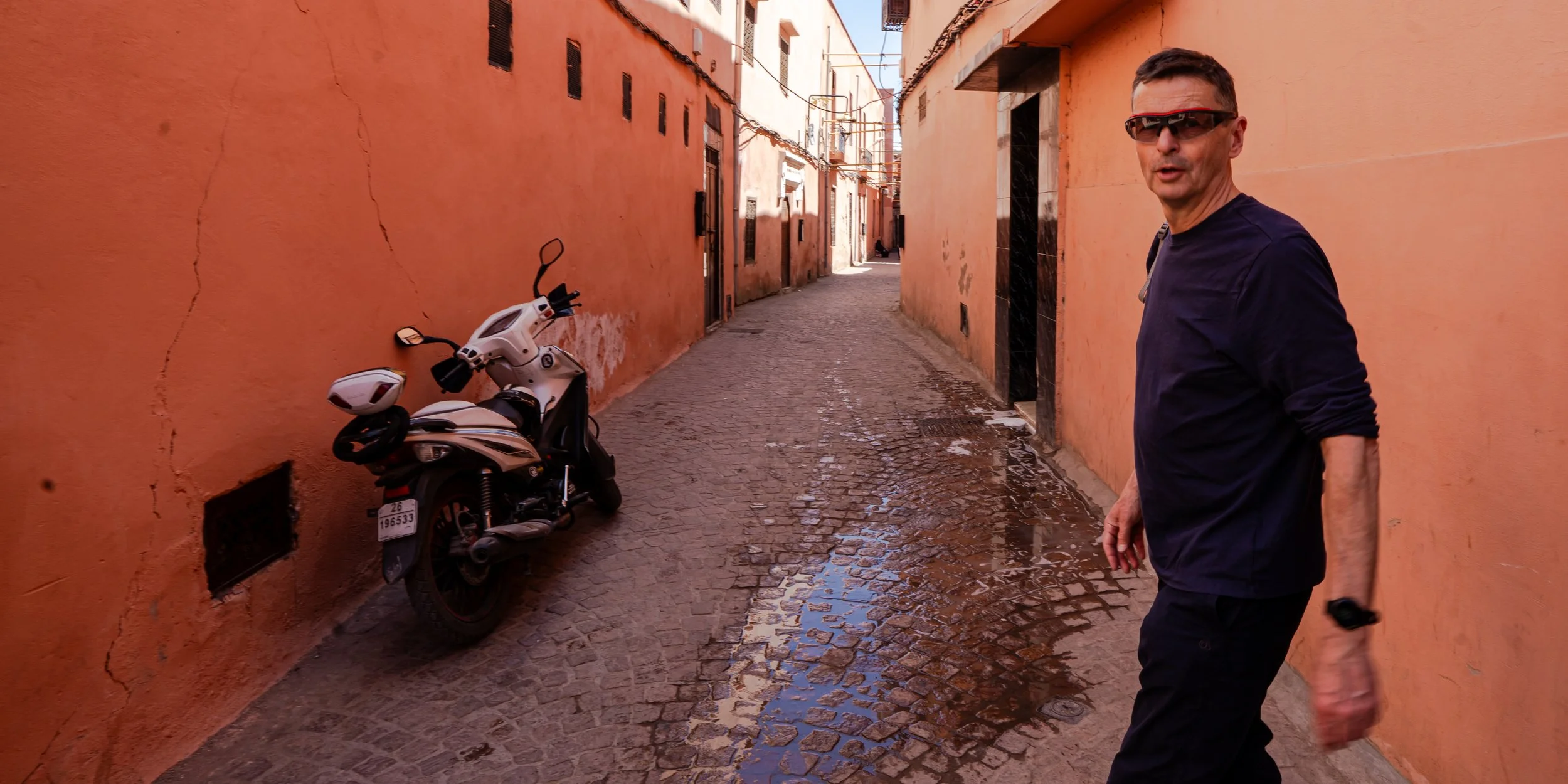
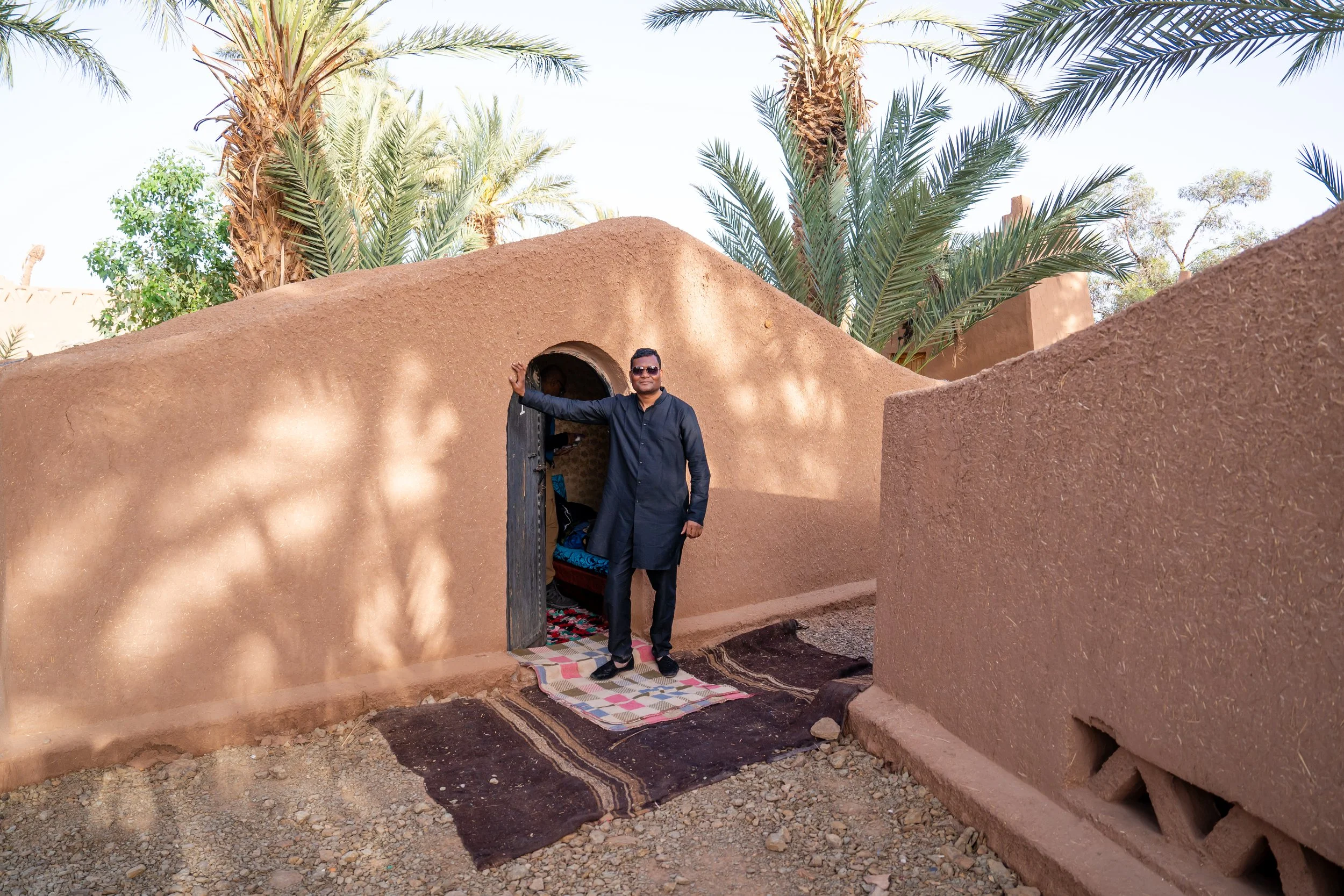
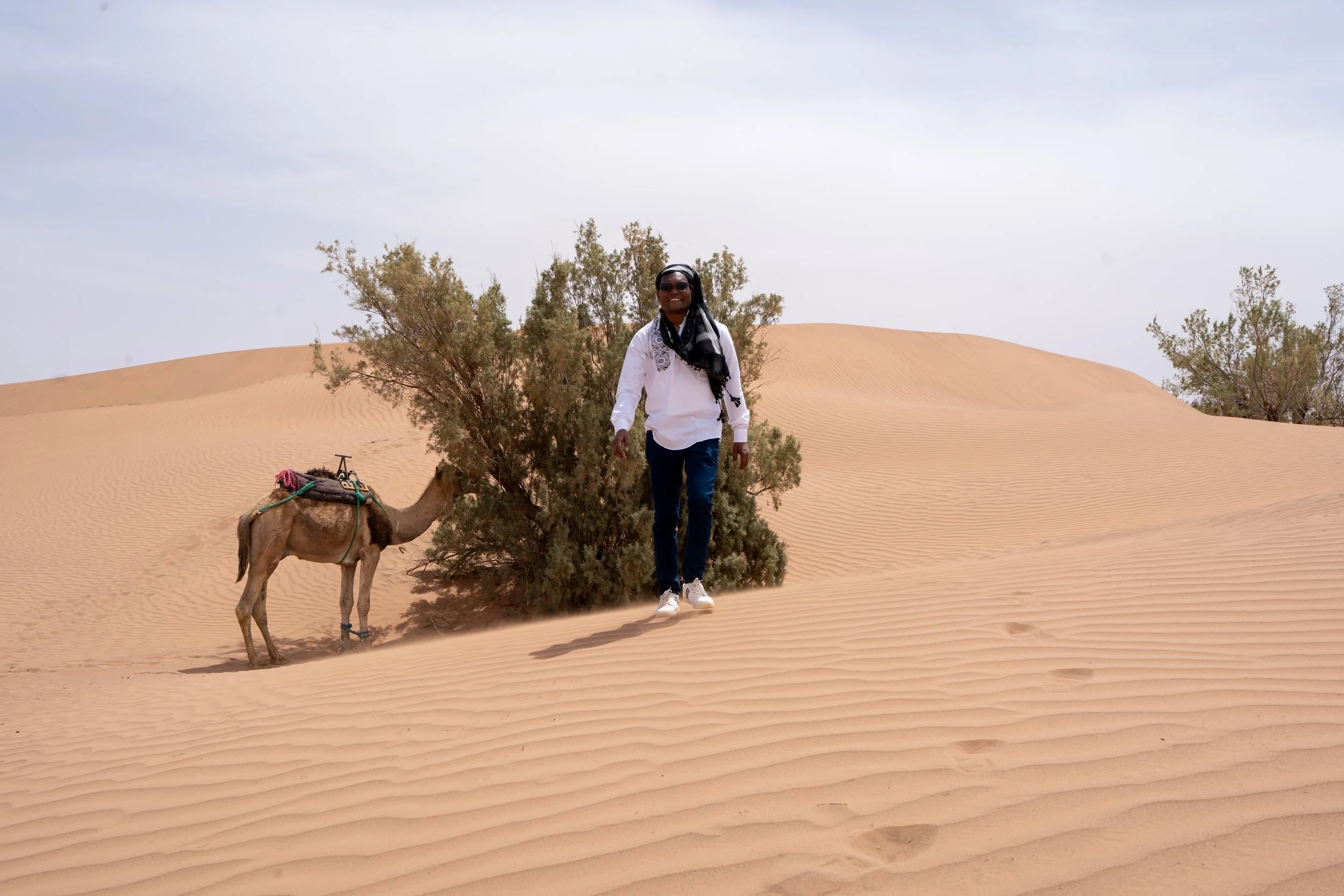
In Marrakech’s winding alleys, I met a man in sunglasses who spoke with measured certainty. He revealed the beetle’s trail led far south—to a khema in the remote village of Oulad Driss near Mhamid. From that moment, the desert’s edge became my destination, and his words my compass.
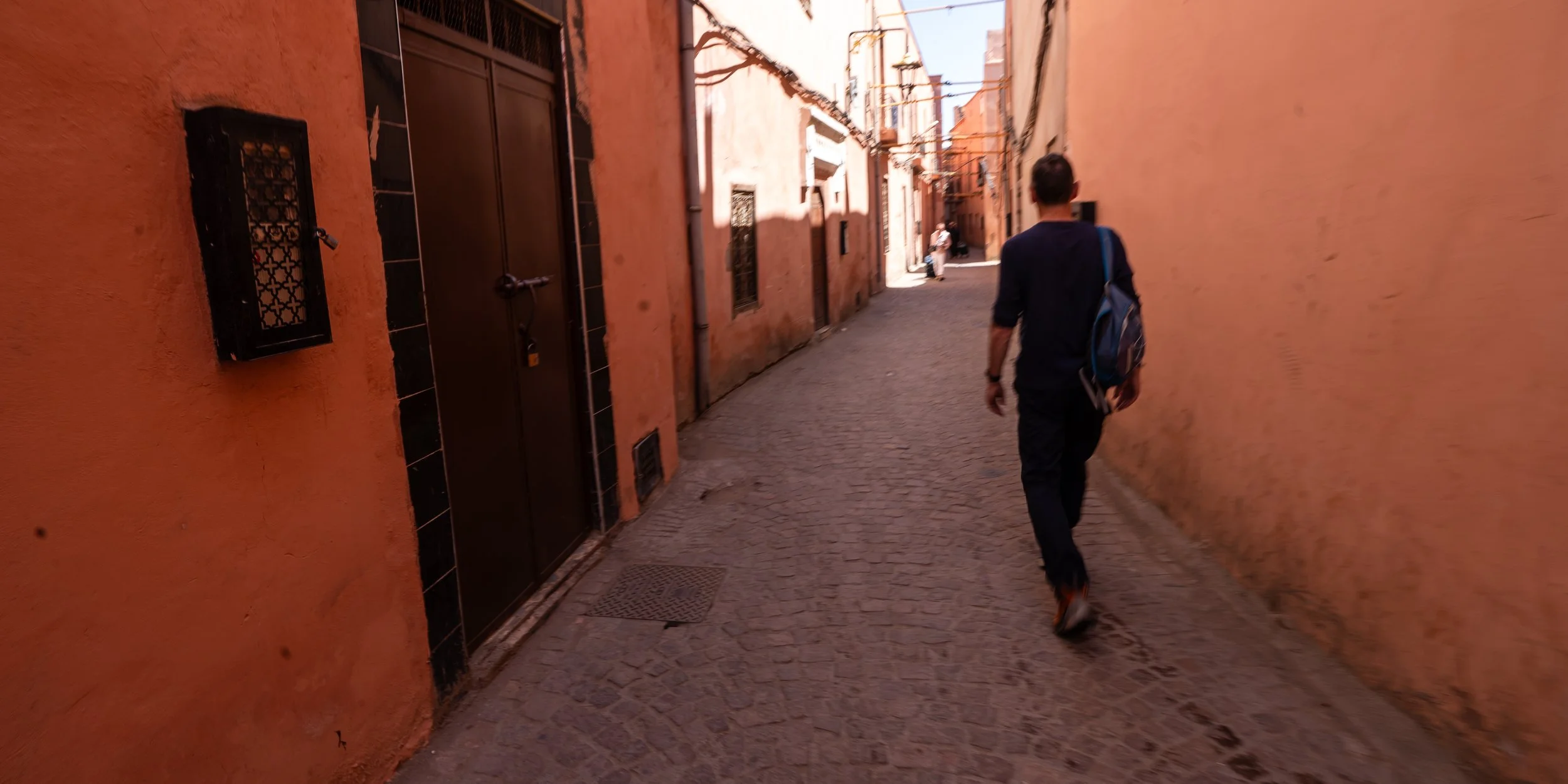
The narrow street pressed in with clay walls and fading light, the medina’s noise dissolving into silence. He introduced himself simply as Matt, his sunglasses reflecting the dim glow of lanterns. “We must prepare for Oulad Driss—but first, Bahia Palace awaits,” he said. His words set the course, and I knew the journey began by following him.
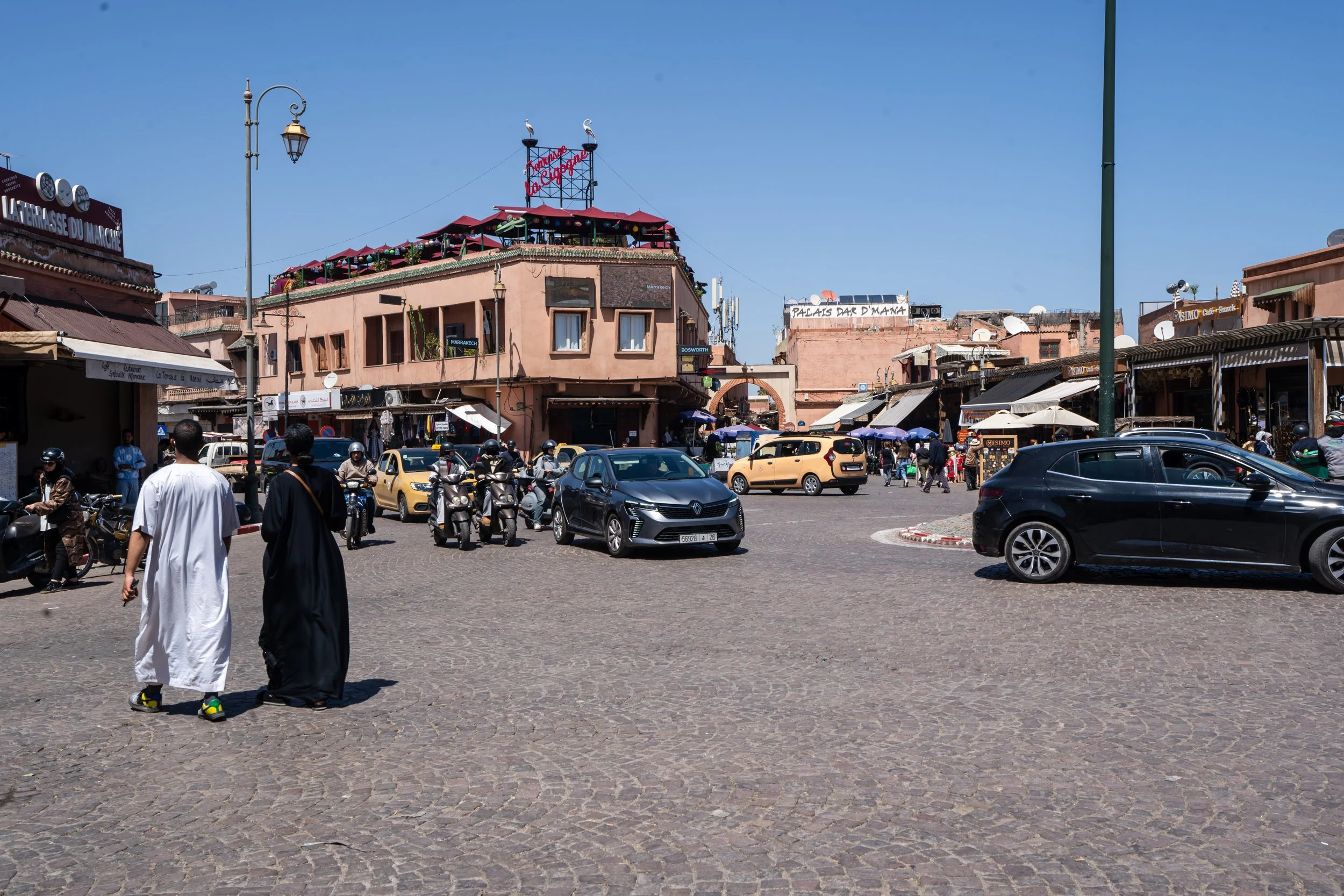
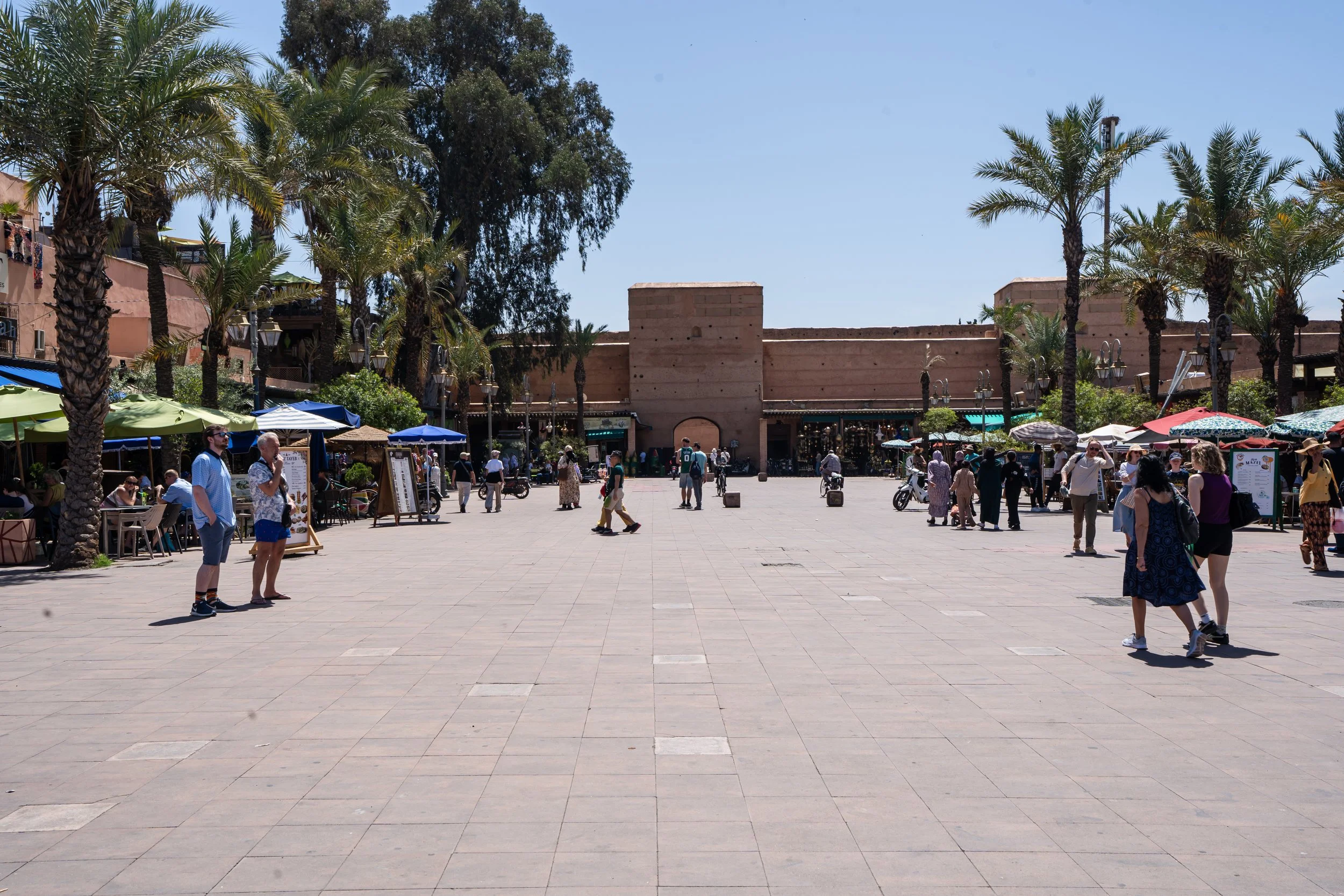
We left the narrow street behind and stepped into a broader stretch of Marrakech, where space widened and the city’s pulse shifted. The hush of the alley gave way to open air, the rhythm of footsteps and voices carrying us forward. Ahead lay Bahia Palace, the place Matt had spoken of, and the path that would lead us toward Oulad Driss.
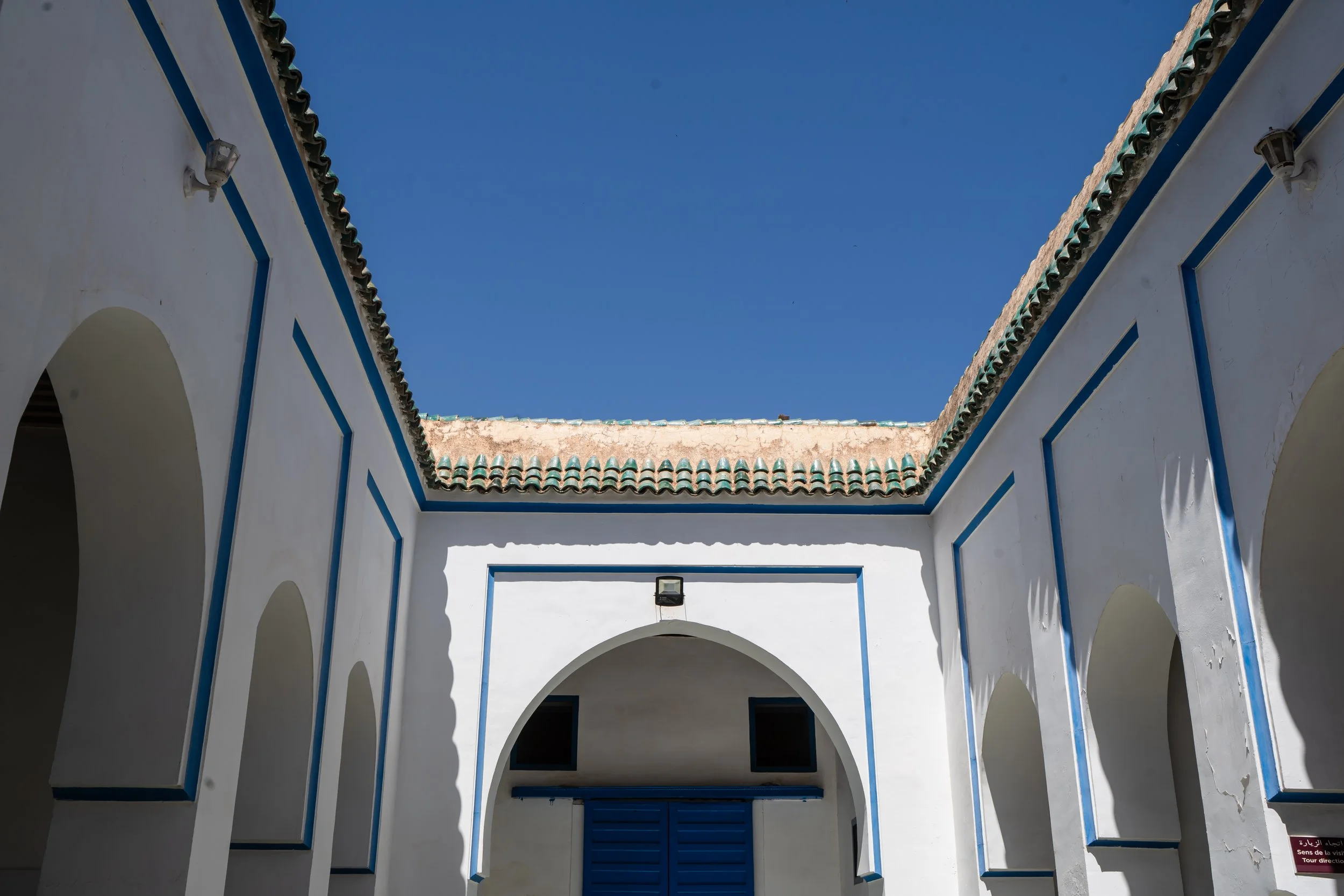
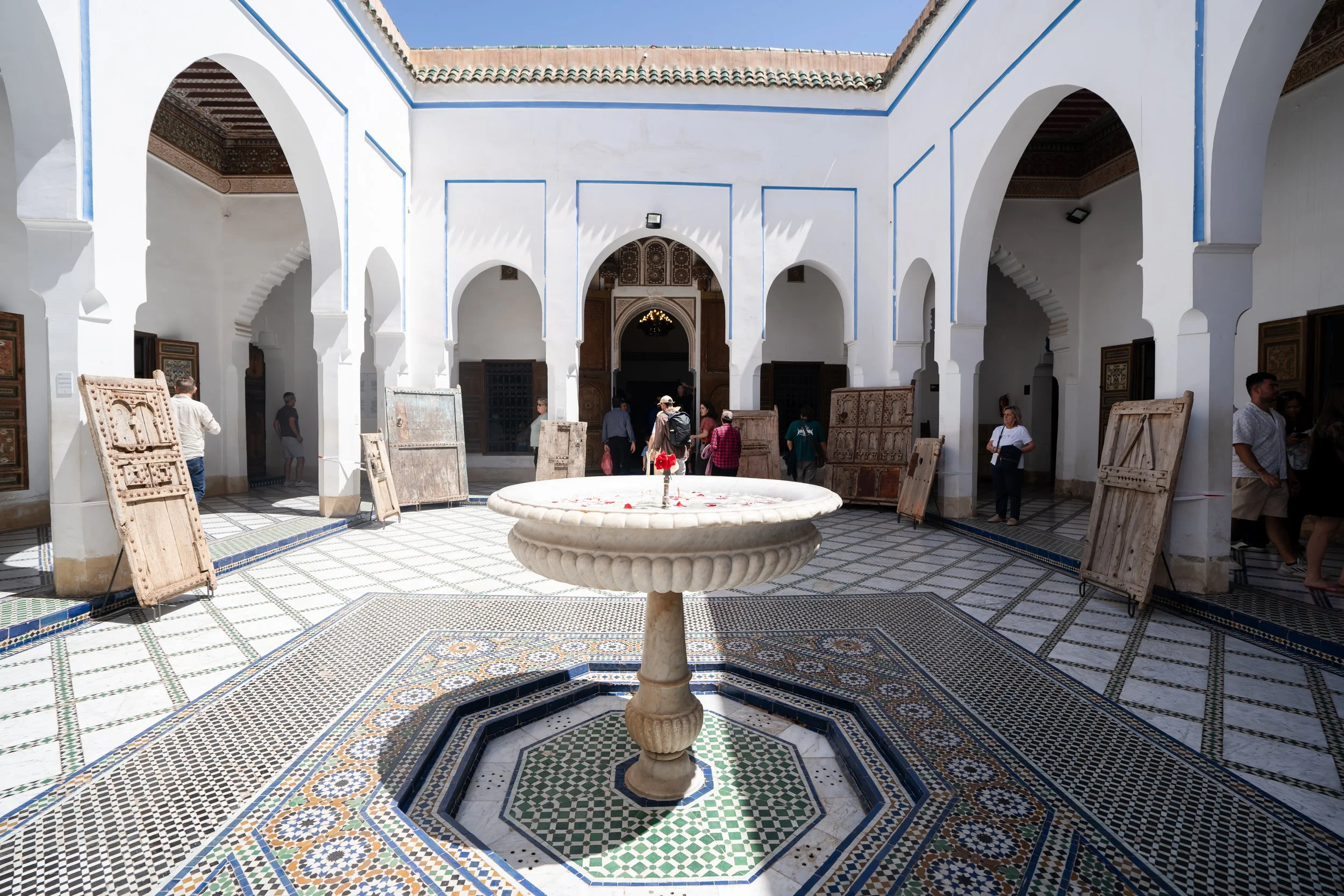
We reached Bahia Palace, its grand gates opening into courtyards alive with mosaic patterns and carved cedar. Light filtered through stained glass, scattering colors across marble floors as if the palace itself breathed history.
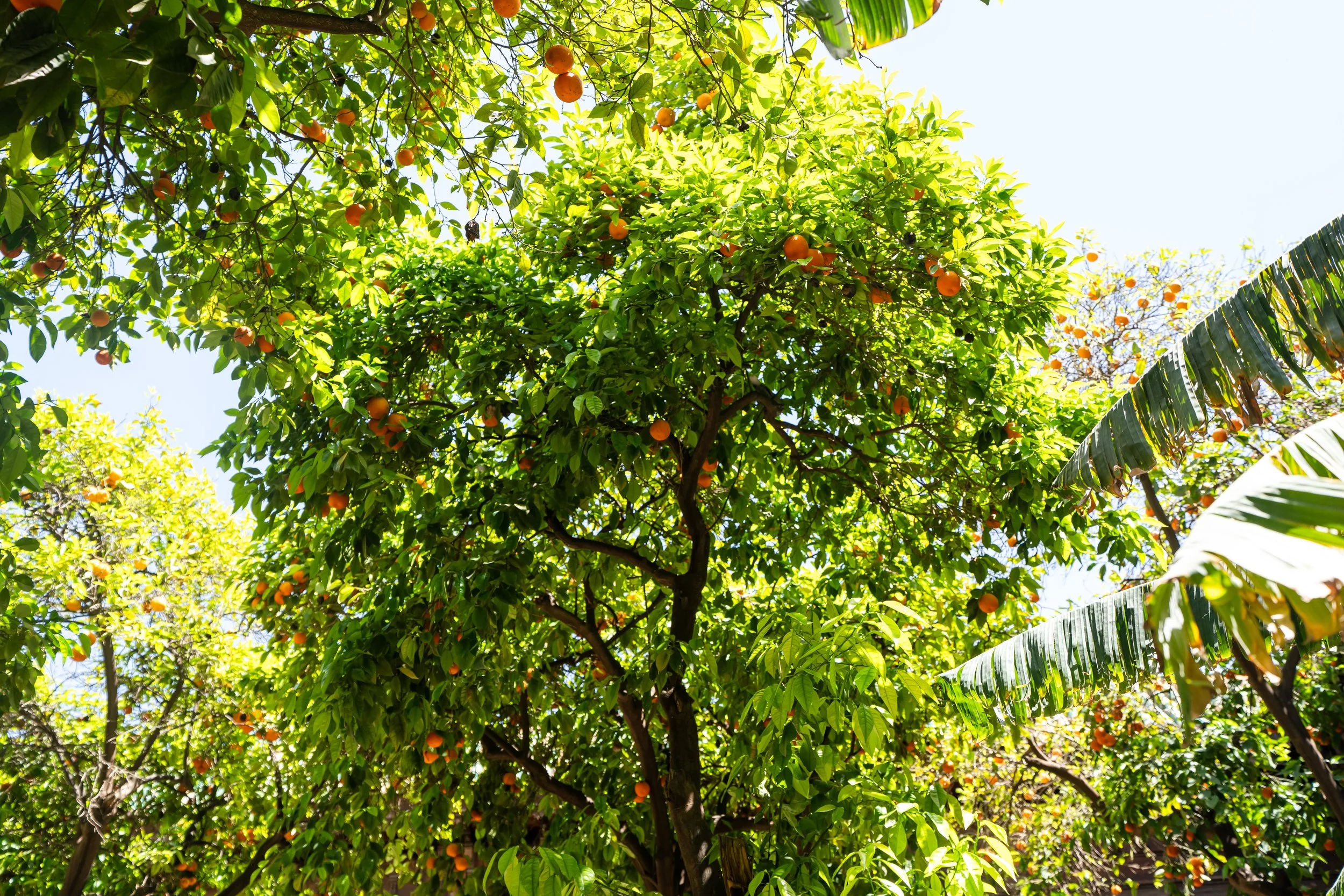
In the stillness, Matt reminded me of the offering—bright oranges placed with care—an act that felt less like tradition and more like unlocking the path toward Oulad Driss.
Indeed, the Bahia Palace, meaning “brilliance,” certainly lives up to its name: sunlight shines through the wrought‑iron windows casting beautiful shadows on the traditional Zellij tiles, while, in the courtyard, fresh orange trees and shaded gardens surround a trickling fountain.
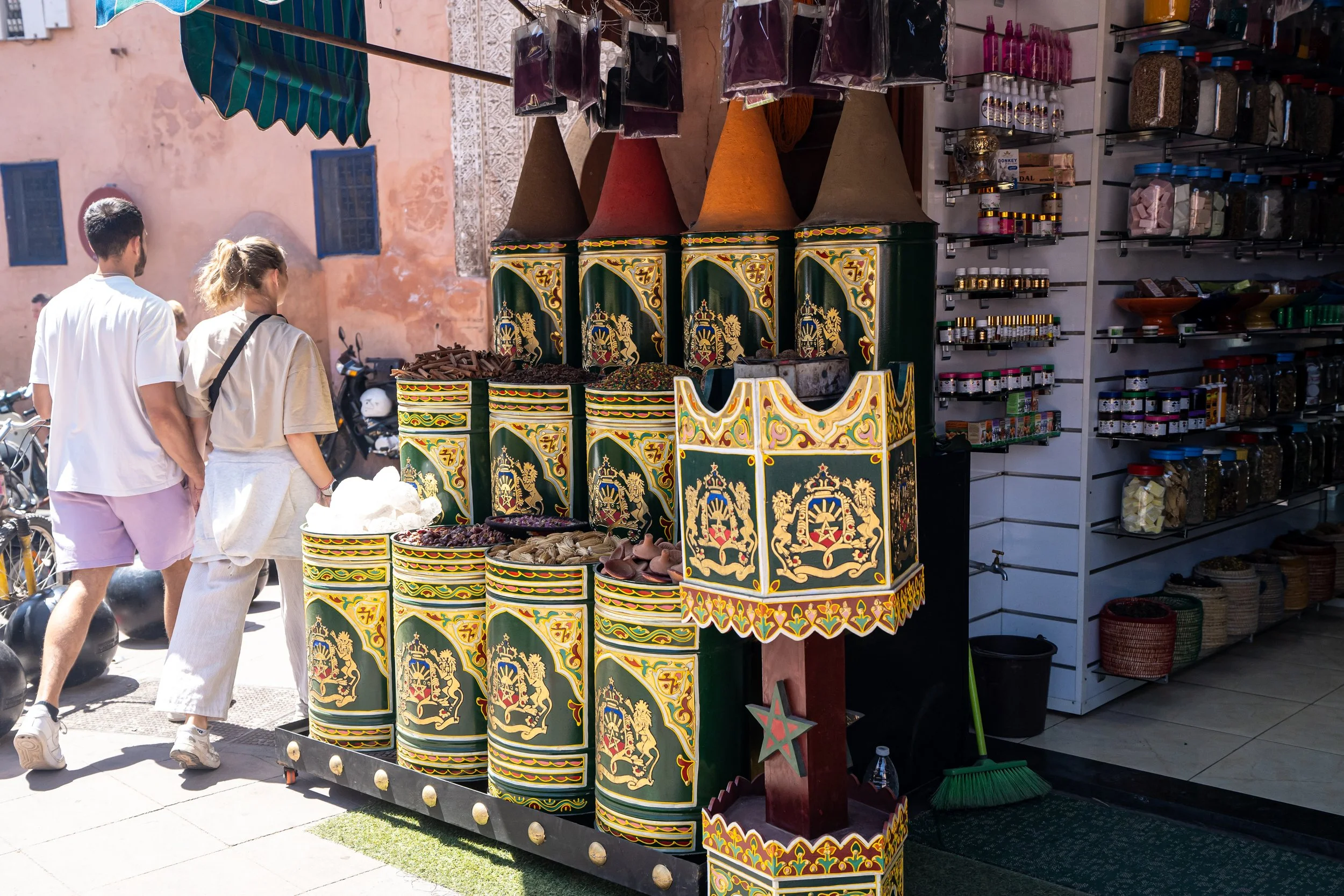
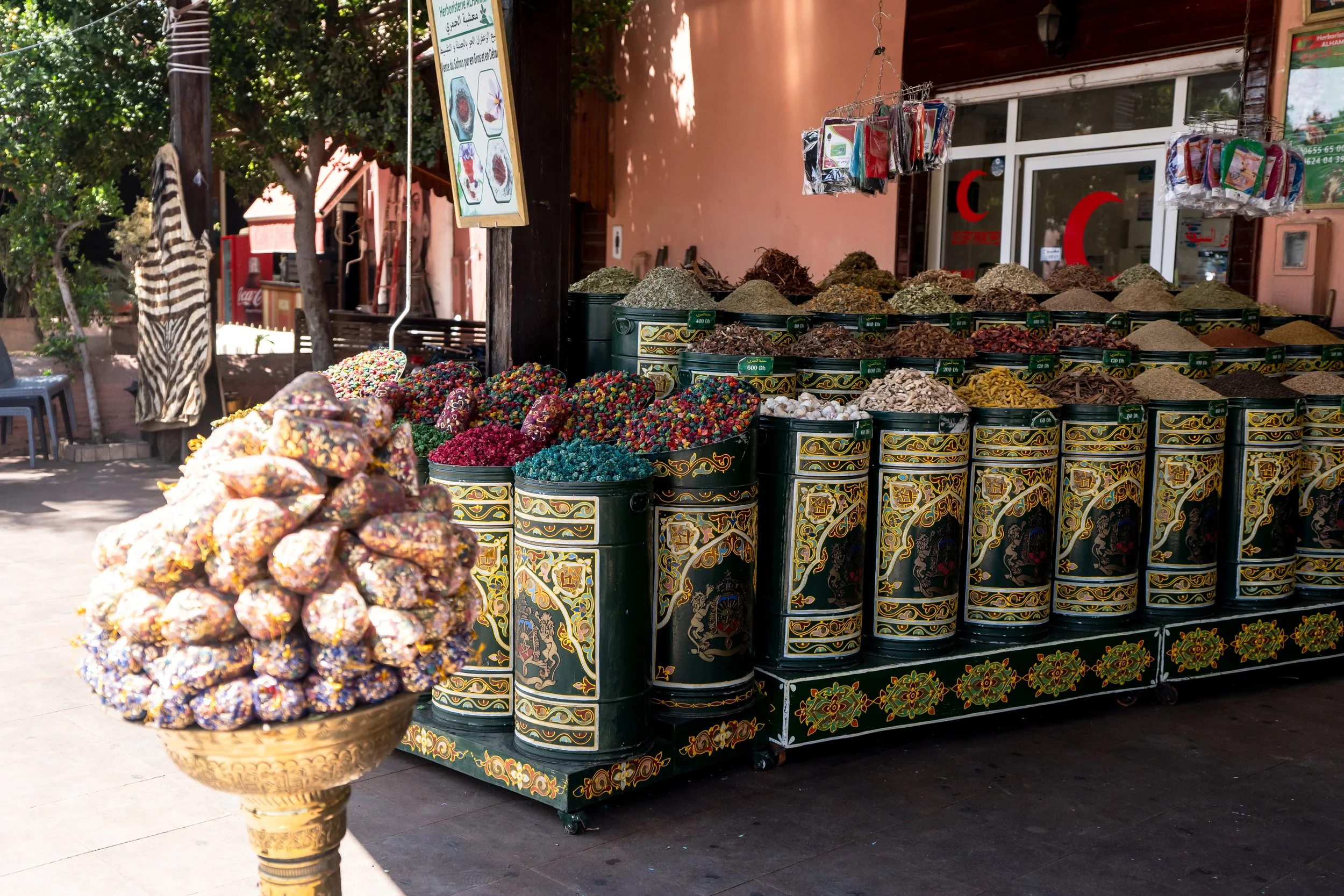
We stepped out of Bahia Palace and returned to the street, where shops lined the way with spices stacked in vivid pyramids. The air was thick with the scent of saffron, cumin, and cinnamon, each stall a burst of color and fragrance. The city’s rhythm pulled us forward, its markets alive with both memory and promise.
As we moved past the spice shops, another wonder caught our eyes—pyramids of saffron, turmeric, and paprika rising like painted sculptures under the afternoon light. Fiery reds, golden yellows, and earthy browns seemed to hold fragments of distant lands, each spice a quiet treasure waiting to be savored. The street became a tapestry of scents and hues, Marrakech unfolding in layers of brilliance…
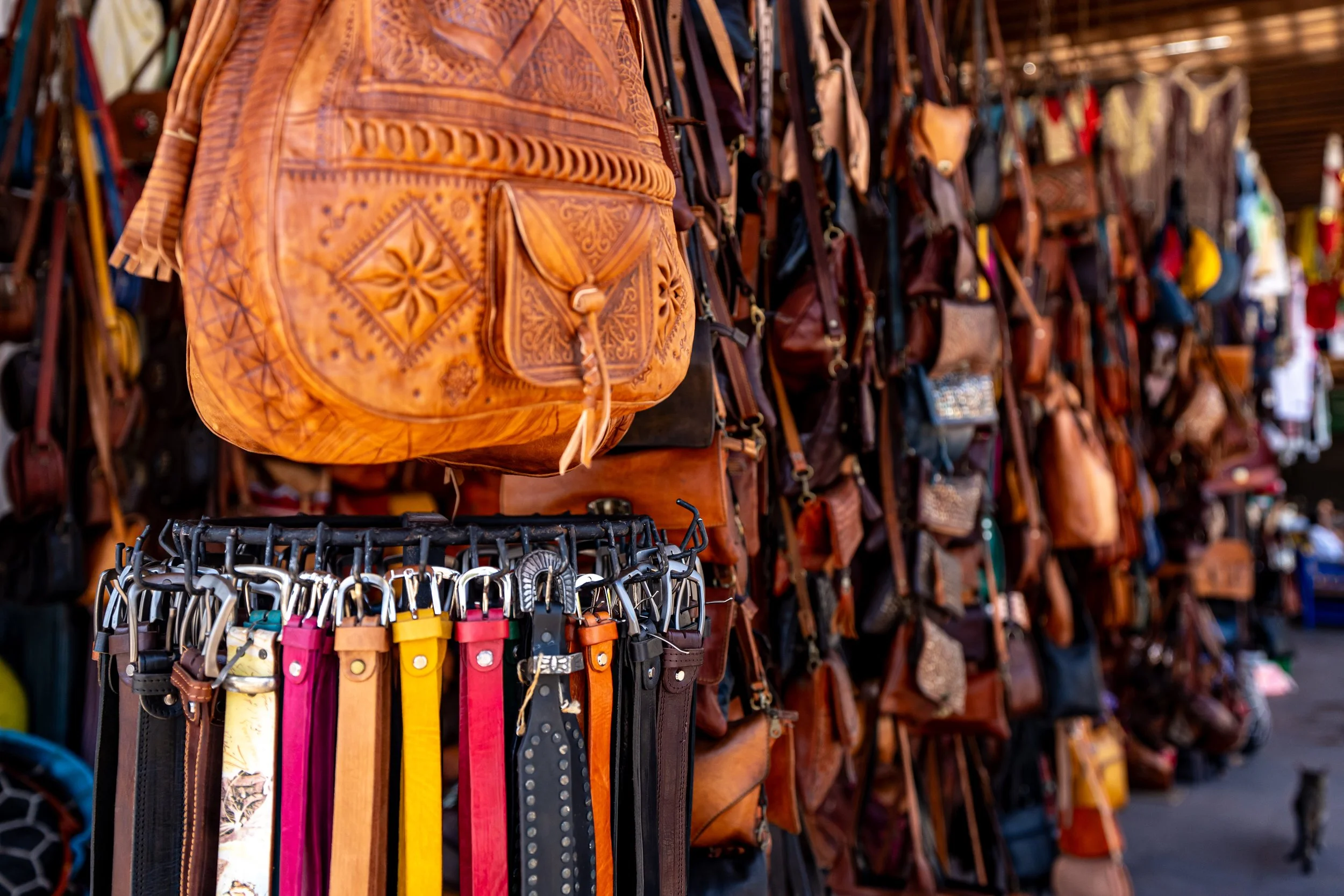
Further along the street, we came across a shop where leather goods were displayed with pride. Hand‑stitched bags, belts, and slippers hung neatly, their earthy tones carrying the scent of tanned hide. The craftsmanship spoke of tradition, each piece shaped by patient hands, echoing Marrakech’s enduring artistry.
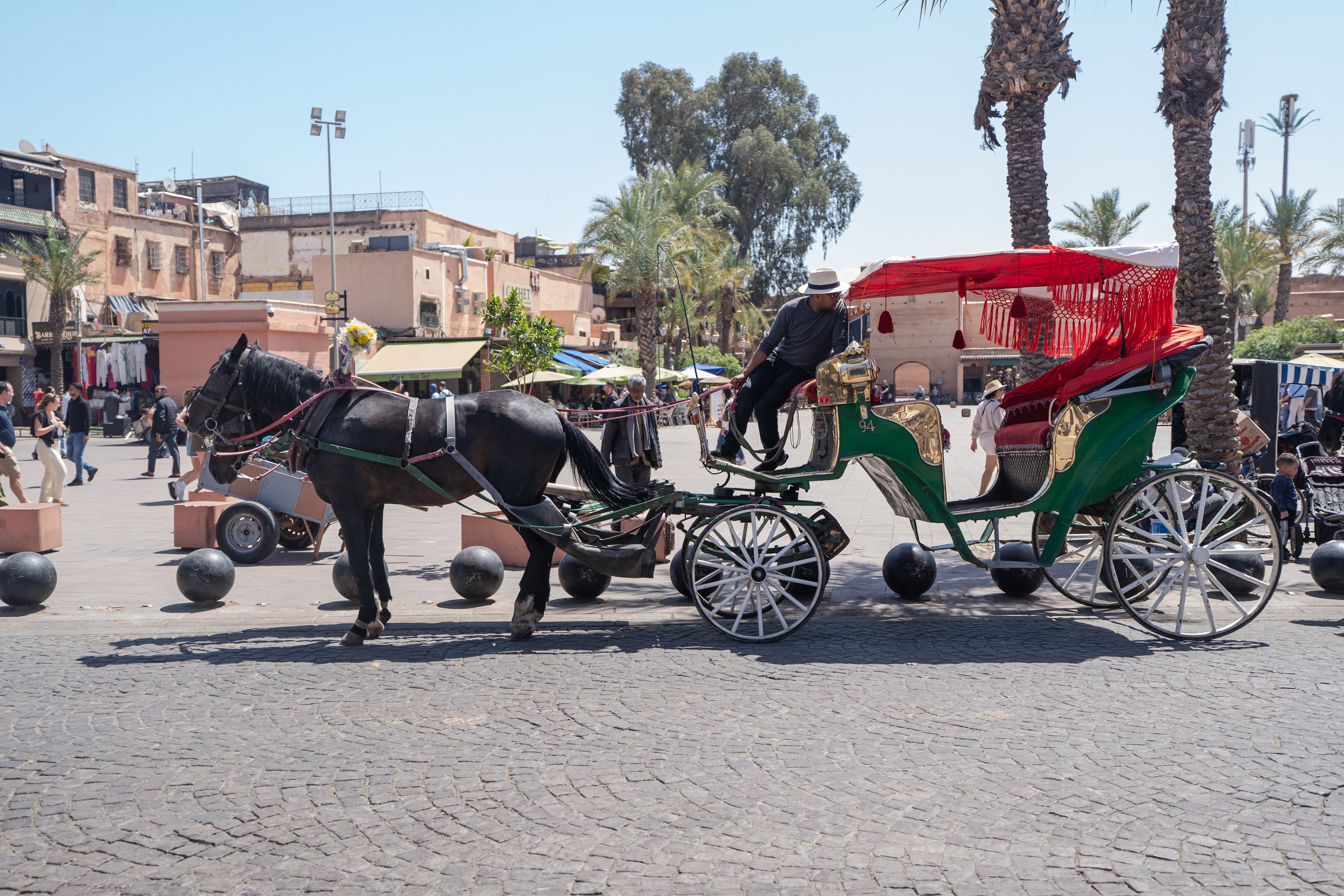
We came across Koutchi and asked if he could drop us at Oulad Driss. He laughed warmly, pointing out how far it truly was—over 330 kilometers from Marrakech, a journey stretching deep into the desert. Seeing our hunger, he offered instead to take us to a restaurant serving authentic Moroccan cuisine, where the flavors of tradition awaited before the long road ahead.
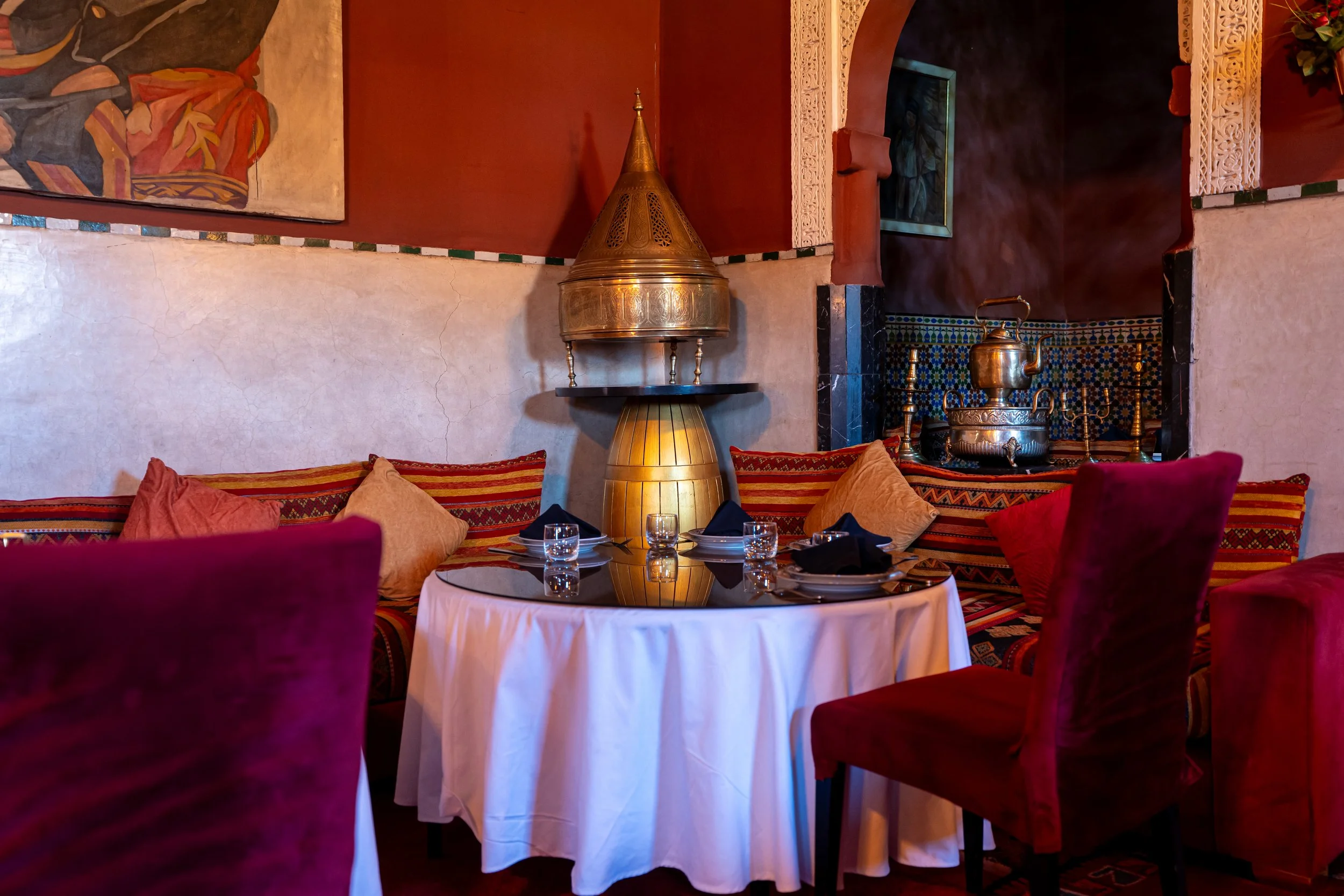
The restaurant was modest yet full of character, its walls painted in warm clay tones that echoed Marrakech’s streets. Woven lanterns hung low, casting amber light across carved wooden tables polished smooth by years of use. The tiled floor shimmered with intricate patterns, each step a reminder of Morocco’s artistry. Matt and I settled into a corner where the hum of conversation mingled with the faint strains of oud music, the space itself a sanctuary of tradition before the desert journey.
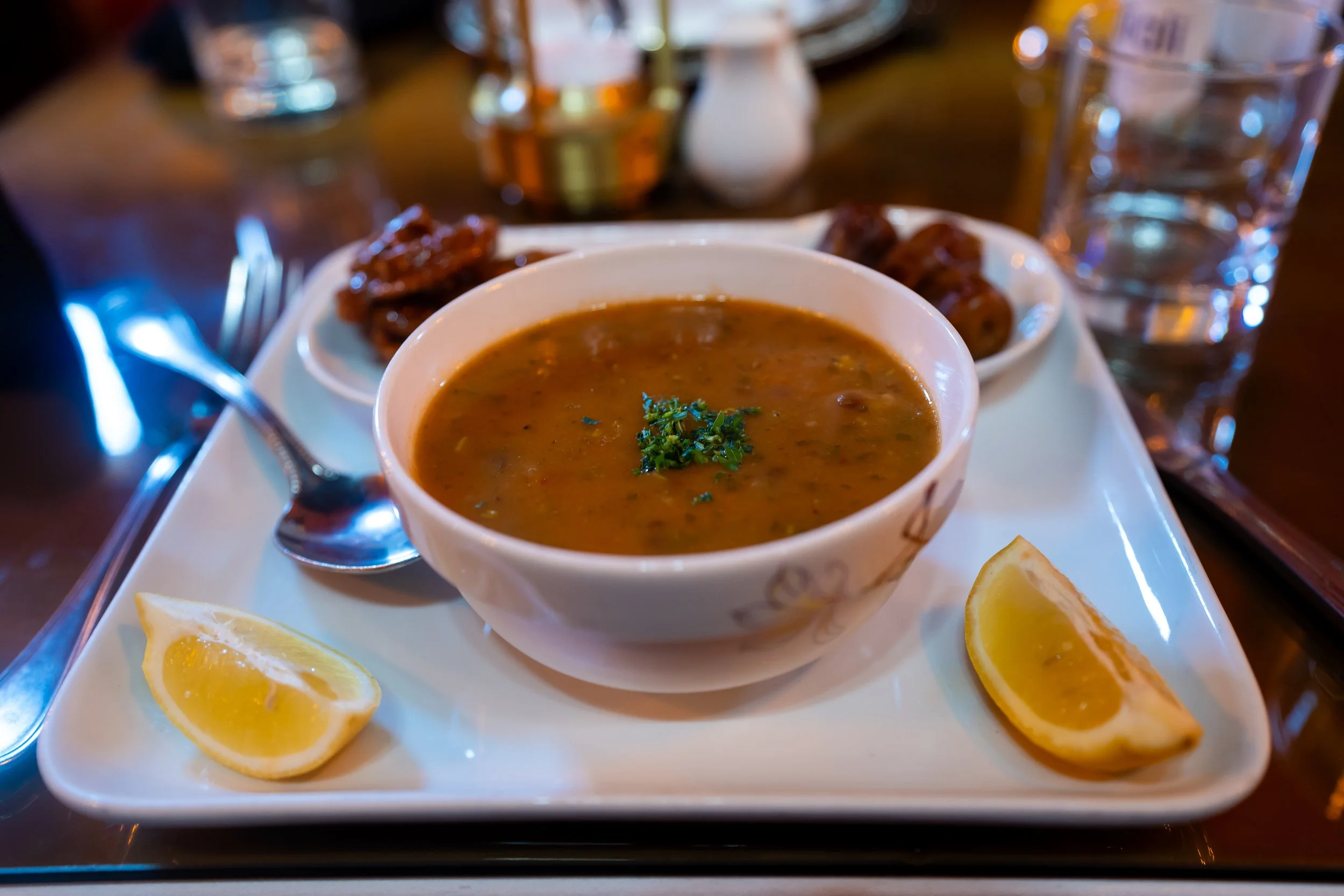
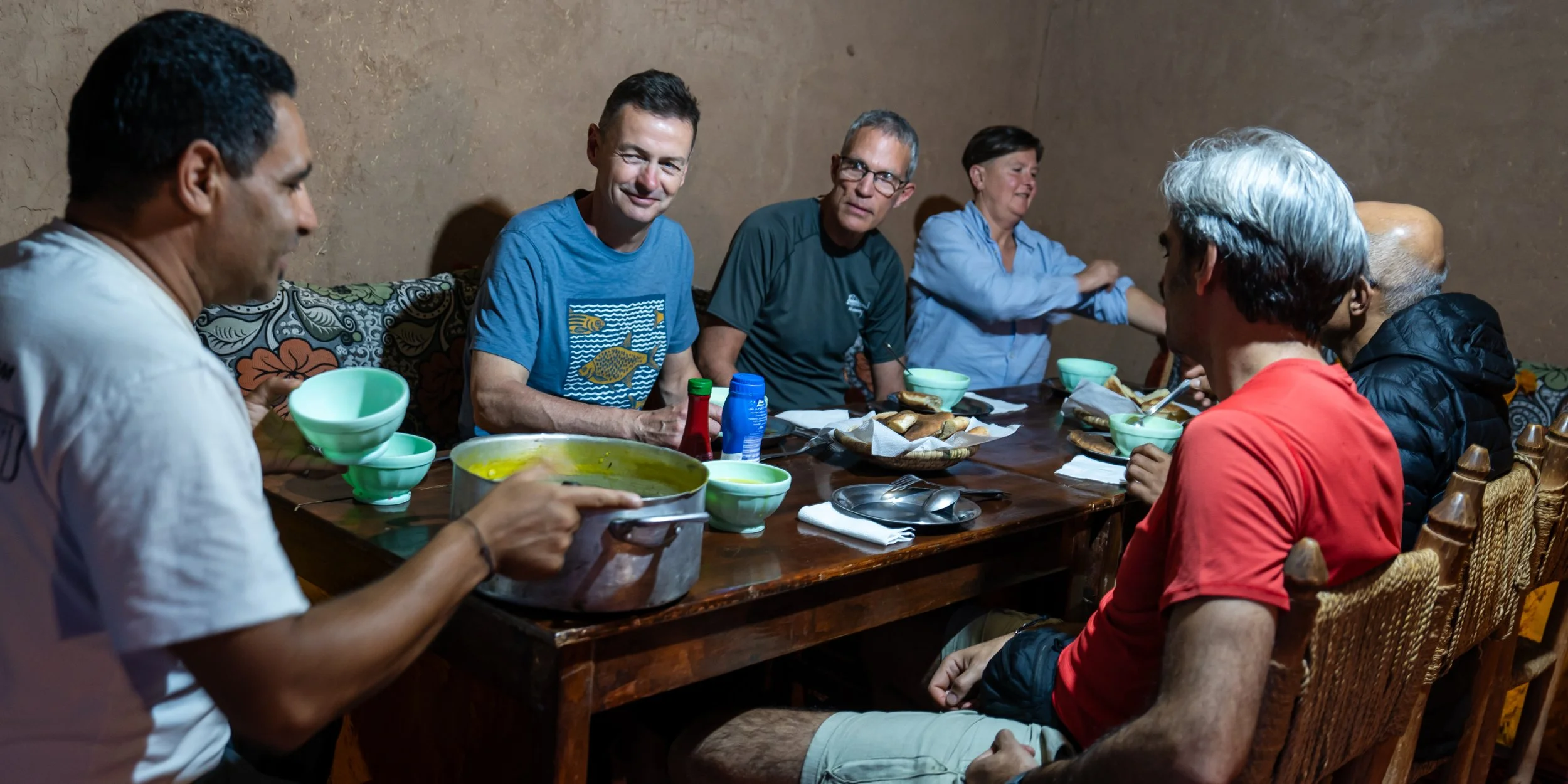
Bowls of harira, Morocco’s beloved soup, arrived rich with lentils, chickpeas, and tomatoes, its saffron‑tinged broth carrying the comfort of home. Freshly baked khobz bread was set before us, its crust warm and crisp, ready to be torn and shared. Soon after, clay pots were uncovered to reveal slow‑cooked tagines, their aromas of preserved lemon and olives mingling with ginger and saffron. Mint tea followed, poured high into slender glasses, its rising steam curling like a ritual of hospitality. Matt and I sat together, tasting Morocco’s tradition in every bite, gathering strength for the long road that awaited beyond Marrakech.
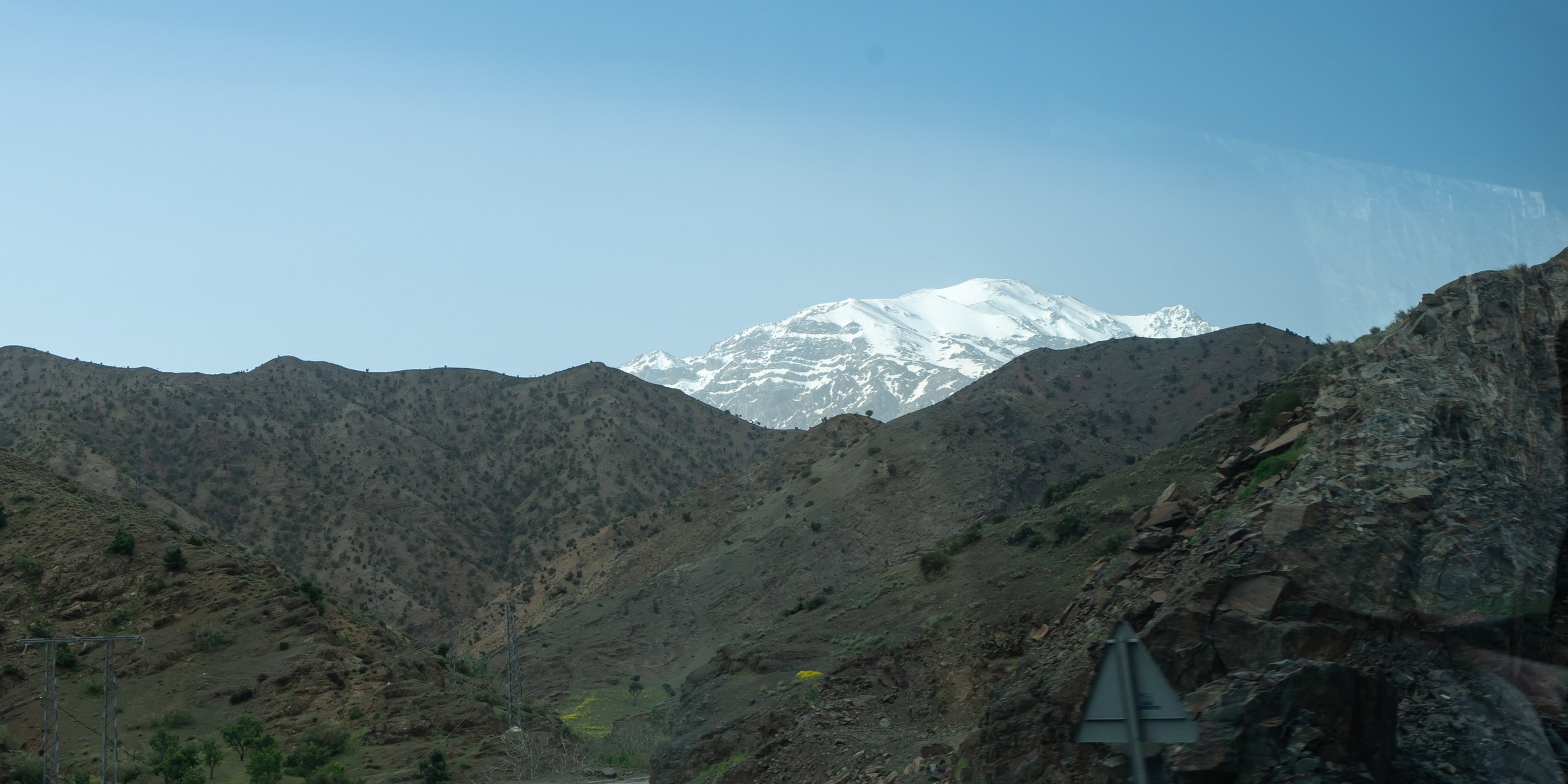
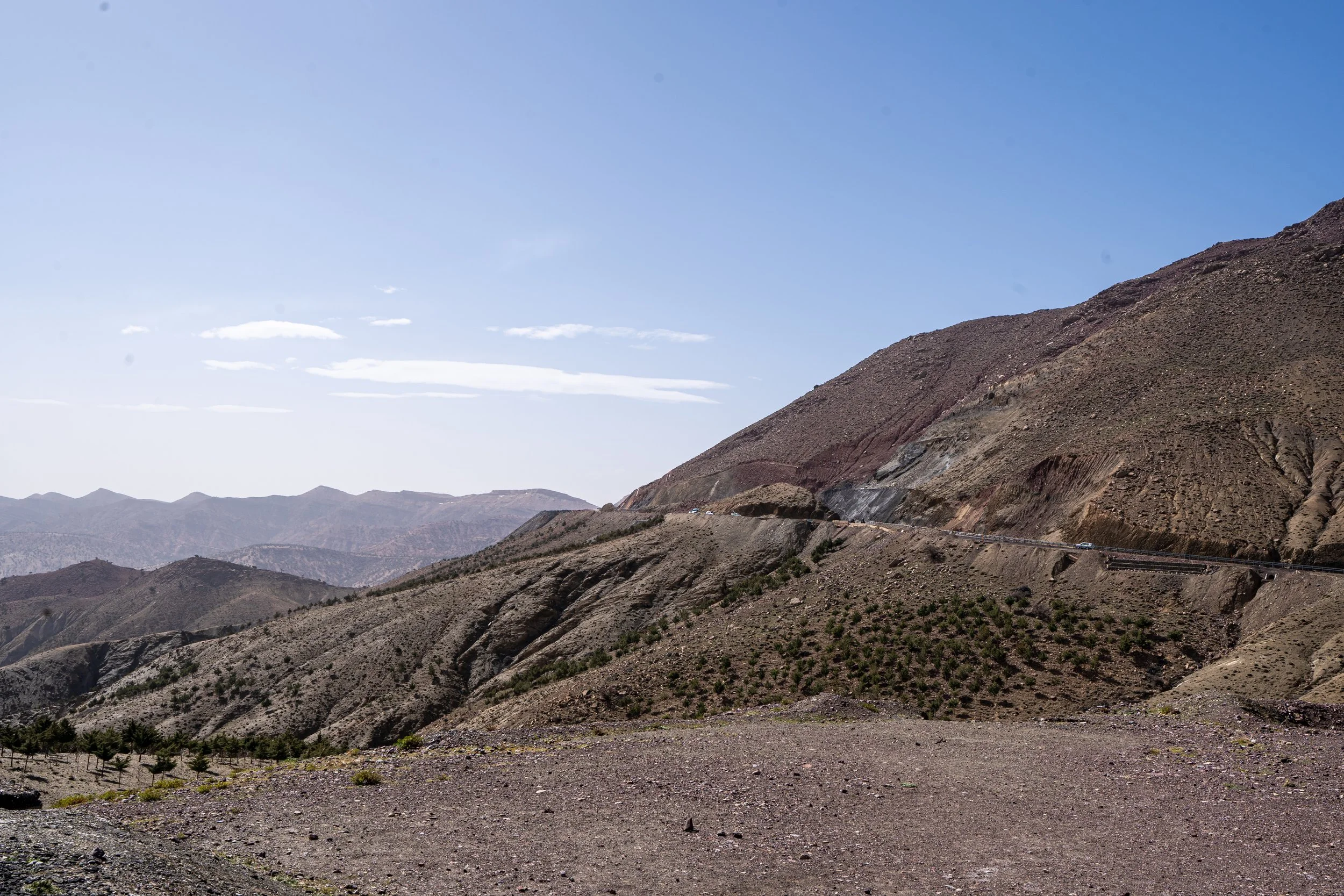
Leaving Marrakech behind, the road stretched southward, winding into the mighty Atlas Mountains. Peaks rose like guardians, their slopes painted with terraced villages and the shifting hues of rock and earth. Beyond their ridges, the landscape transformed—the Atlas stood as a vast barrier separating Morocco’s fertile plains and coastal lands from the arid Sahara. For centuries, these mountains have marked the threshold between Mediterranean climates and desert expanses, a frontier that shaped trade routes, cultures, and the rhythm of life across North Africa. Crossing them was not just a journey through altitude, but a passage between worlds…
As we climbed higher into the Atlas, the warmth of Marrakech slipped away. The air grew crisp, each turn of the road carrying a sharper cold that settled into our bones. The peaks loomed above, their silence vast, and the mountain’s breath seemed to remind us that we were crossing into another world—where the desert waited beyond the ridges.
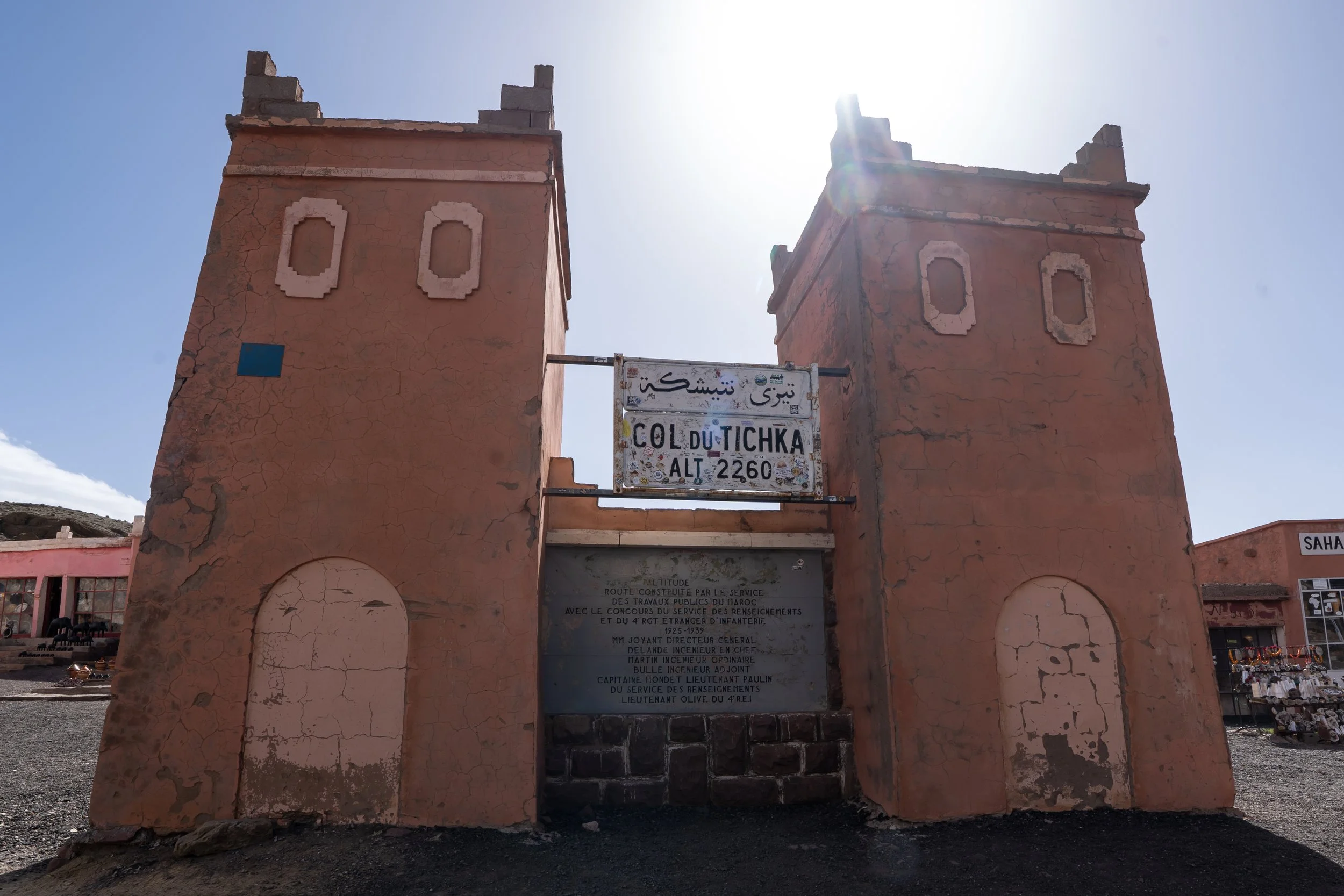
The road twisted higher until we reached the Tichka Pass, the great gateway through the Atlas. At over 2,200 meters, it felt as though the mountains themselves had opened a narrow corridor, carved by centuries of wind and stone.
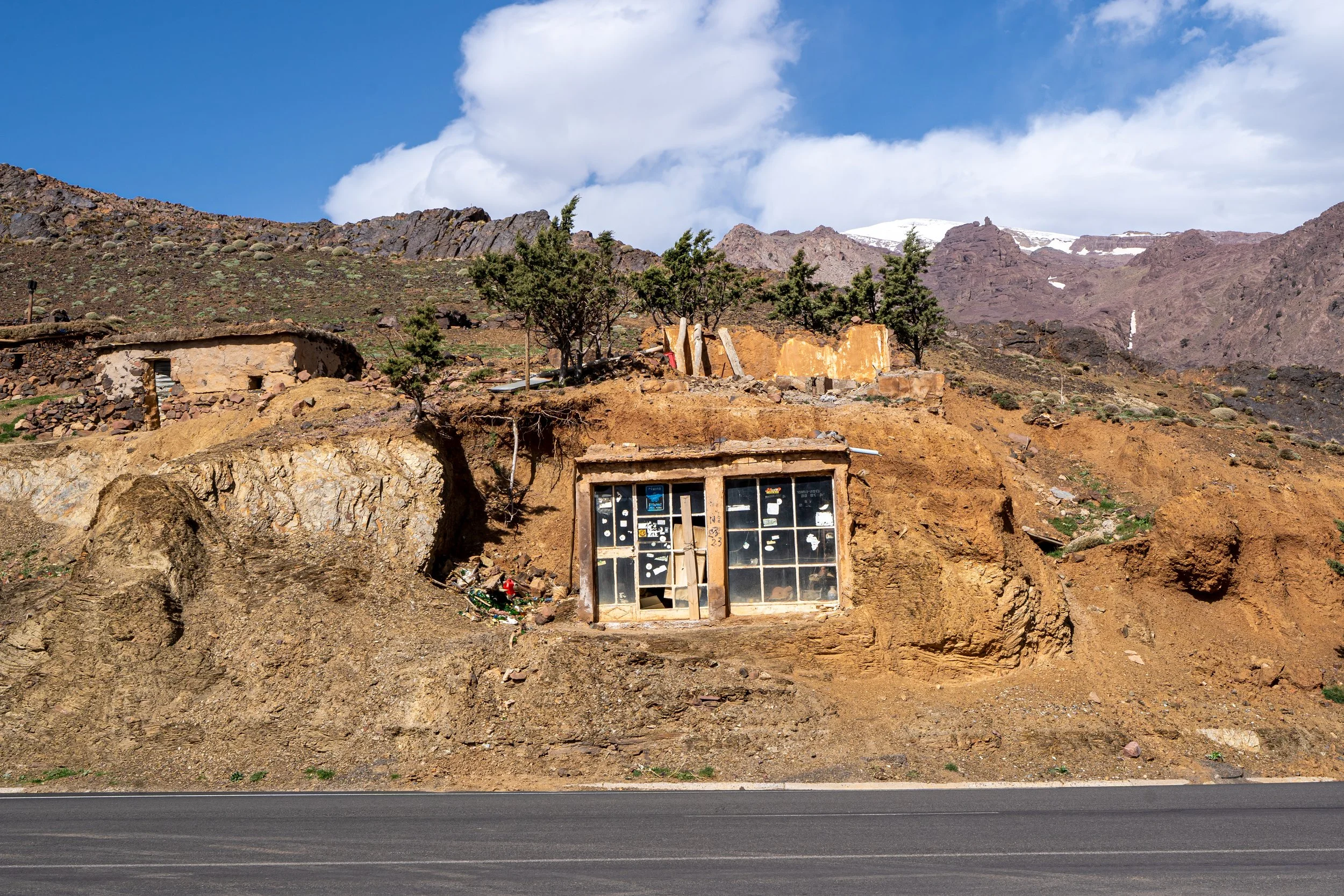
The pass revealed sweeping views—valleys plunging deep below, ridges stretching endlessly, and villages clinging to slopes like quiet sentinels. Here, the Atlas showed its dual nature: both barrier and bridge, separating Morocco’s fertile north from the Sahara’s vast silence, yet binding them together through this single winding road.
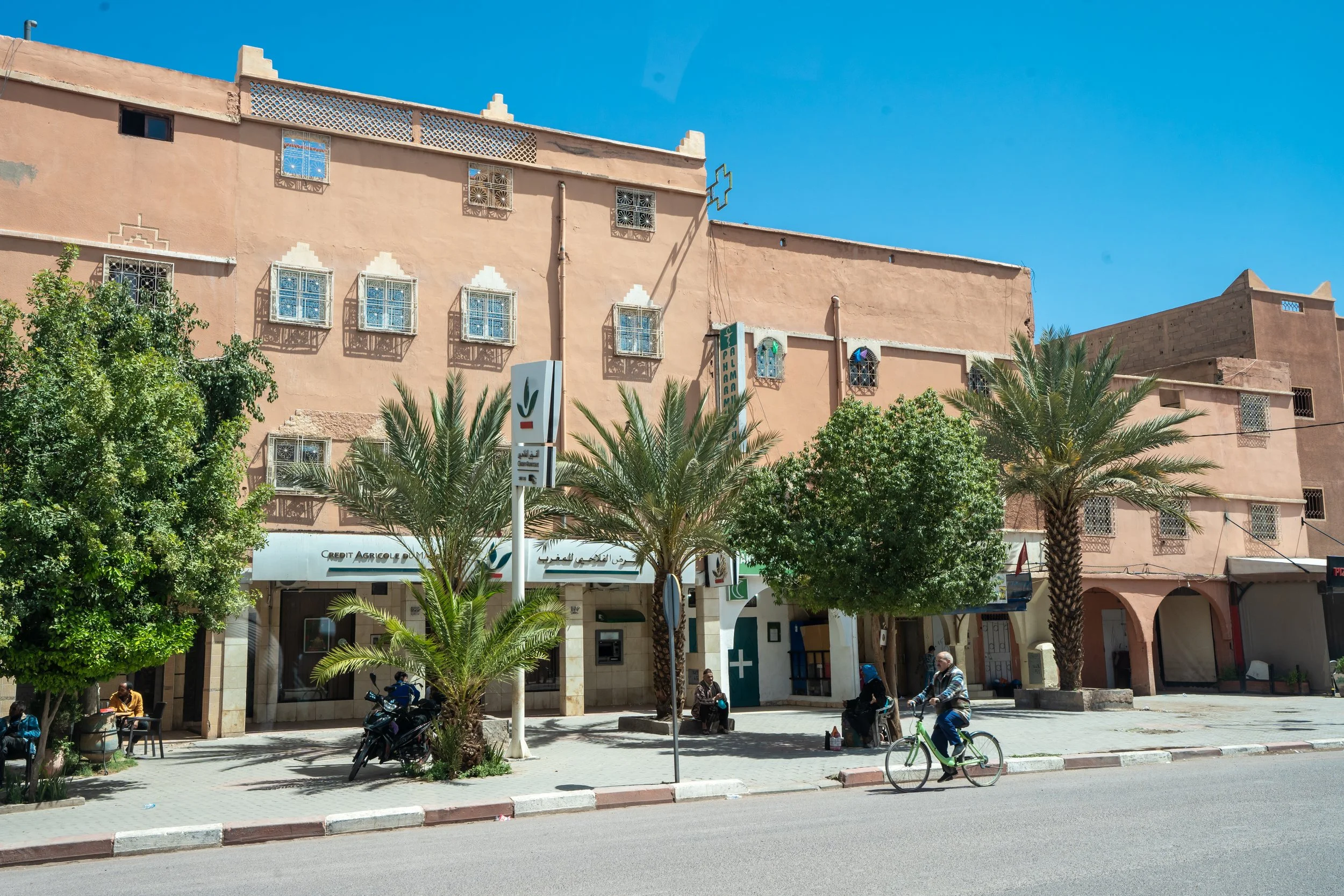
Descending from the Atlas, the road carried us into Ouarzazate, a city poised between mountain and desert. Its ochre walls glowed under the sun, and the kasbahs stood like timeless fortresses, reminders of caravans that once passed through on their way to the Sahara. Known as the “door of the desert,” Ouarzazate felt both a resting place and a crossroads—where traders, travelers, and storytellers converged.
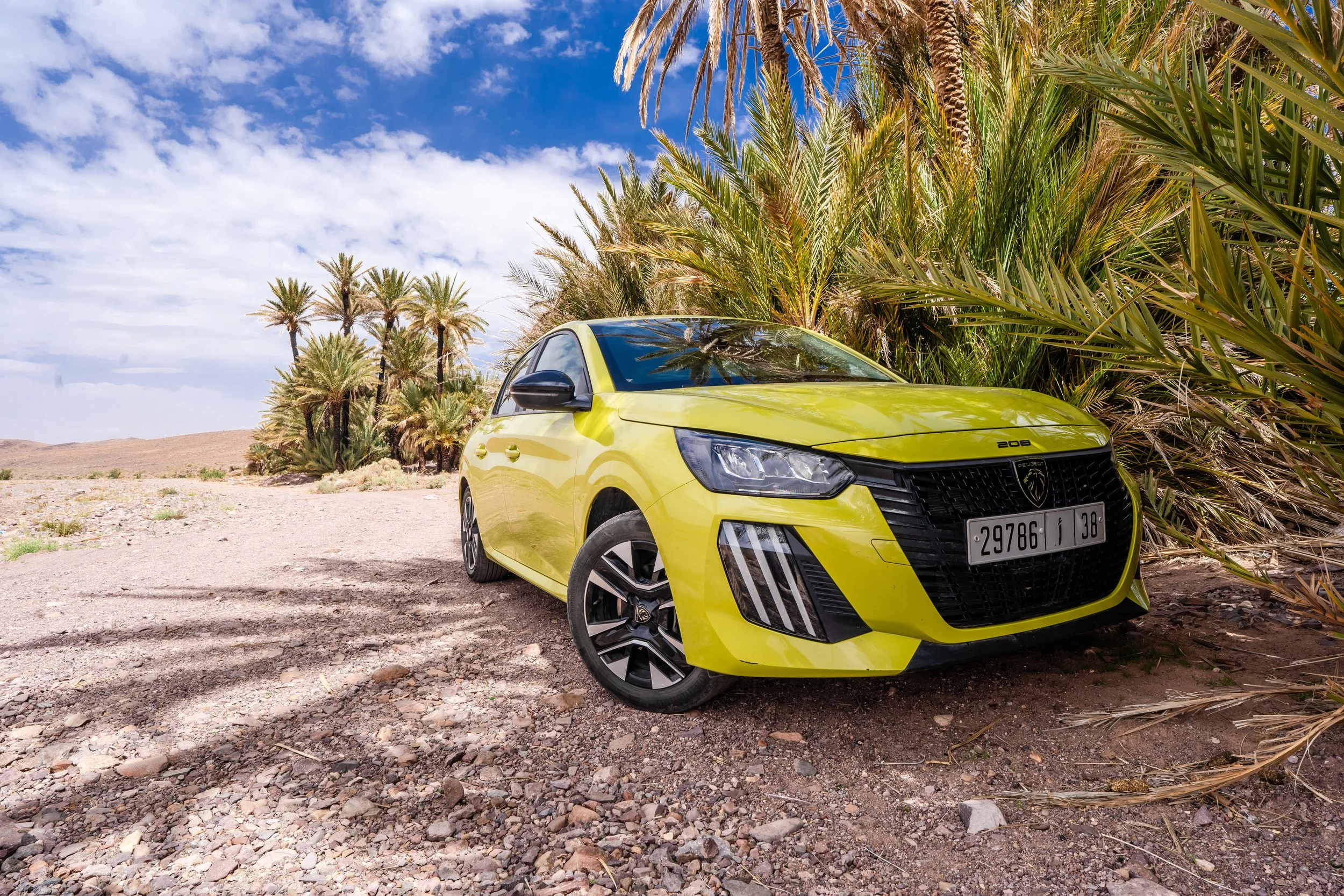
After leaving Ouarzazate, we pulled our car off the winding road, the silence of the plains stretching wide around us. The ochre earth glowed under the afternoon sun, broken only by scattered shrubs and the distant outline of kasbah walls. It felt like a moment suspended between worlds—the mountains behind us, the desert ahead—where time slowed and the vastness of Morocco revealed itself in stillness.
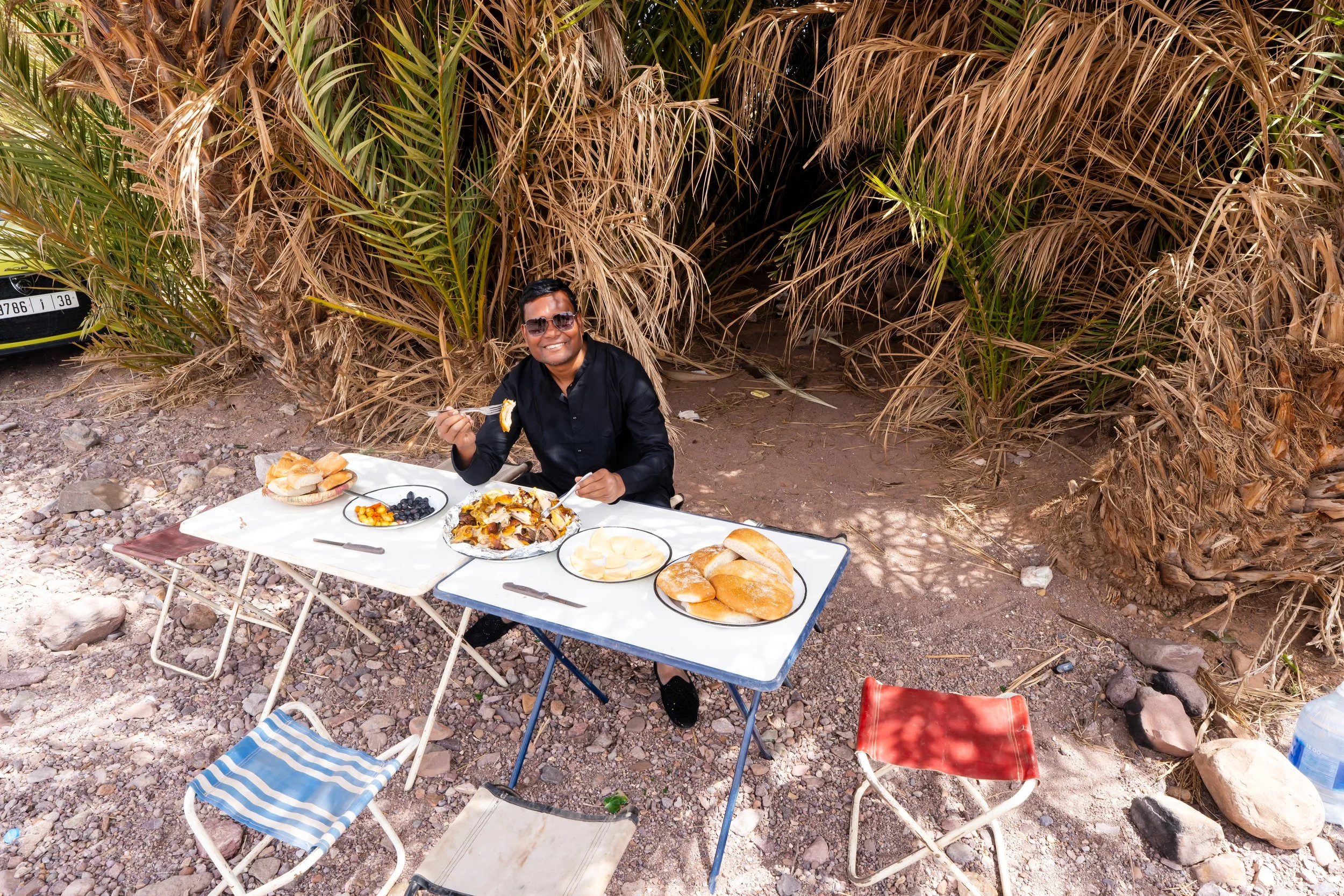
It was lunchtime when we stopped by the roadside, the sun high above the valley. A basket of fresh bread was laid out, its crust warm and fragrant, torn easily by hand. Beside it, simple roasted chicken was served, seasoned with local spices that carried the taste of the land. The meal was modest yet comforting, a pause of nourishment amid the vast journey.
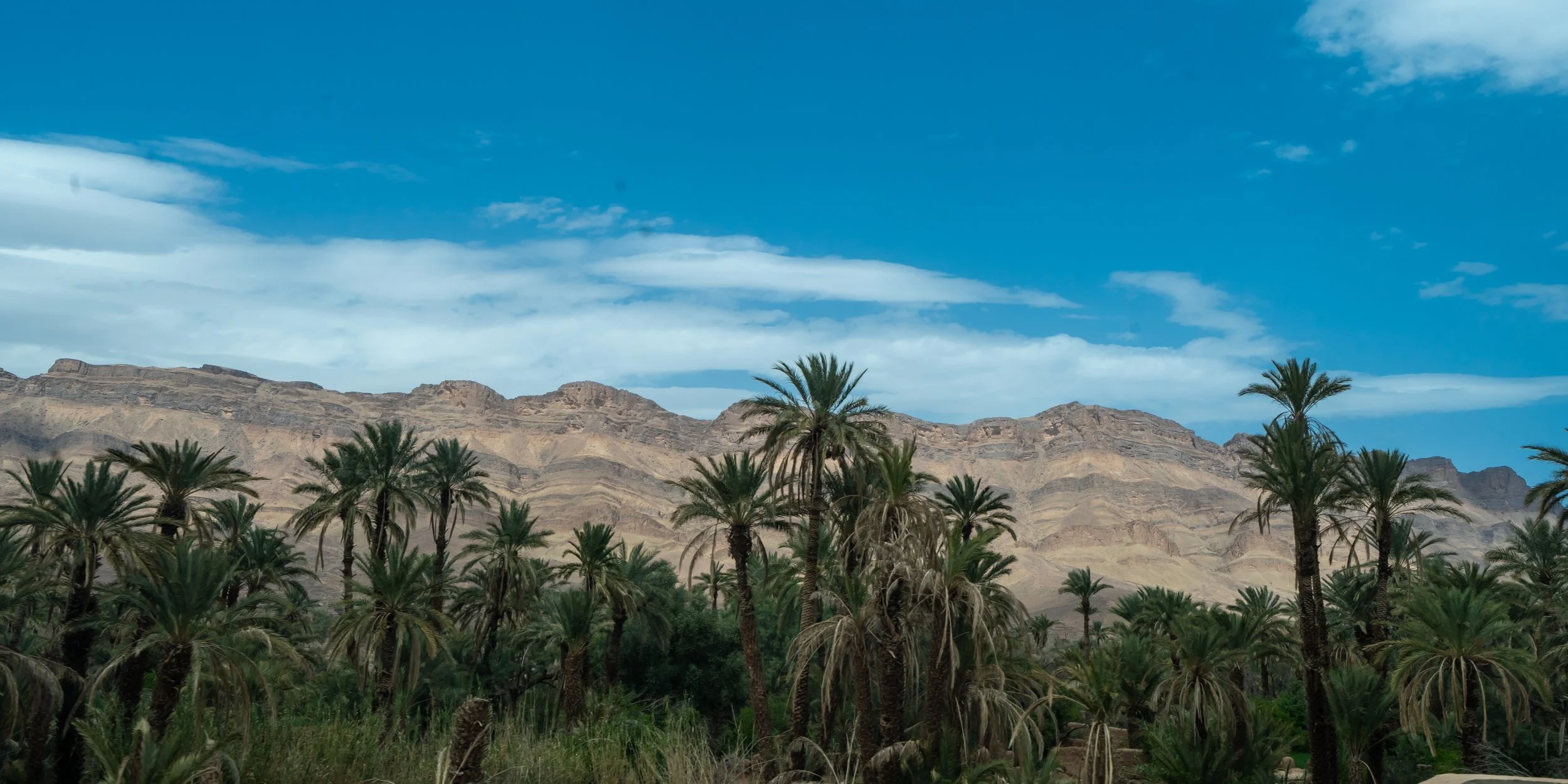
The Draa Valley opened before us like a ribbon of life, its palm trees rising in endless rows, their fronds shimmering against the desert light. Behind them, the Atlas Mountains stood in solemn contrast—rugged, towering, and distant, their ridges a reminder of the barrier we had crossed.
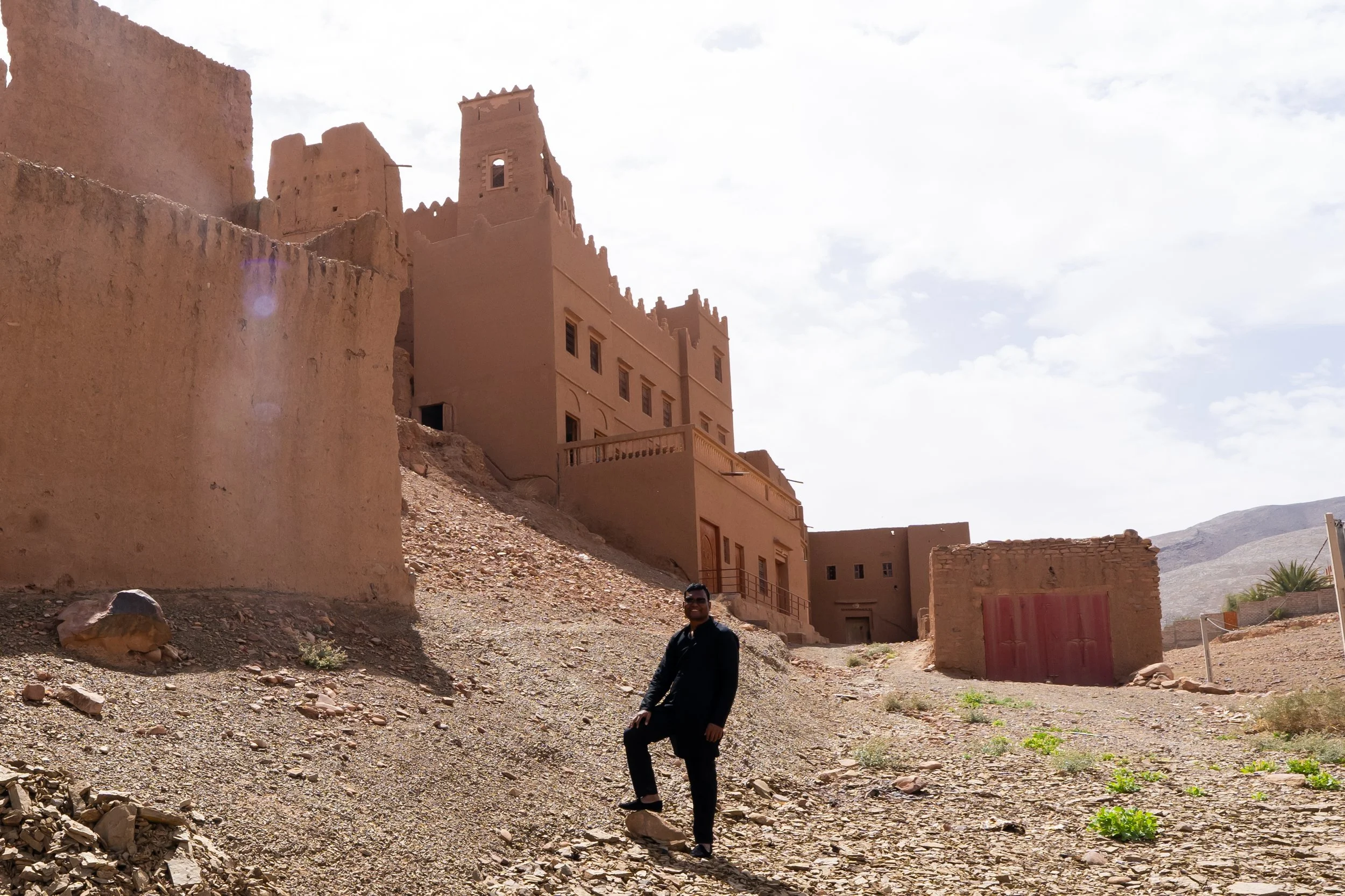
Beyond Ouarzazate, the road carried us deeper into history, where the Kasbah Oulad Othmane rose like a sentinel above the desert plain. Its mud‑brick walls, weathered yet proud, whispered of dynasties and caravans that once passed through, a fortress of memory standing against time.
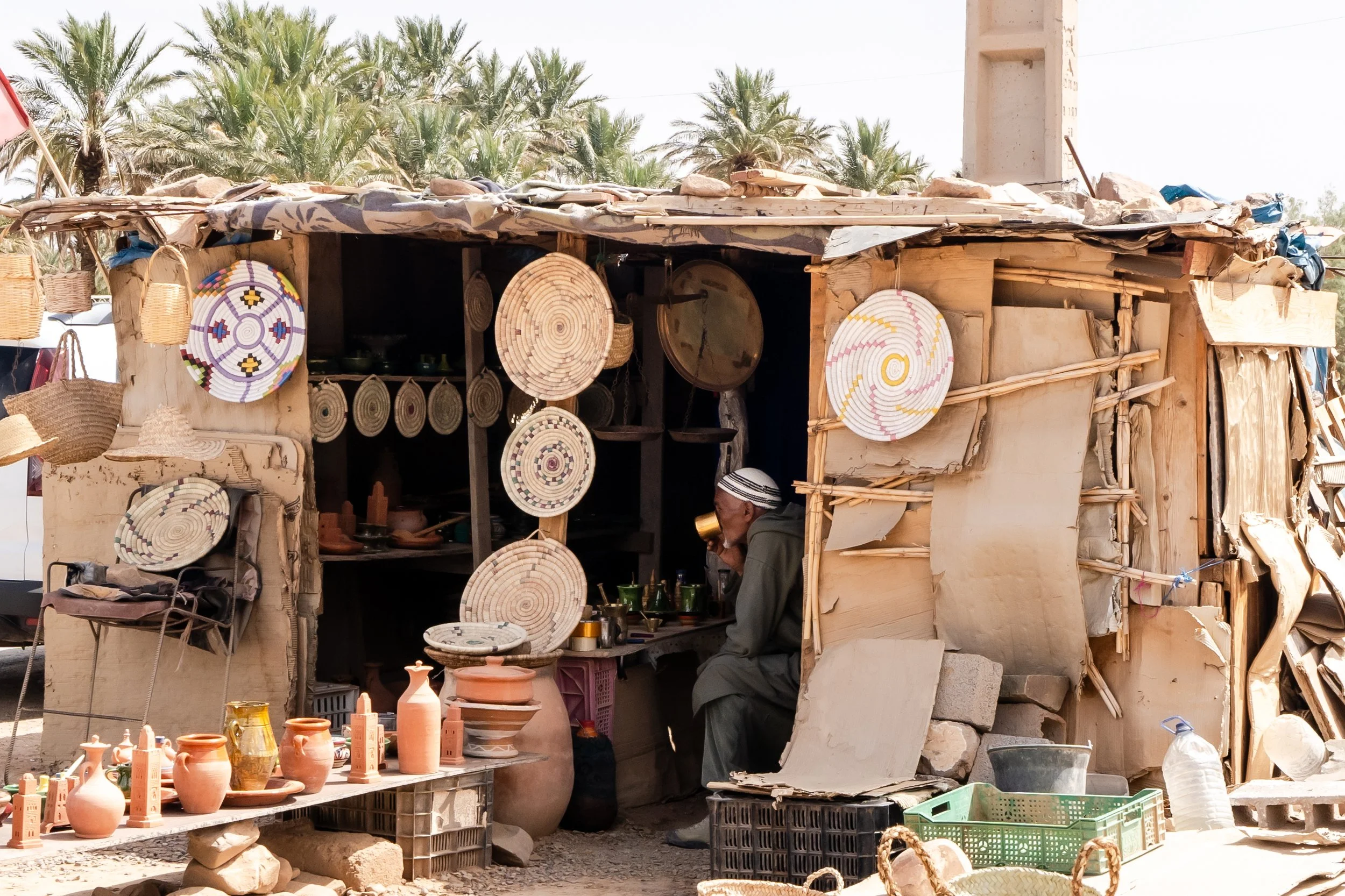
Along the roadside, a small stall appeared where pottery and handmade crafts were displayed beneath the sun. Clay jars, bowls, and painted plates stood in neat rows, their earthy tones echoing the valley’s soil. Beside them, woven baskets and carved wooden trinkets told stories of local artisans, each piece shaped by patient hands. The seller greeted travelers with quiet pride, offering not just objects but fragments of the Draa’s tradition. Stopping here felt like pausing at a living museum, where the valley’s spirit was captured in craft before the desert journey continued.
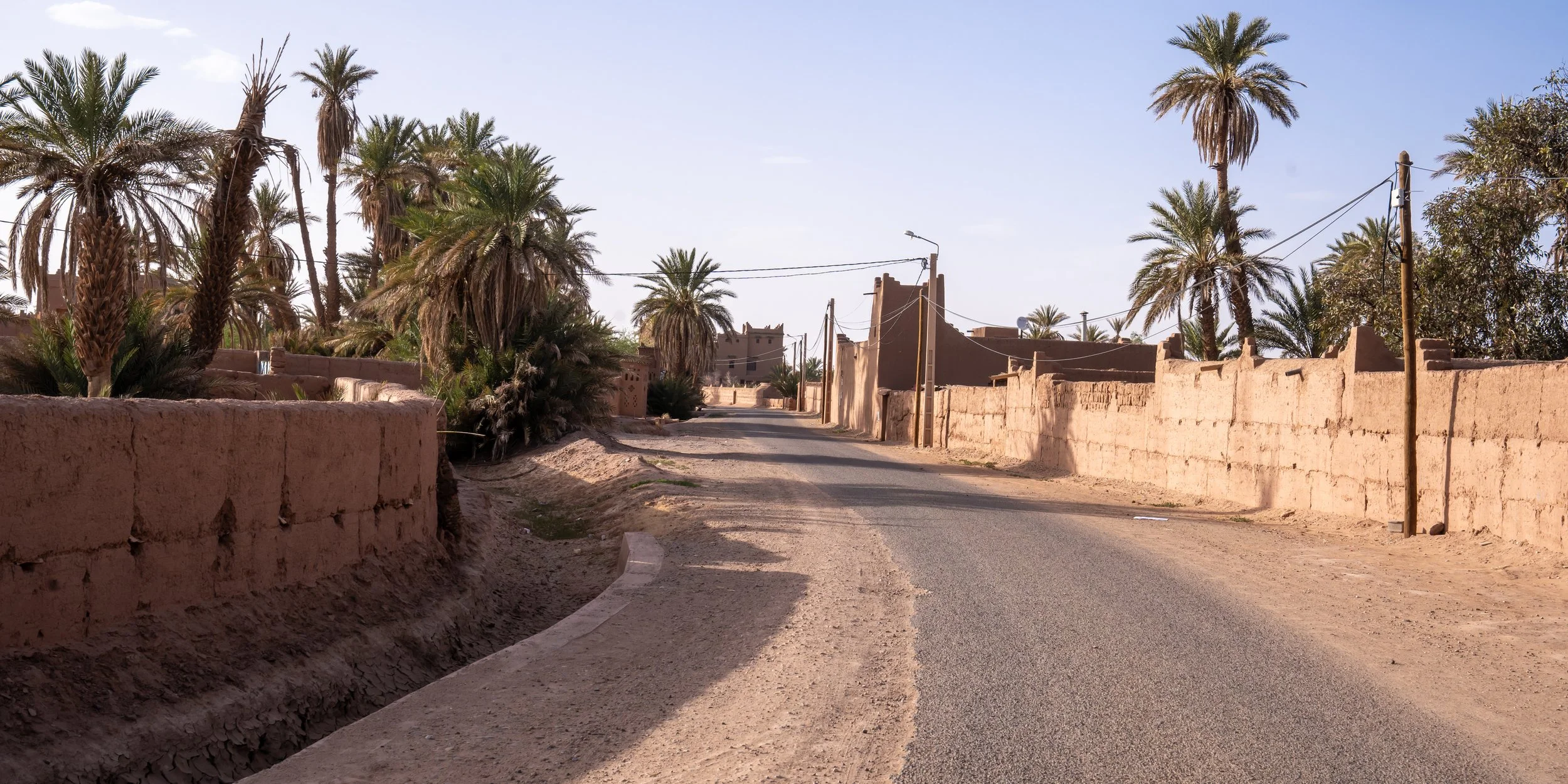
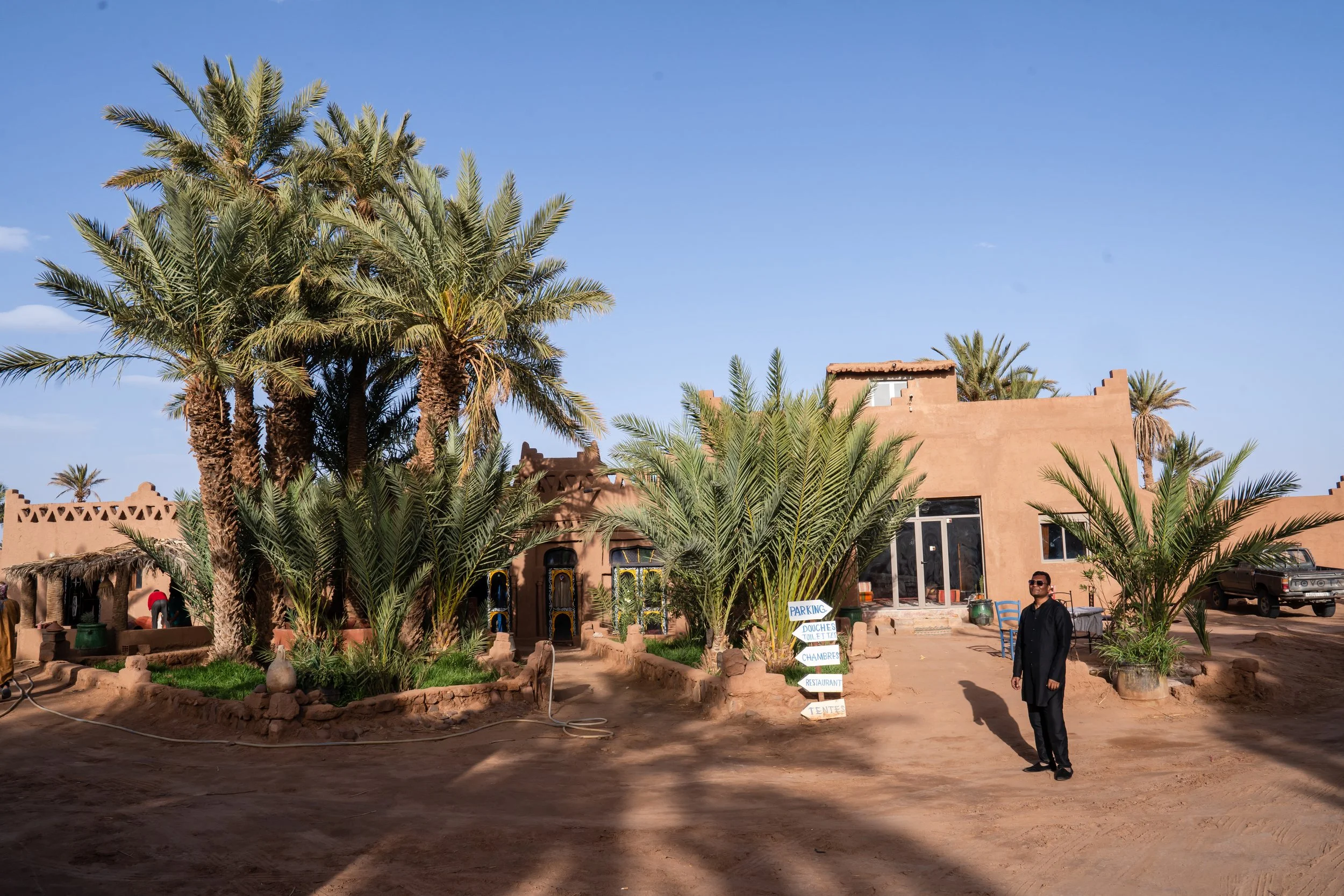
At last, the road carried us to Oulad Driss, a village at the edge of the Sahara where the desert begins to breathe. Mud‑brick houses stood in quiet harmony with the dunes, their walls blending into the ochre earth. Palm groves framed the settlement, offering shade and life before the vast emptiness beyond. The air felt different here—still, expansive, and heavy with silence—marking the threshold between the world we had crossed and the desert that awaited. Oulad Driss was not just a destination, but a pause at the frontier, where journeys into the Sahara truly begin.
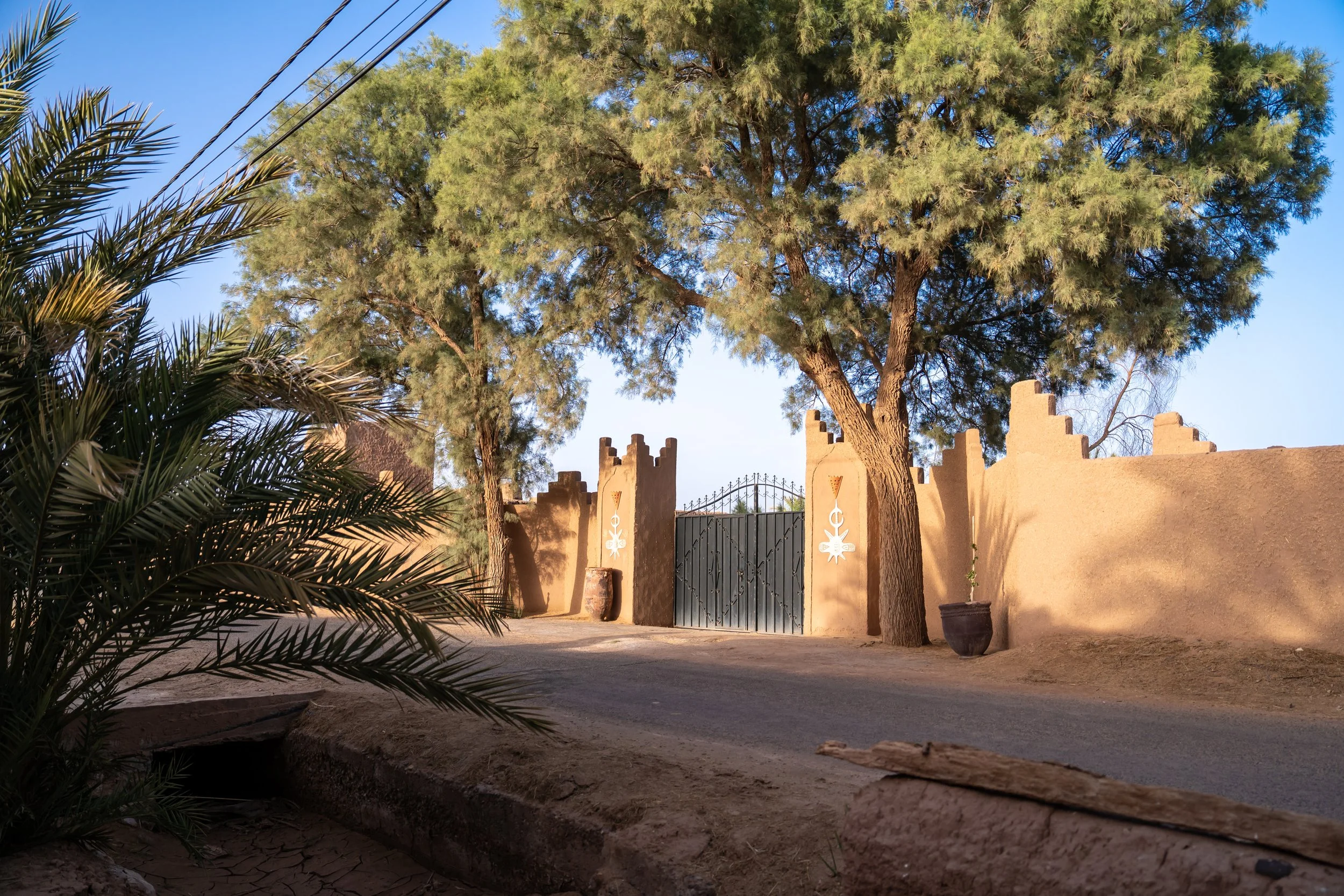
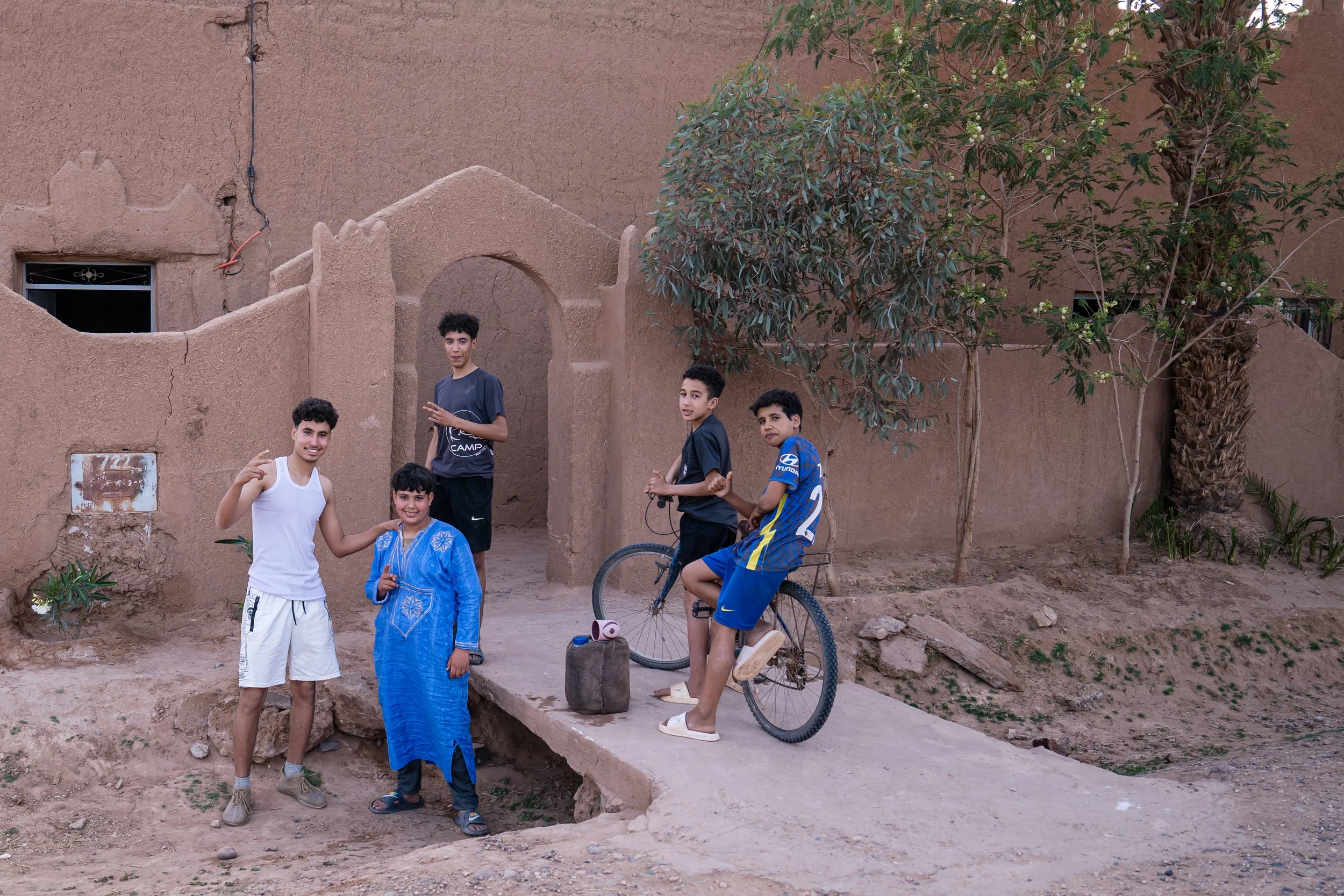
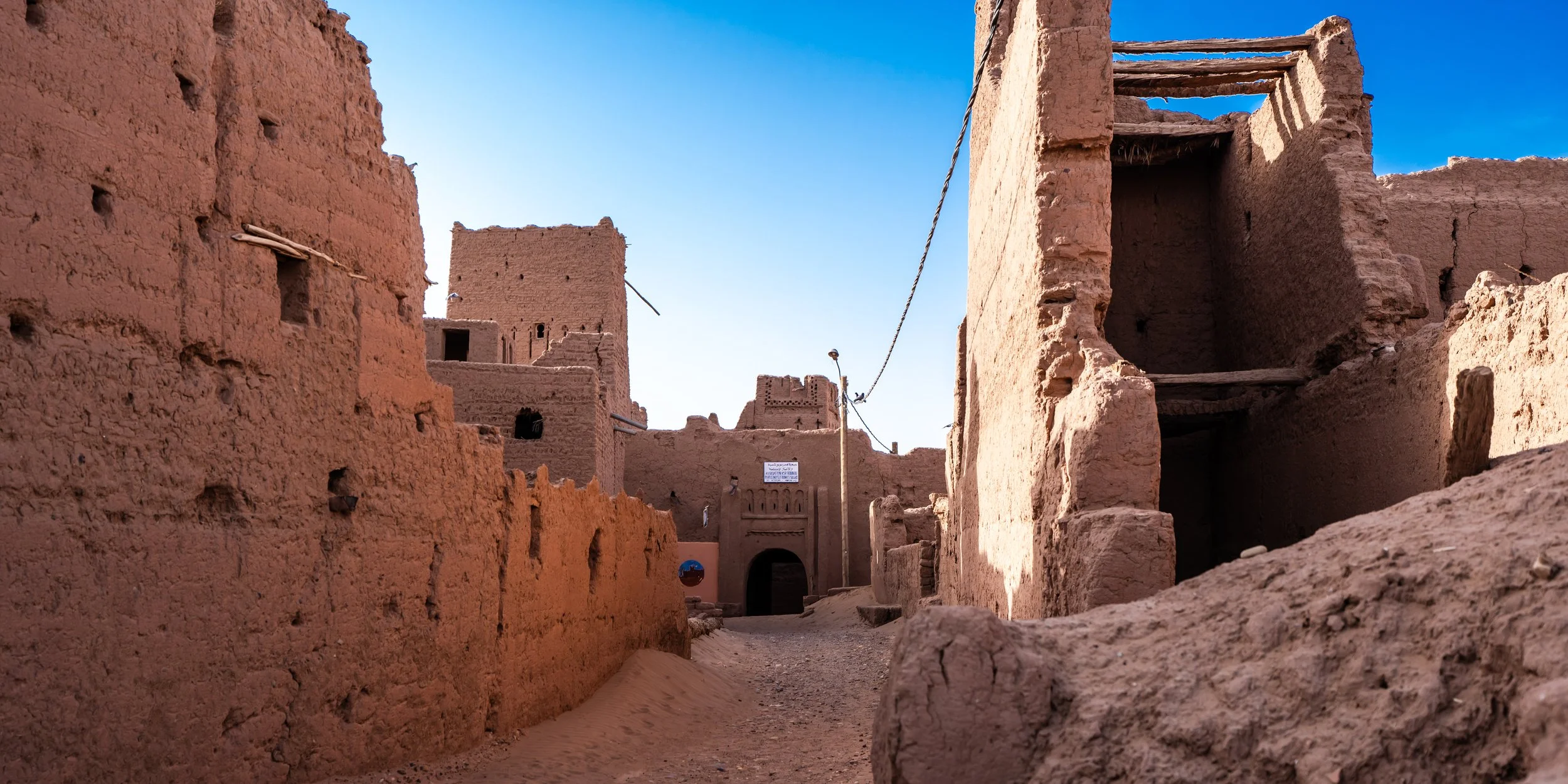
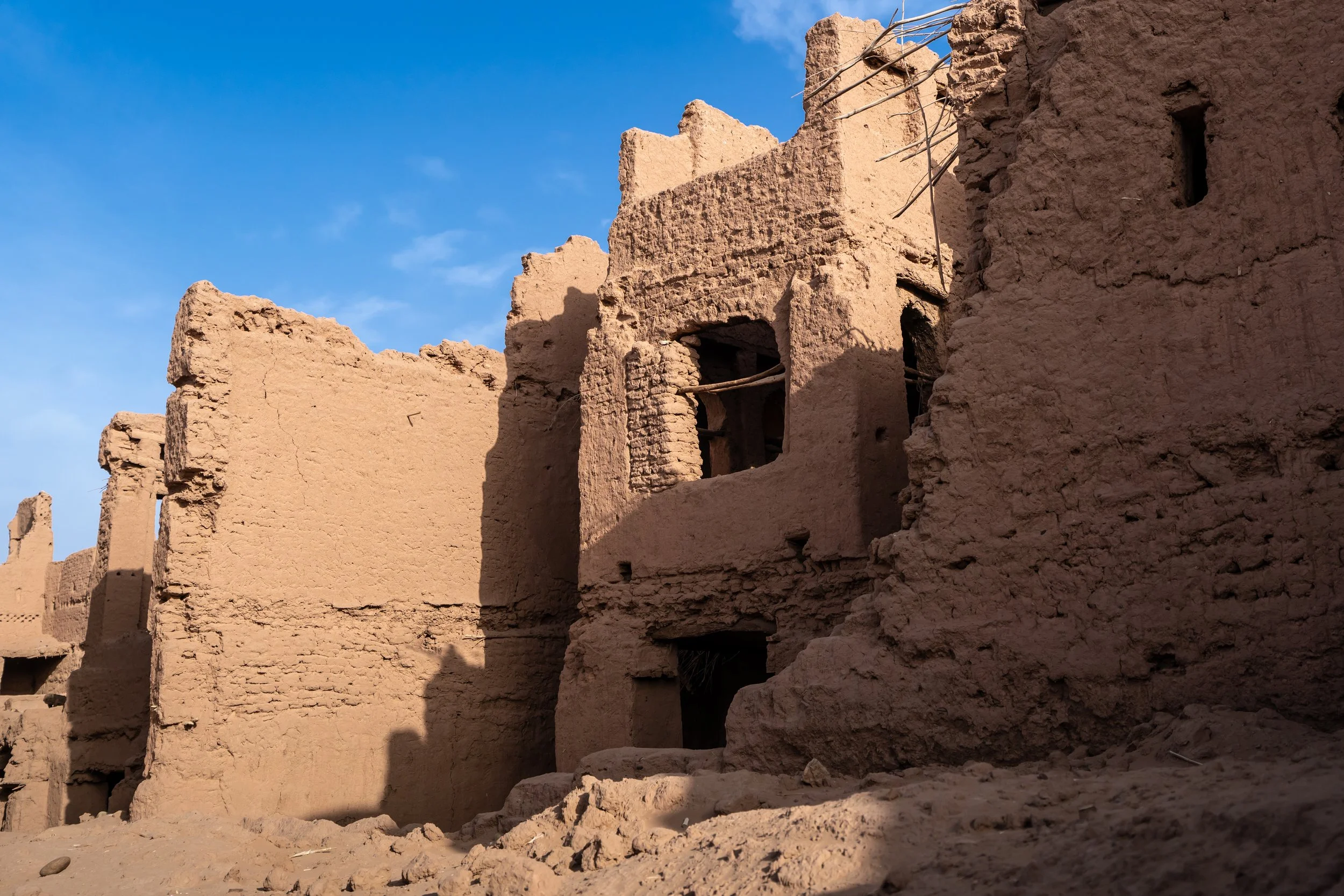
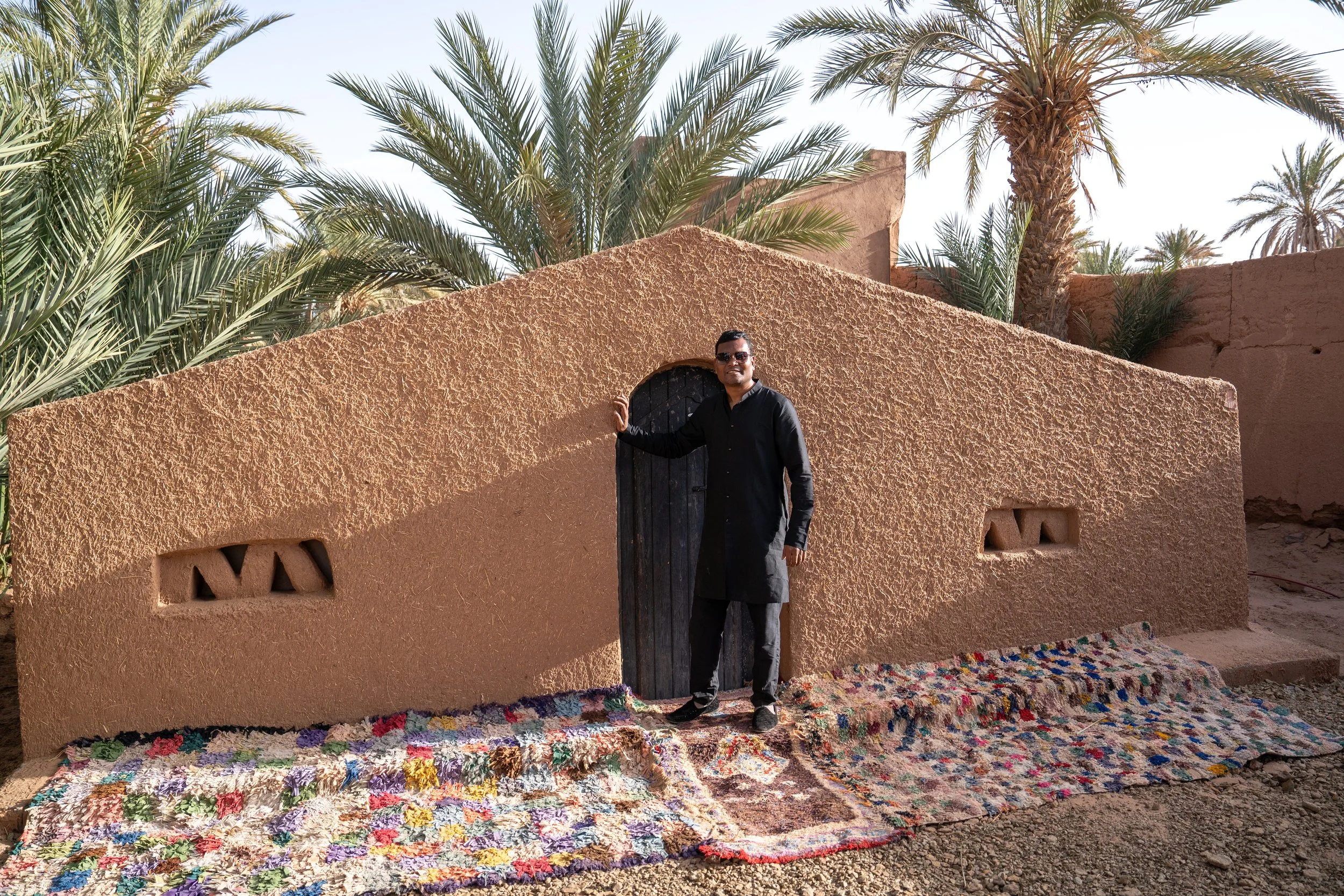
In Oulad Driss, the Berber khema stood beside a cluster of mud houses, their walls blending seamlessly into the desert’s ochre tones. The structures were simple yet enduring, built from earth and straw, shaped to withstand the heat of day and the cool of night. Around them, narrow alleys wound through palm groves, and the silence of the Sahara pressed close. The khema itself felt like an extension of this architecture—half dwelling, half memory—anchored in the traditions of a people who shaped shelter from the land itself.
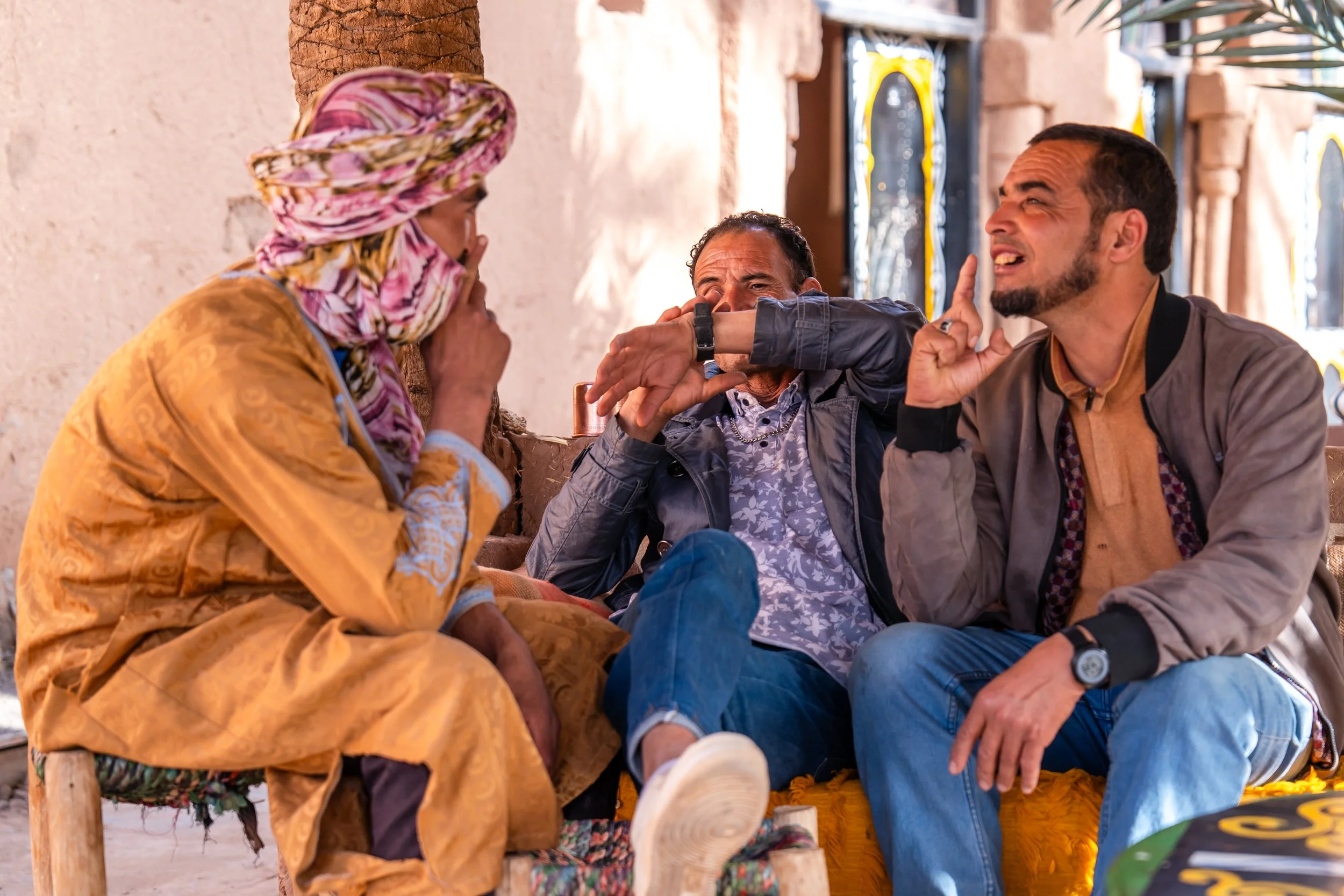
We asked the Berbers if we might stay within their khema, but hesitation lingered in their eyes. To them, we were strangers—unknown faces arriving at the edge of their world. The mud‑brick walls and woven tents stood as guardians of tradition, and entry was not freely given. Their reluctance carried the weight of caution, shaped by generations who had learned to protect their homes and way of life. In that pause, the desert seemed to remind us that belonging here was not immediate, but something earned through trust and time.
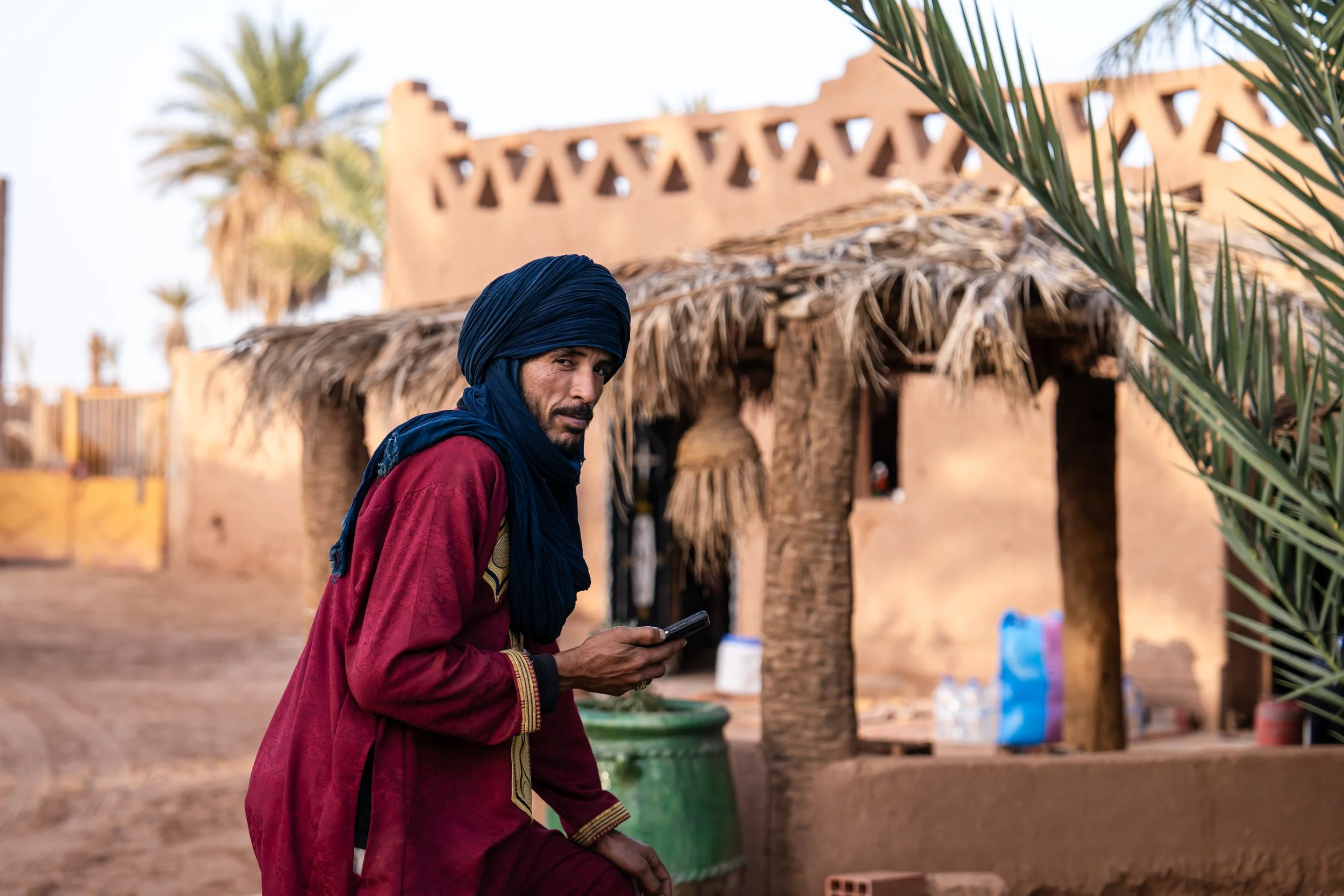
As we lingered near the khema, another Berber passed by, his figure marked by traditional robes that flowed with the desert wind. A turban wrapped neatly around his head, its folds shielding him from sun and sand. His eyes caught ours, steady and observant, carrying the quiet authority of someone rooted deeply in this land. In that gaze, there was both curiosity and caution, as if he measured our presence against the rhythm of his people’s traditions.
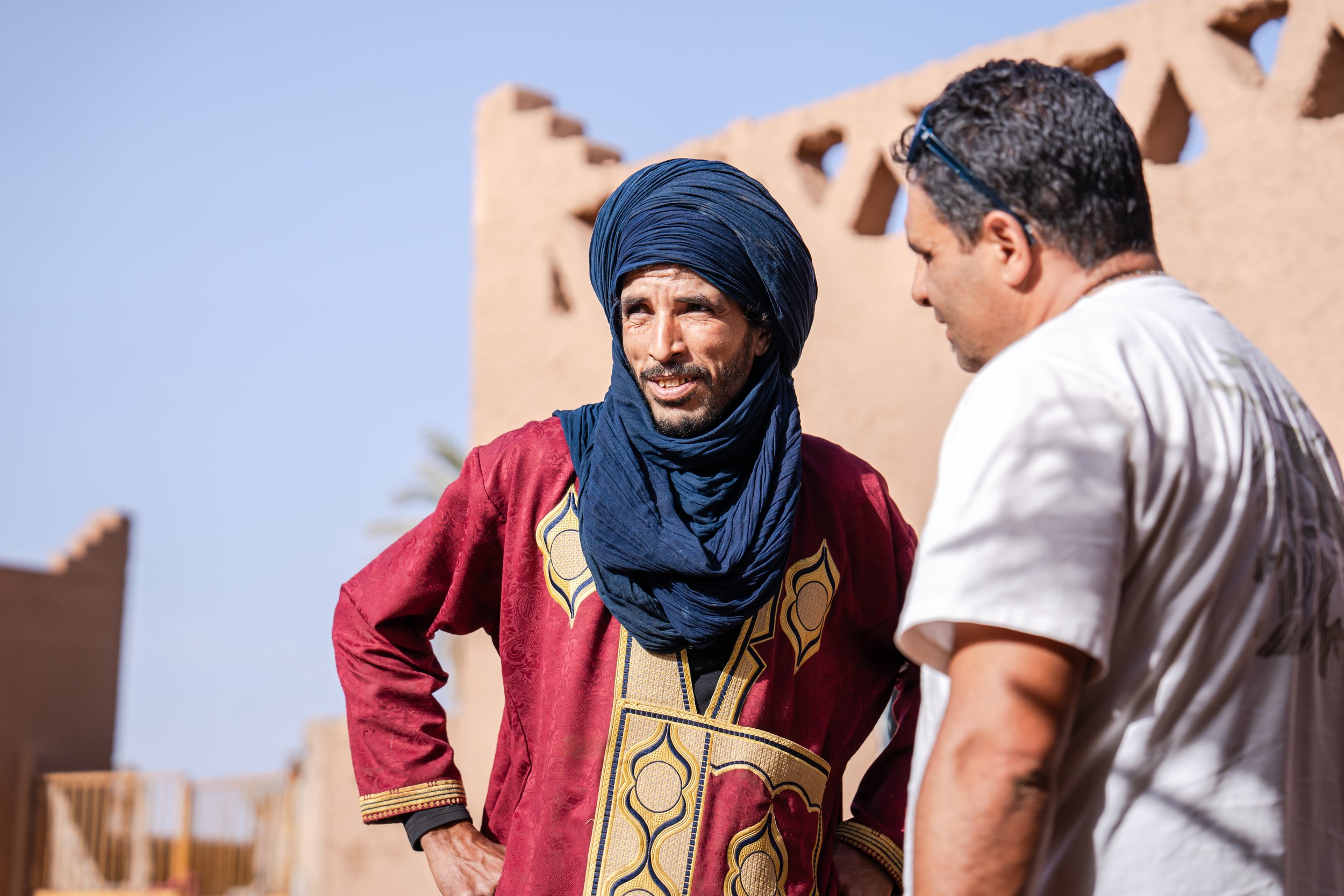
The Berber’s gaze lingered, and in that silence it seemed he understood: we were not wanderers seeking shelter alone, but travelers in search of the rare beetle whispered about in desert lore. Without speaking to us, he turned and walked toward the khema’s leader, a figure whose presence carried the weight of decision. The desert air felt charged, as though the knowledge of our mission had shifted the ground beneath us. In that moment, the path to trust—and perhaps to the beetle itself—lay in the hands of the leader who now knew why we had come.
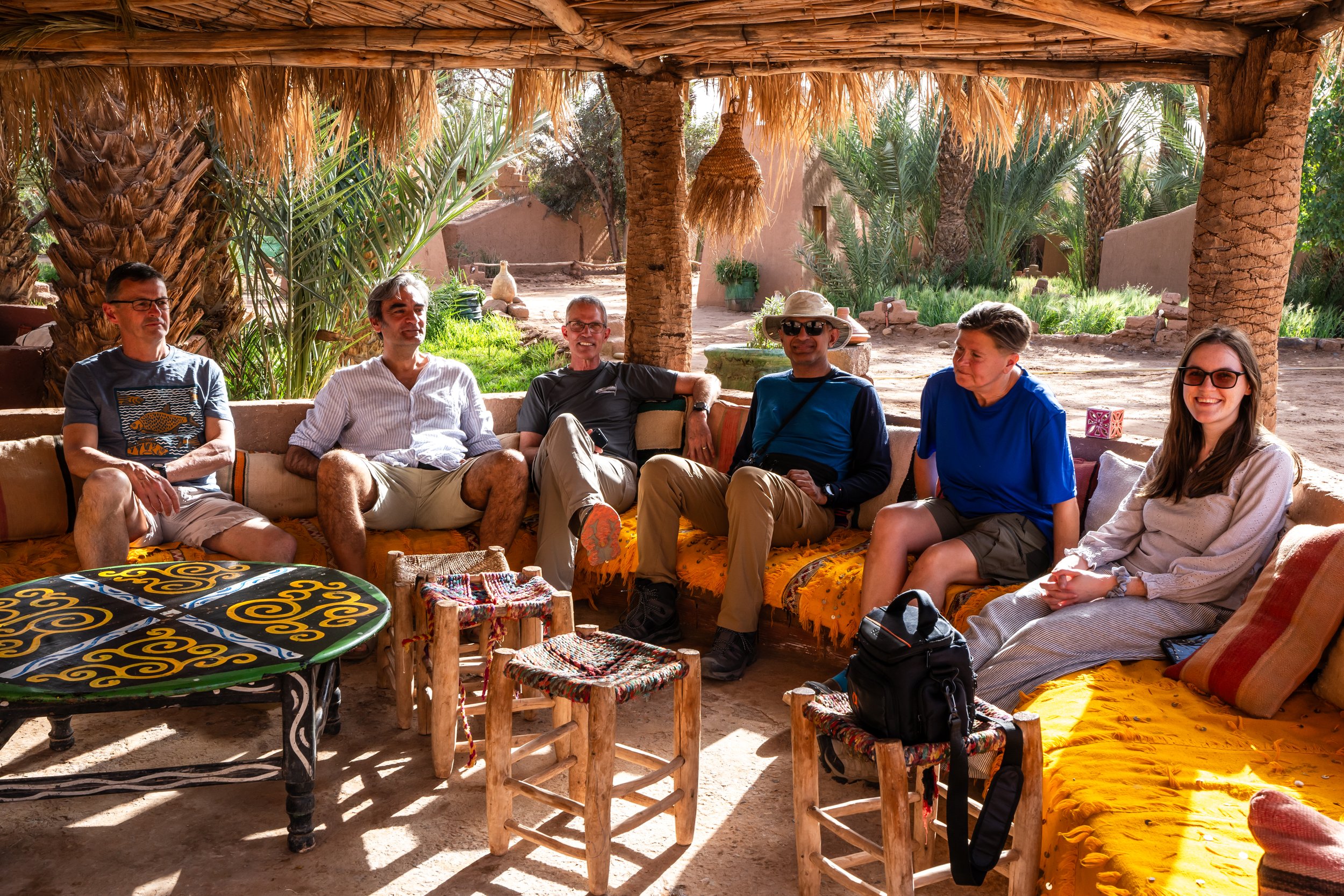
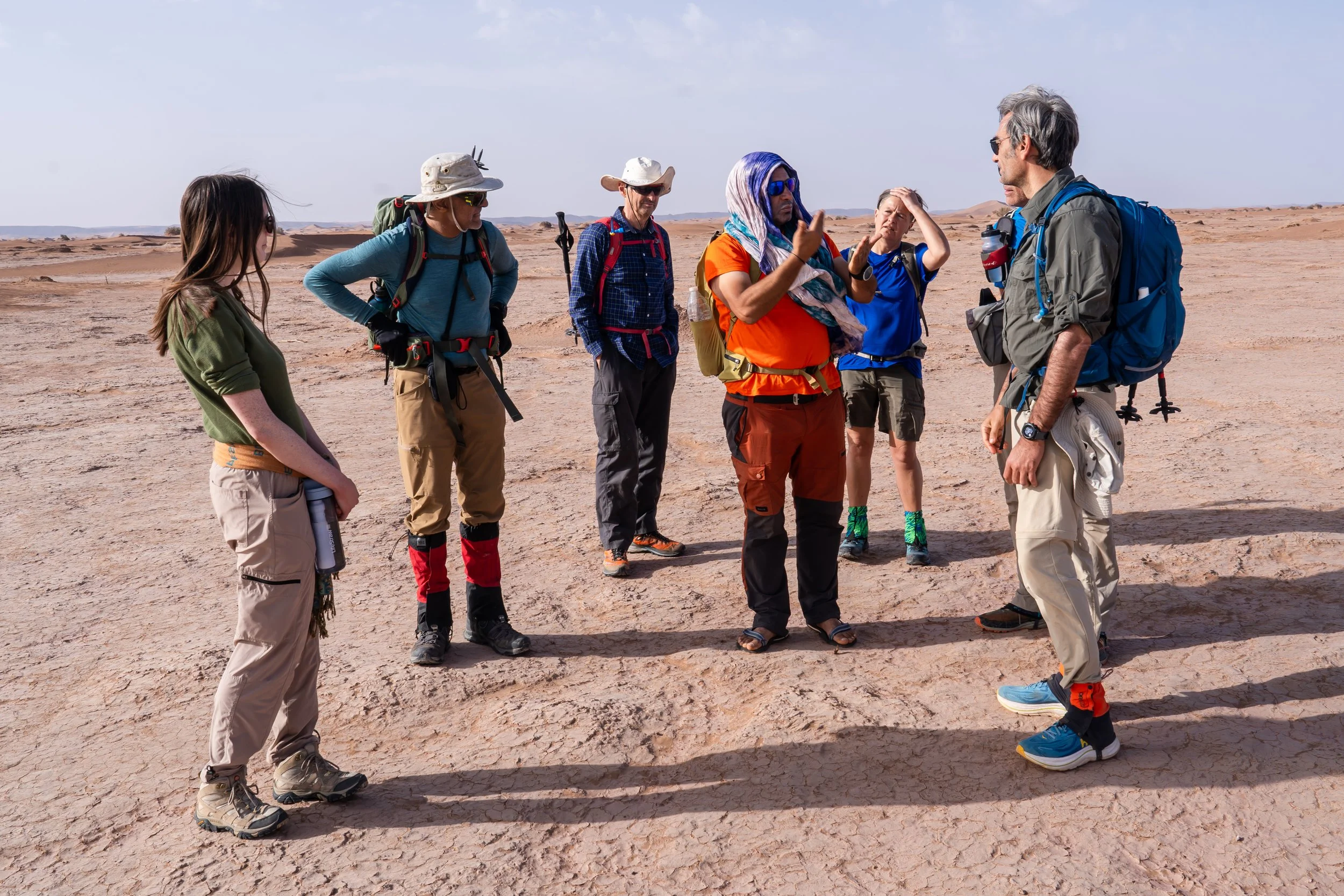
The khema leader stepped forward, his voice calm yet resolute. “In this noble mission, you will not walk alone,” he said. He introduced himself as Younes, a man whose presence carried the weight of desert wisdom. One by one, he named those who would accompany us: Mattio, Doug, Ven, Paul, and Danni—each a traveler drawn into the same search. Matt and I joined the circle, strangers no longer, but part of a gathering bound by purpose. In that moment, the desert seemed to shift, as if acknowledging the fellowship that had formed at its threshold.
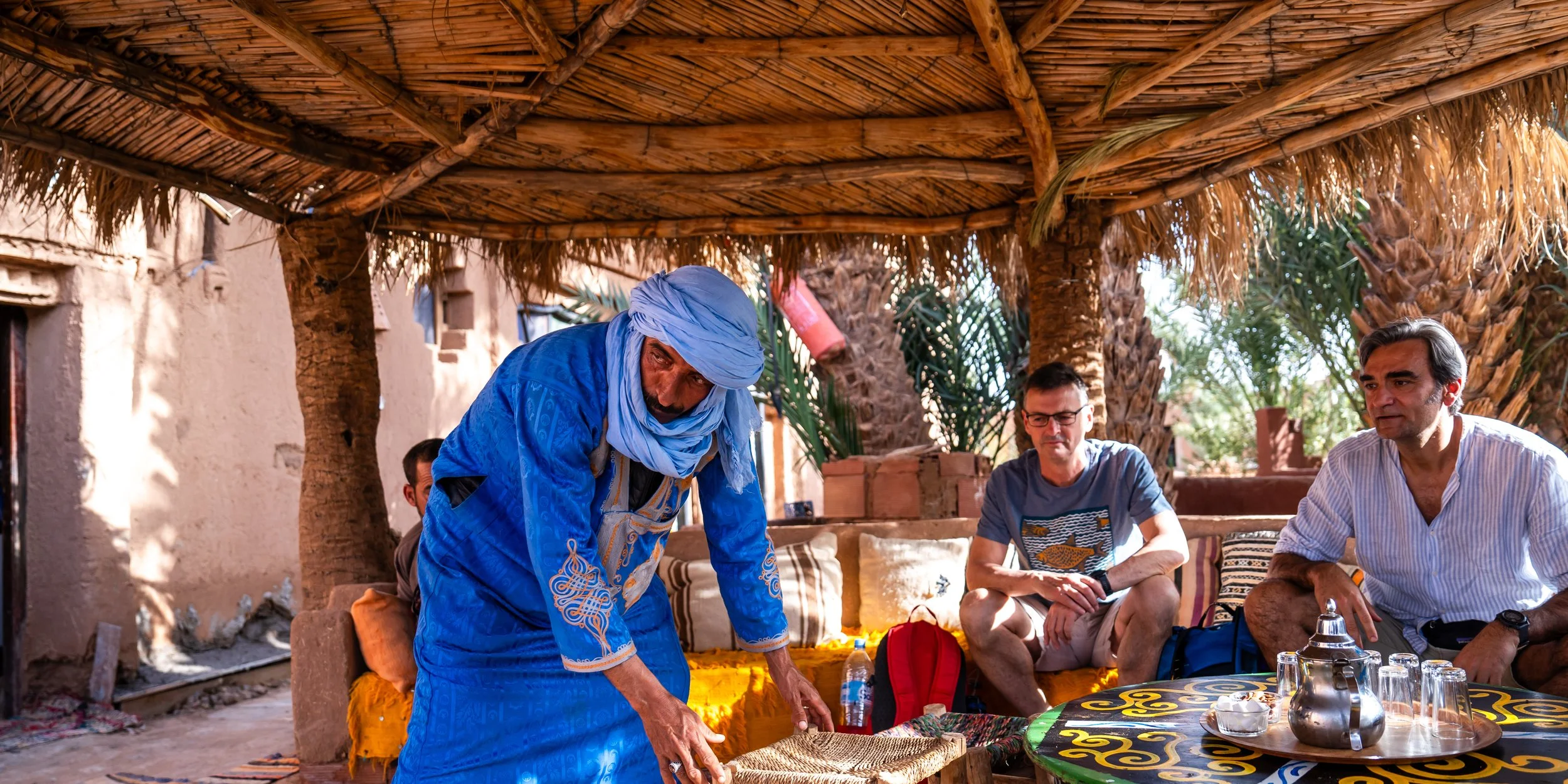
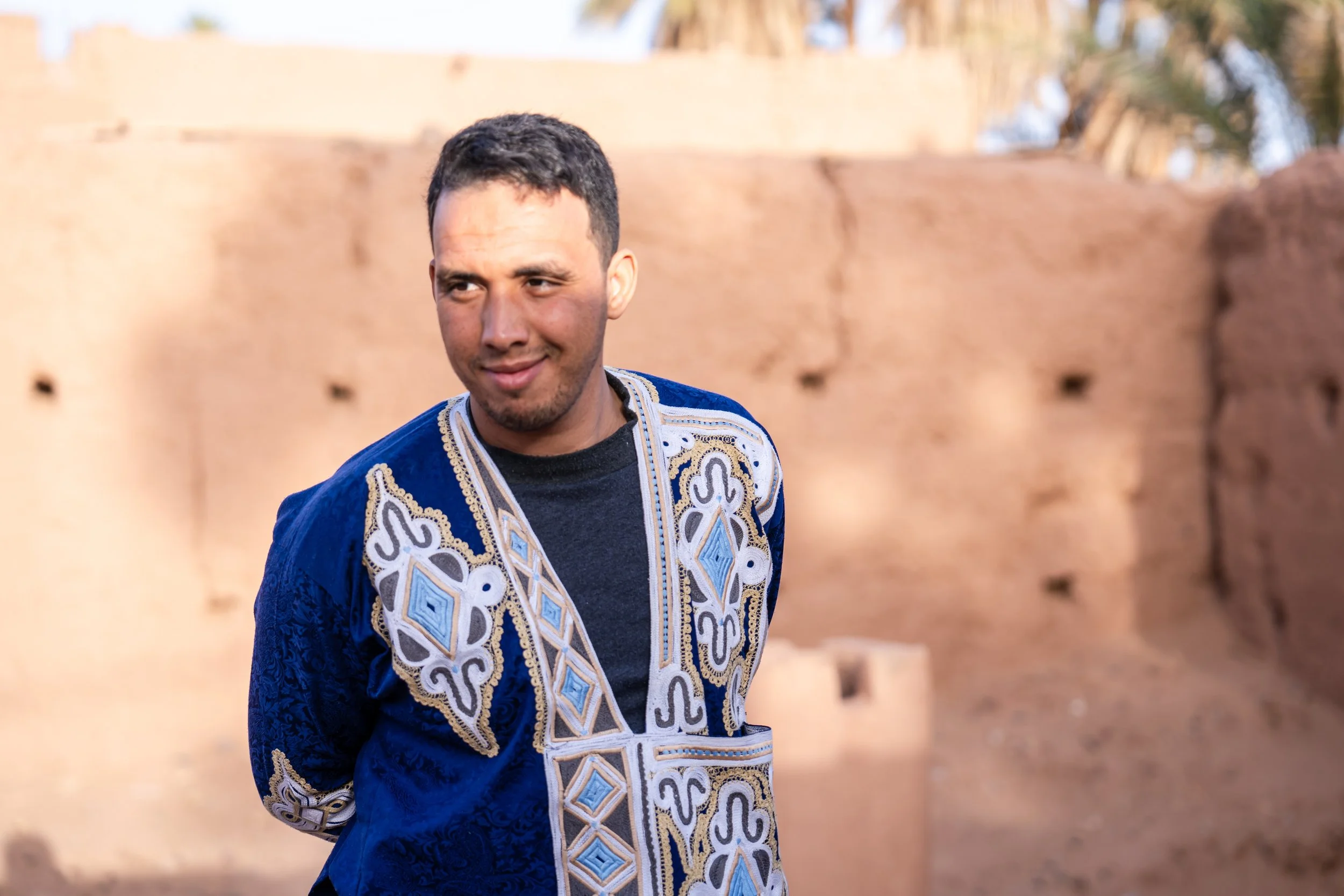
The Berber in indigo robes moved with quiet precision, arranging the low table beneath the khema’s shade. Brass trays were placed carefully, their surfaces catching the desert light, while slender glasses stood in neat rows beside the teapot.
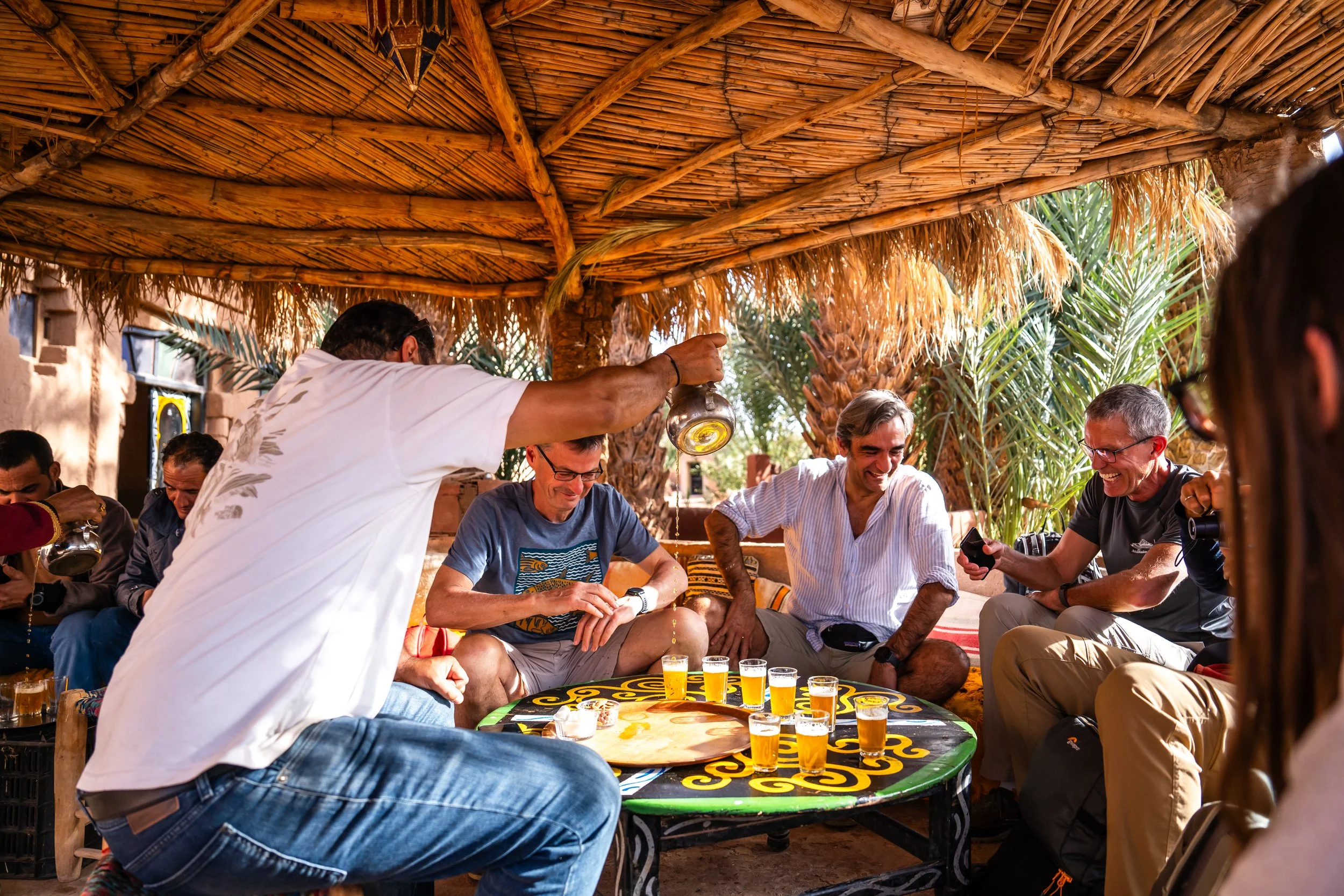
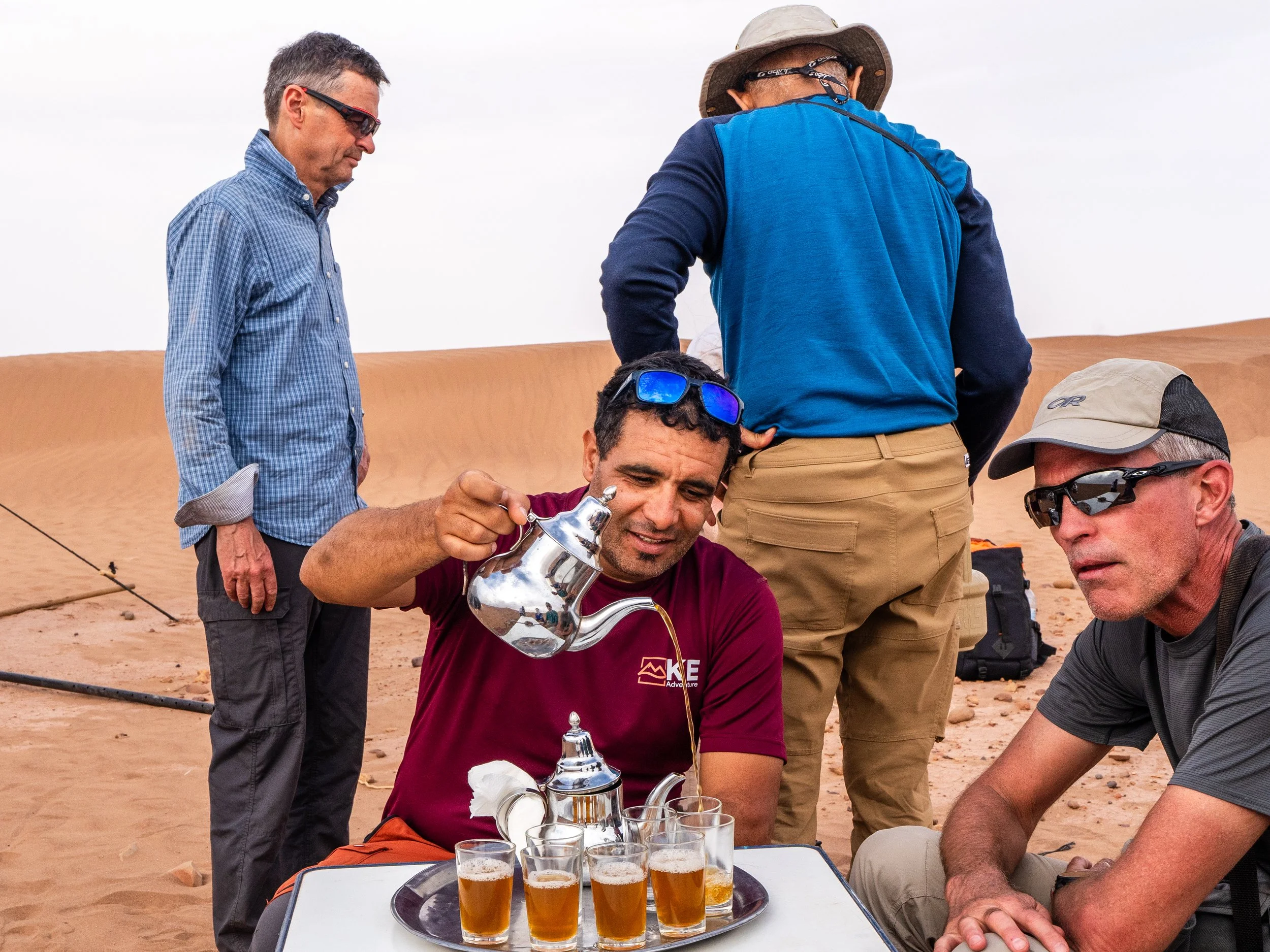
Younes himself took the teapot, its brass gleaming in the dim light of the khema. He dropped sugar cubes into the brew, letting them dissolve into the fragrant green mint tea. With practiced tradition, he lifted the pot high, pouring in a long stream so that bubbles formed at the surface of each glass—a sign of hospitality and care. When the glasses were filled, he handed them around. Together we raised them, saying “B’Saha”—to health—and sipped the sweet, refreshing tea. In that moment, fellowship was sealed, and the desert seemed to welcome us into its rhythm.
Younes leaned closer, his words deliberate. “The beetle is safe with the Guardian here in the village. It has been kept in trust, waiting for those chosen to carry it forward. Only you are eligible to take it from him and hand it to another Guardian.” He paused, then gave them names—titles that carried weight, as if drawn from desert legend. “They are known as the Keepers of the Eternal Beetle, the Wardens of the Desert Secret, the Custodians of Life’s Balance. Each Guardian holds a fragment of duty, ensuring the beetle never falls into unworthy hands.” We stepped out from the khema into the winding lanes of Oulad Driss.
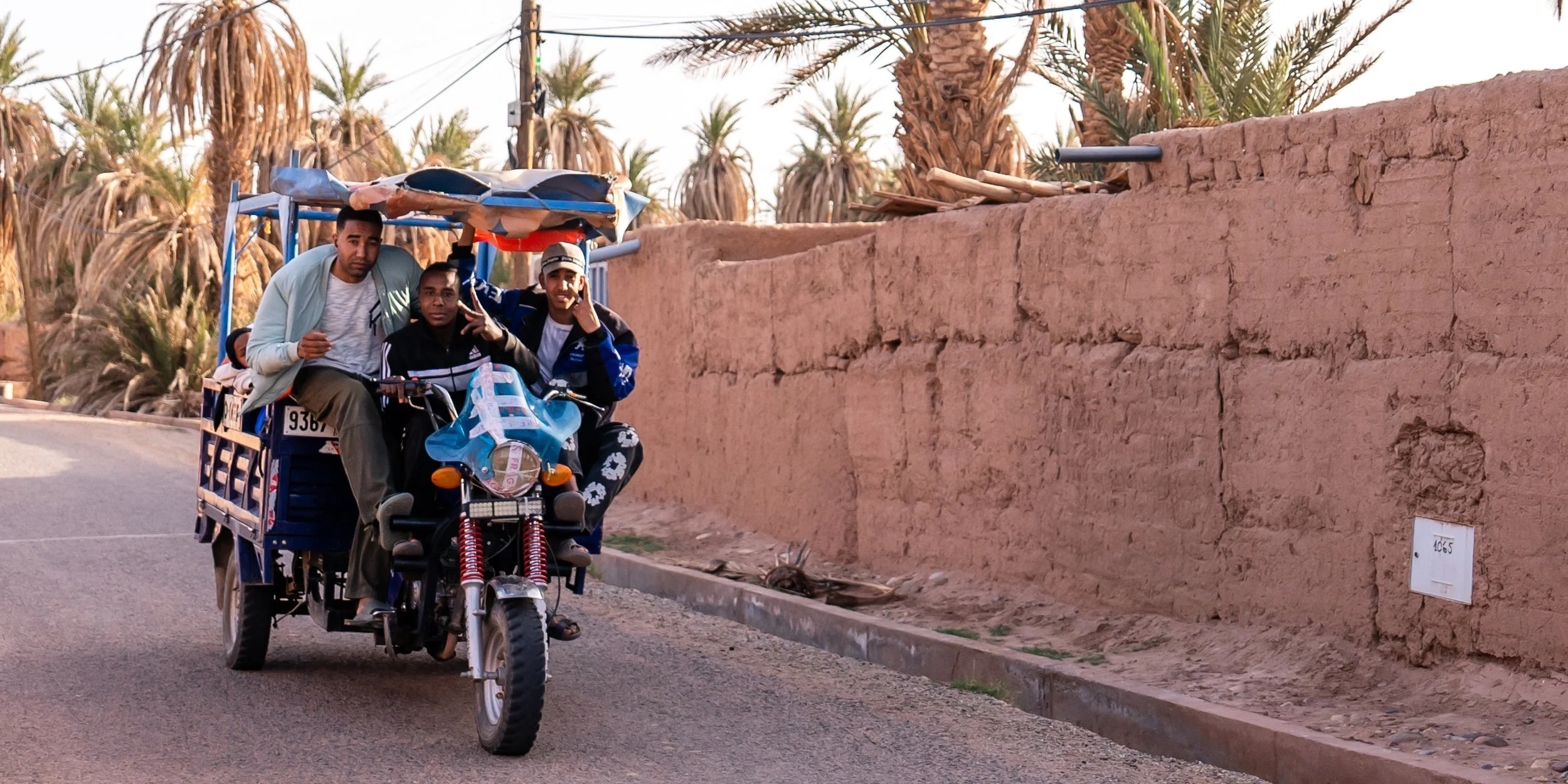
As we wandered deeper into the village, a few Berbers approached in tuk‑tuks, their small vehicles rattling cheerfully across the sandy lanes. They greeted us with warm smiles and gestures, their voices carrying the rhythm of welcome. Without hesitation, they pointed the way, guiding us toward the path we needed to follow. The tuk‑tuks moved ahead like desert messengers, weaving through palm groves and mud‑brick alleys, ensuring we did not lose our way. In their guidance, the village seemed to open itself to us, each turn bringing us closer to the Guardian and the beetle’s secret.
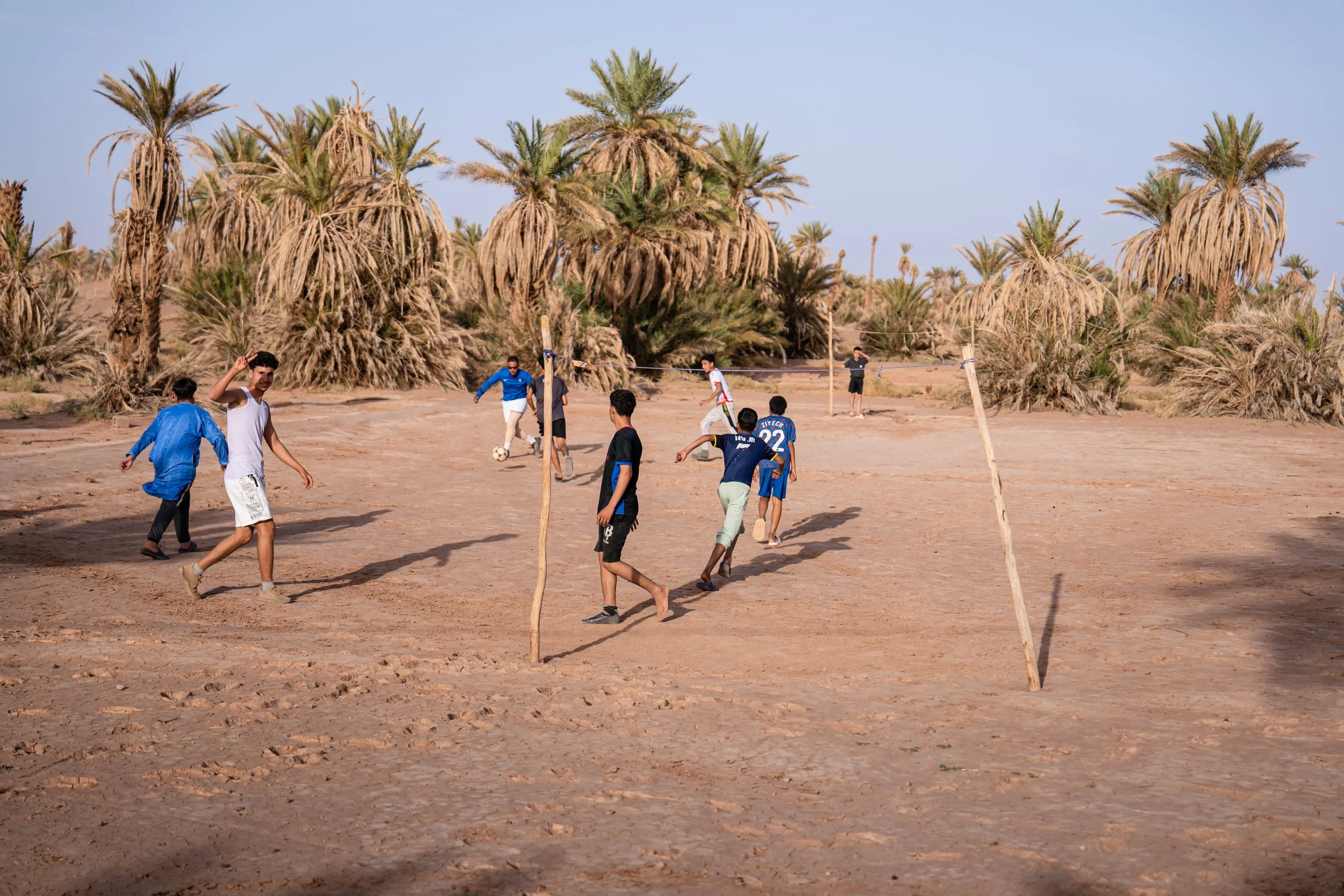
As we followed the path through Oulad Driss, the sound of laughter rose ahead. A group of children were playing football on the dusty ground, their shouts echoing against the mud‑brick walls. Bare feet kicked the ball with surprising skill, sending it darting between makeshift goalposts. Football is beloved across Morocco, and here in the village it was more than a game—it was joy, community, and pride woven into every pass. For a moment, the mission faded, and we watched as the desert itself seemed to pause, giving space for play and the rhythm of life.
At last, we found the Guardian of the beetle, his khema set apart from the village, quiet and solemn. Within its mud‑brick walls, the beetle had been kept safe, watched over with care and reverence. The Guardian stepped forward, his eyes steady, and placed the small vessel into our hands. “It is yours now,” he said, his voice carrying both blessing and burden. “May your path honor its purpose.” With that, he wished us well, entrusting the beetle’s journey to us—the chosen companions bound to carry it onward to the next Guardian.
The Guardian placed the vessel into Danni’s hands, and with that, the responsibility became hers. She held it close, her eyes bright with a restless energy. Danni was known for her endless words—she spoke to anyone, to the air itself, to the beetle now resting in her care, and sometimes to no one at all. Her voice carried across the khema, weaving stories, questions, and musings without pause. Some companions smiled at her chatter, others simply let it flow like desert wind. Yet in that ceaseless stream of words, there was a strange comfort, as if the beetle itself was never left alone, always accompanied by her voice.
On our way back to the khema, we crossed paths again with the same children, their football now resting at their feet. They tried speaking to us in their Berber tongue, words flowing with excitement, but we could not understand. Then, almost suddenly, their voices rose in song—familiar notes from Dilwale Dulhania Le Jayenge. I paused, astonished, realizing how deeply Bollywood had reached even here. The names of Shahrukh Khan and Amitabh Bachchan were not unknown to them; their faces and films had traveled across deserts and villages, becoming part of the children’s world. In that moment, the distance between cultures dissolved, replaced by a shared rhythm of cinema and song.
By the time we reached the khema again, the desert sun had begun to soften, casting long shadows across the mud‑brick walls. The weight of the mission, the laughter of children, and the guidance of the Berbers lingered in our minds. Inside, the air was cool and still, a quiet refuge from the village’s bustle.
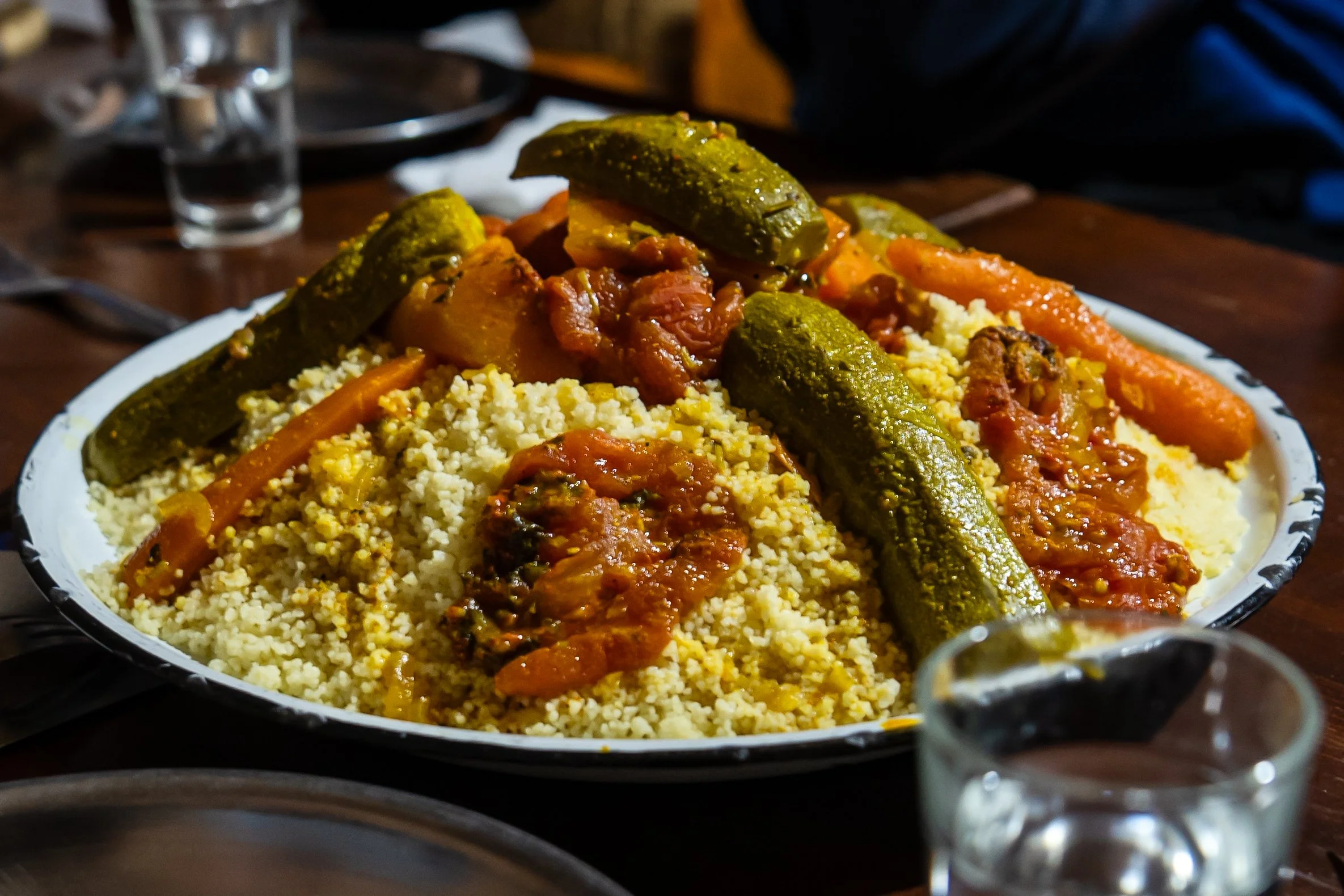
As evening settled over Oulad Driss, the khema filled with the comforting aromas of dinner. Fresh bread was torn and shared, its crust warm from the fire. Bowls of harira arrived, rich with lentils, chickpeas, and tomatoes, carrying the spice of saffron and the comfort of tradition. Clay pots revealed tagines, slow‑cooked with preserved lemon and olives, their steam rising like a blessing. Platters of couscous followed, light and fluffy, crowned with vegetables and sweet raisins. Finally, the meal closed with verbena tea, its citrus fragrance soothing, a gentle end to the day’s journey.
At dinner, Younes gathered us in the khema, his tone solemn yet steady. He spoke of the desert that awaited us—a multi‑day trek across shifting dunes and endless horizons. Our destination was Erg Zahar, the great dune known as the “Screaming Dune,” where another group would take over the beetle. They, too, would ensure its passage to yet another Guardian of the beetle, one whose identity would remain hidden from the world, known only to the chain of keepers.
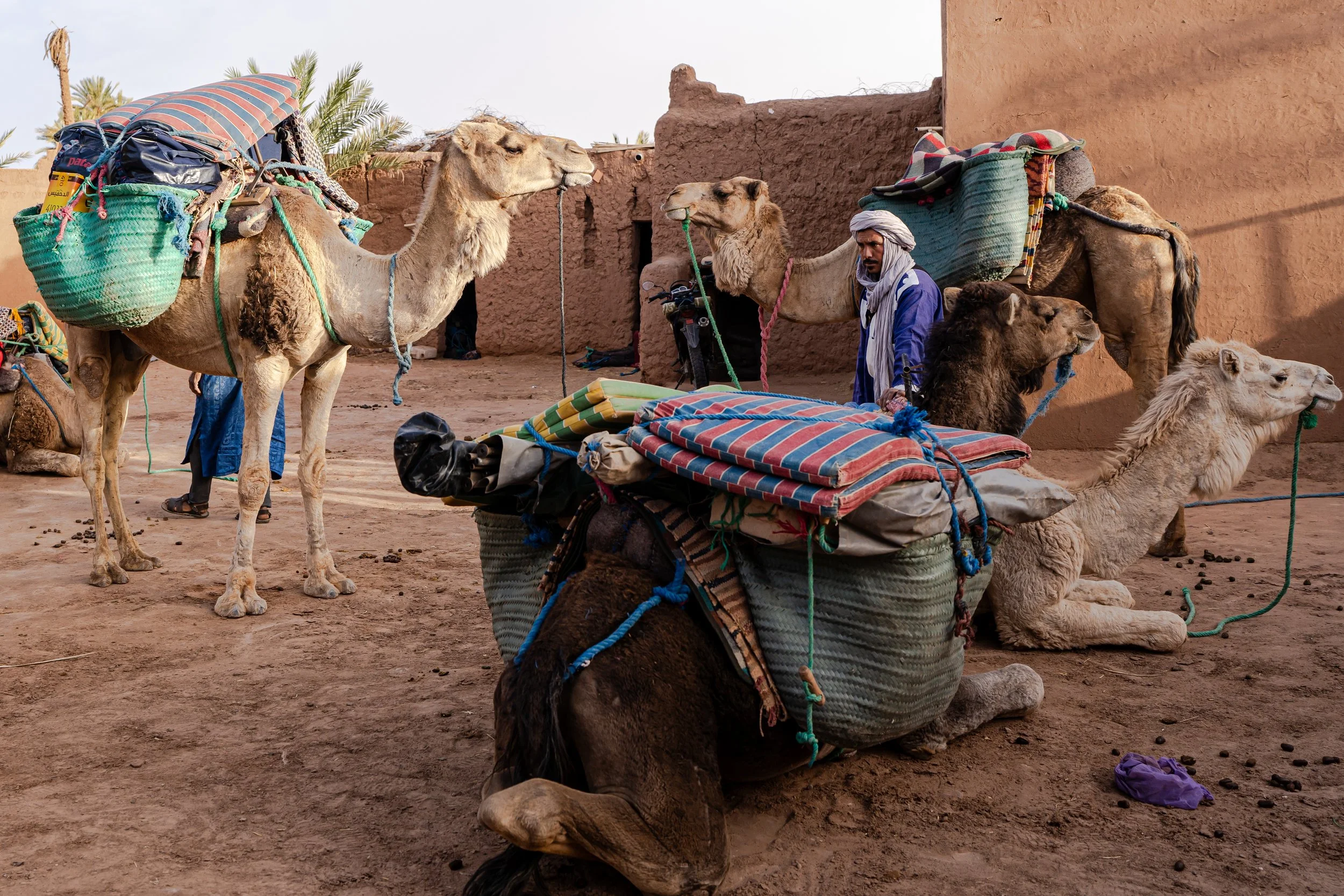
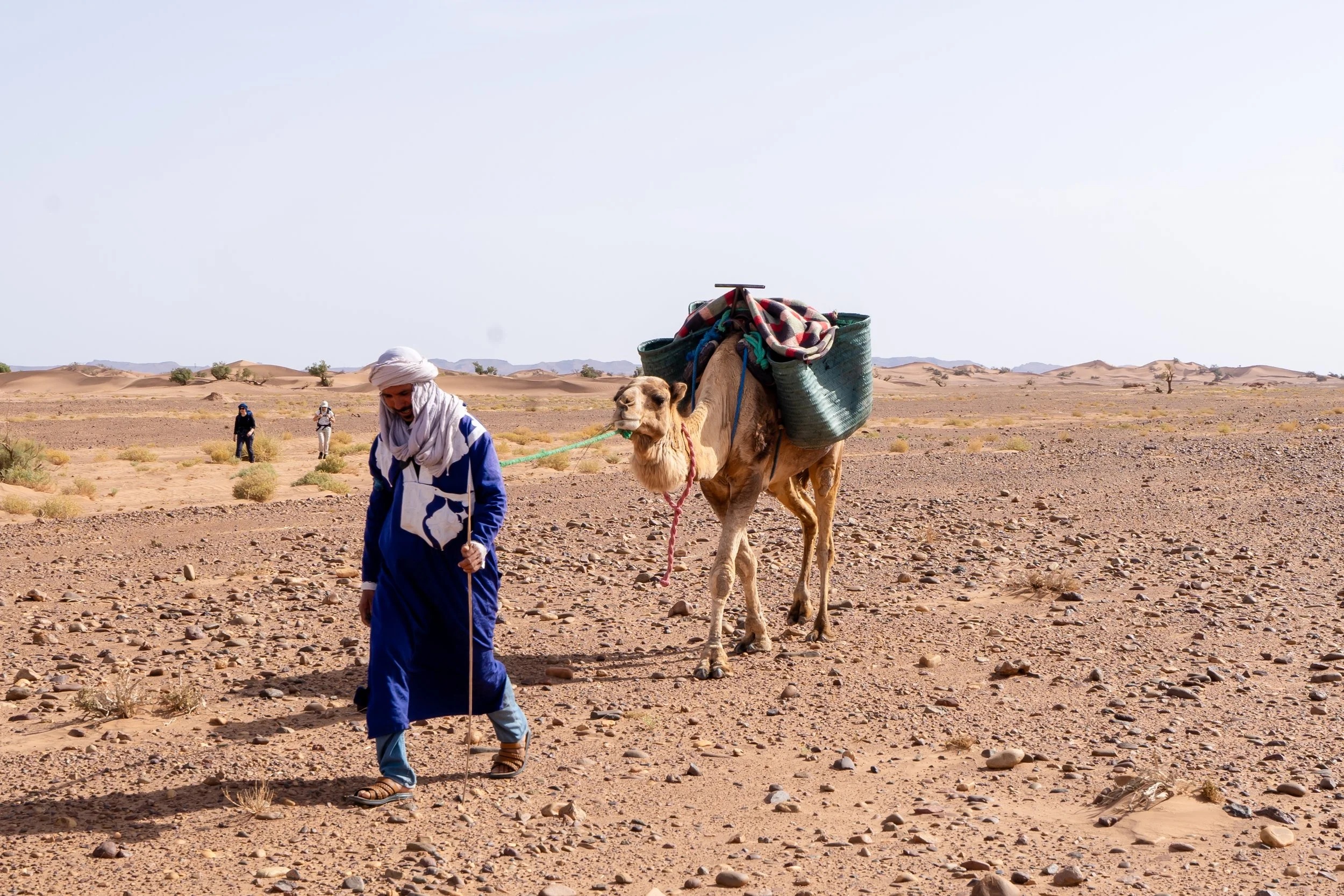
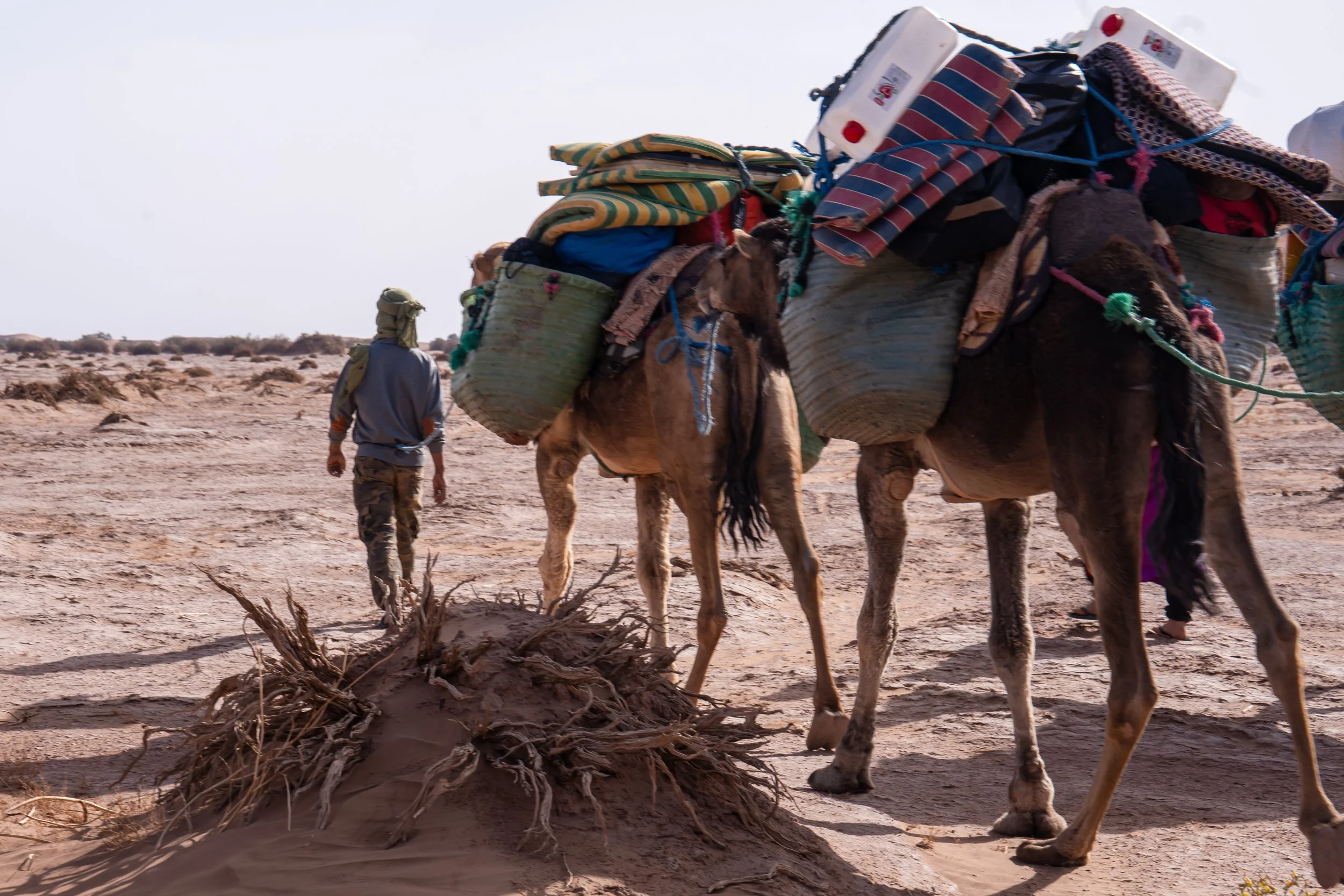
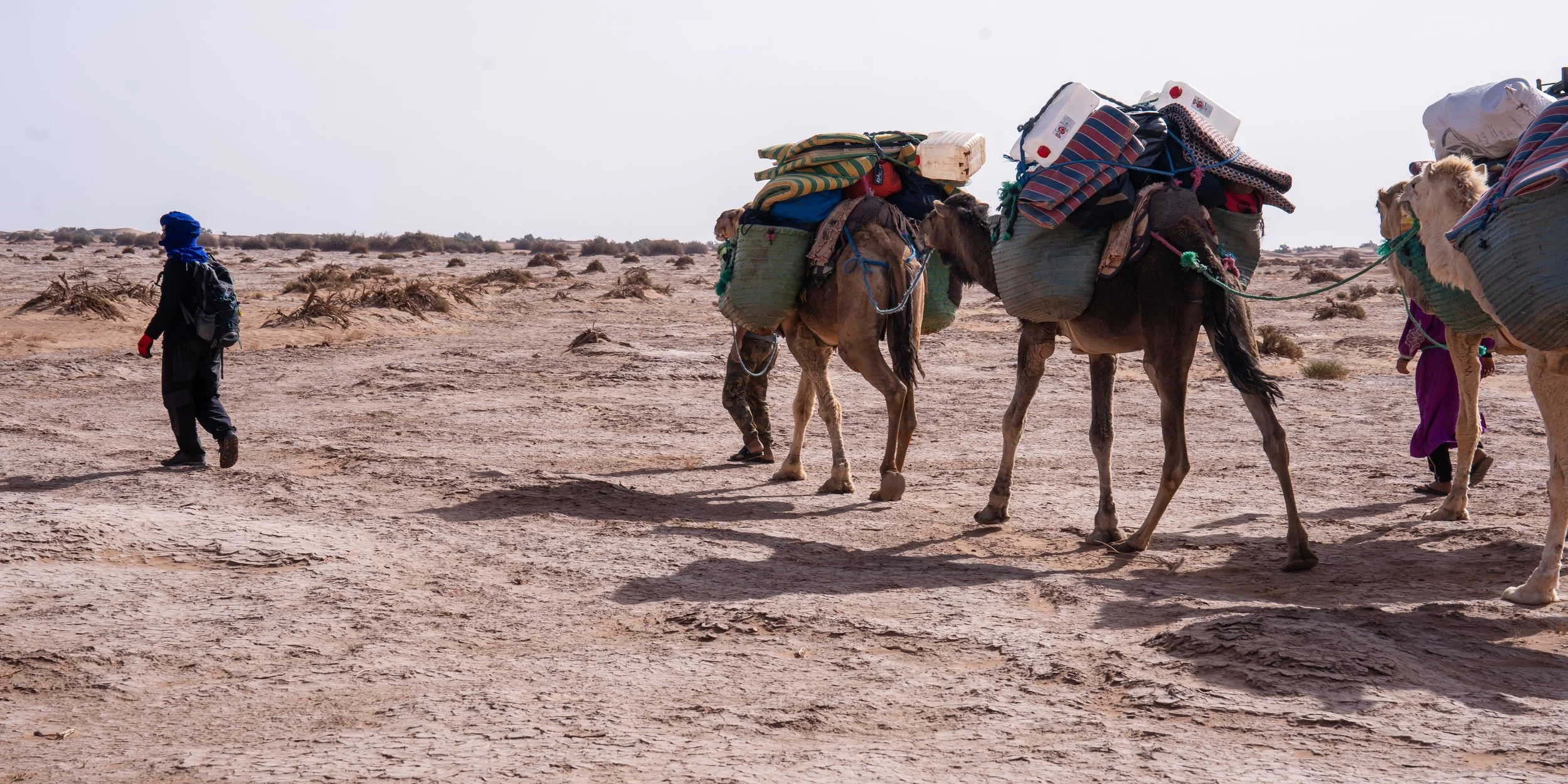
At first light, the khema stirred with quiet activity. The desert air was cool, carrying the promise of heat yet to come. Camels knelt patiently as our luggages were strapped onto their backs—bundles of food, water, and supplies secured with ropes and woven cloth. Their calm eyes reflected the rhythm of countless journeys across the dunes. Younes oversaw the preparations, ensuring every load was balanced, every strap tight.
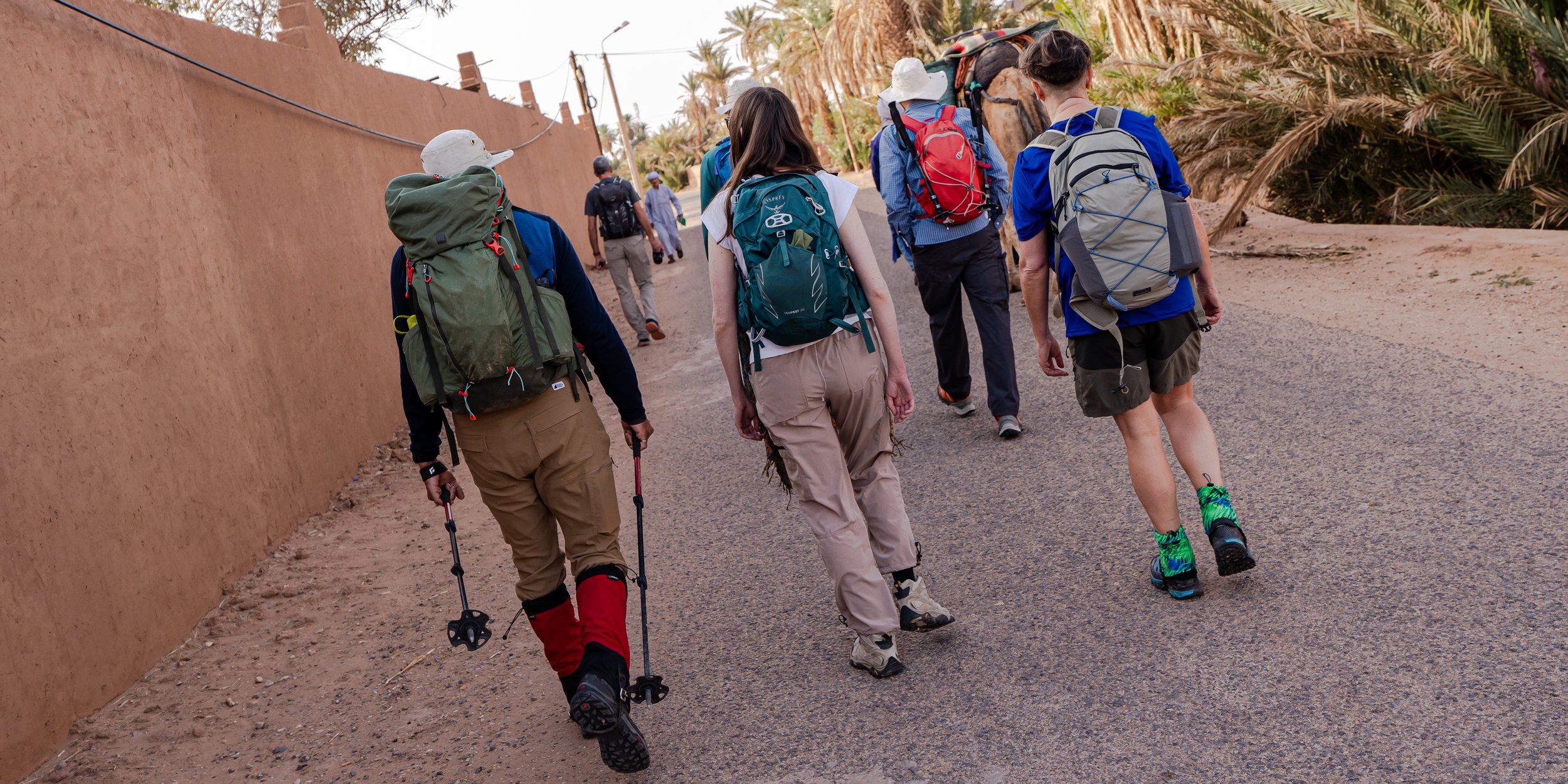
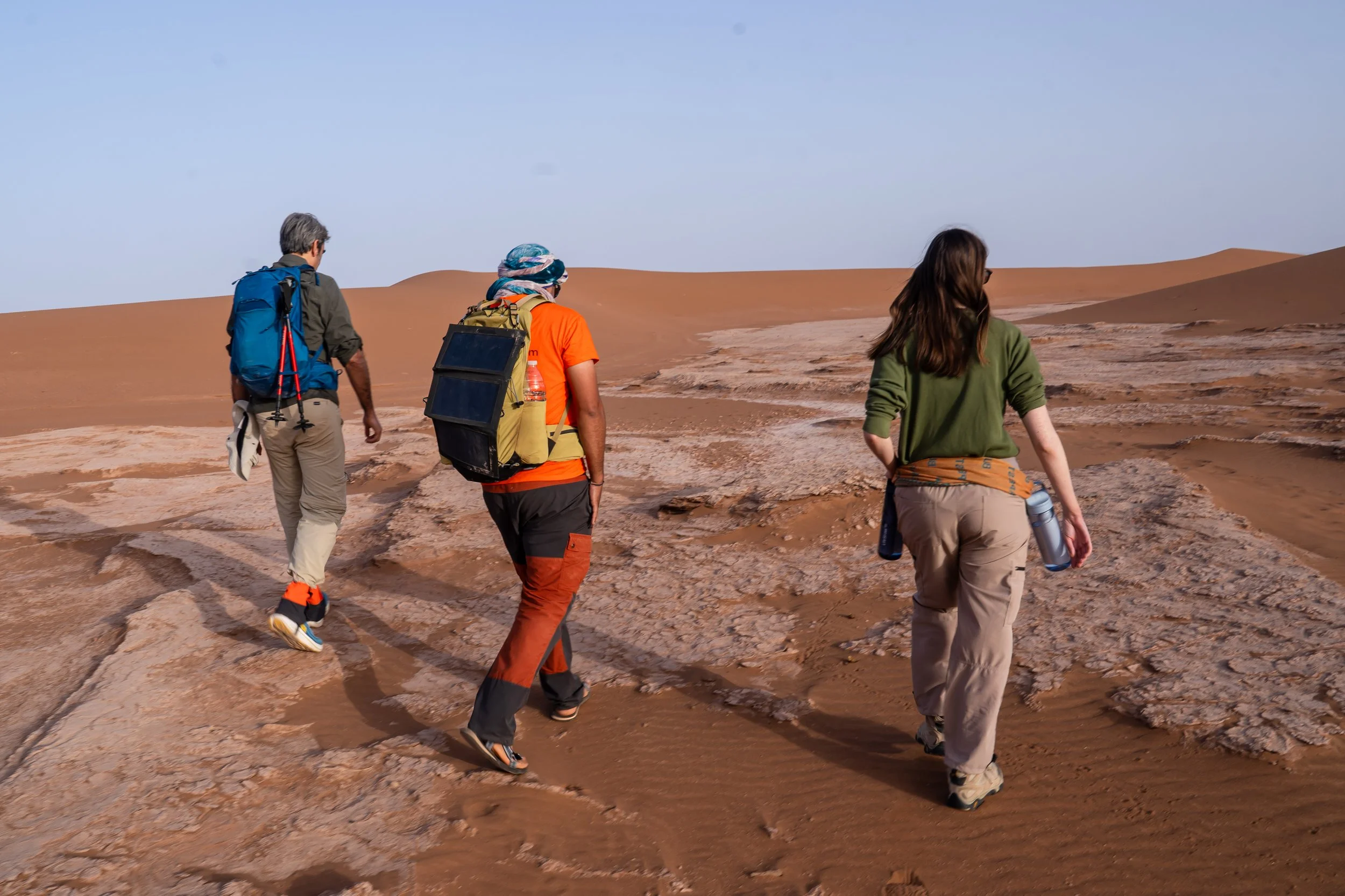
We stepped out of Oulad Driss, the village slowly fading behind us—the mud‑brick houses, the laughter of children, the tuk‑tuks rattling through narrow lanes. The air was crisp, carrying both silence and promise. Younes led the way, his stride steady, while Danni murmured softly to the beetle, her words drifting like desert wind. Each step forward felt like crossing a threshold: from the familiar warmth of the village into the vast unknown of the Sahara.
As we left Oulad Driss behind, the caravan moved steadily. In a while, we reached Bounou village, a small settlement nestled along the Draa Valley. Its mud‑brick houses rose from the desert like earthen fortresses.
In Bounou, Ven’s vigilance was unmistakable. While the rest of us paused to take in the village’s mud‑brick walls and palm‑lined alleys, Ven kept scanning the group, counting heads, making sure no one drifted too far into the bustle. He walked at the edges, guiding those who slowed, gently urging them forward with a steady hand or a quiet word. His eyes moved constantly—from the companions to the narrow lanes, from the children playing to the villagers watching us pass.
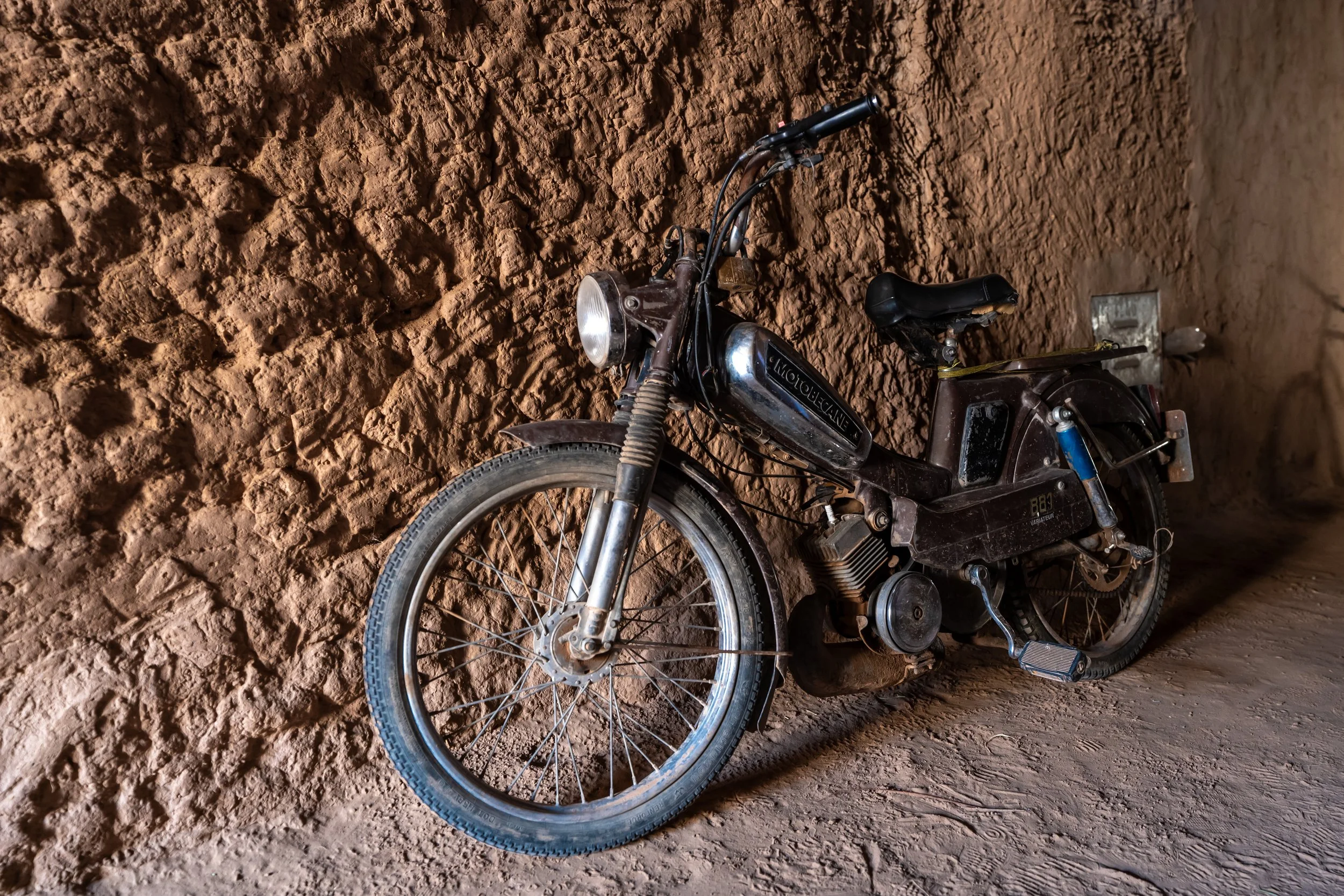
In Bounou, Younes’ warning echoed in my mind—sandbikers could strike without notice, and we needed a way to defend the beetle. As we moved through the narrow lanes, I searched for a bike.
Bounou was quieter than Oulad Driss, its mud‑brick houses standing still under the desert sun. Life moved slowly here—children played in shaded courtyards, elders sat by palm groves, and the silence of the village seemed unbroken. Finding a bike was not easy; most transport was scarce, tucked away behind walls or patched together in small workshops.
I found it—a sturdy, dust‑worn bike, patched together but reliable. Its tires bore the marks of desert roads, its frame scratched yet strong. The machine was mine to ride. In that moment, I felt prepared: if sandbikers came, I would not face them empty‑handed. The beetle’s journey would continue, guarded not only by vigilance but by speed and steel.
We had already crossed Bounou, its quiet lanes and palm‑shaded courtyards fading behind us. Ven stayed at the rear, making sure every one of us was ahead, his steady gaze confirming the group remained intact. The village’s silence gave way to the vast openness of the desert, and with Bounou behind, our steps carried us deeper into the mission’s path toward Erg Zahar.
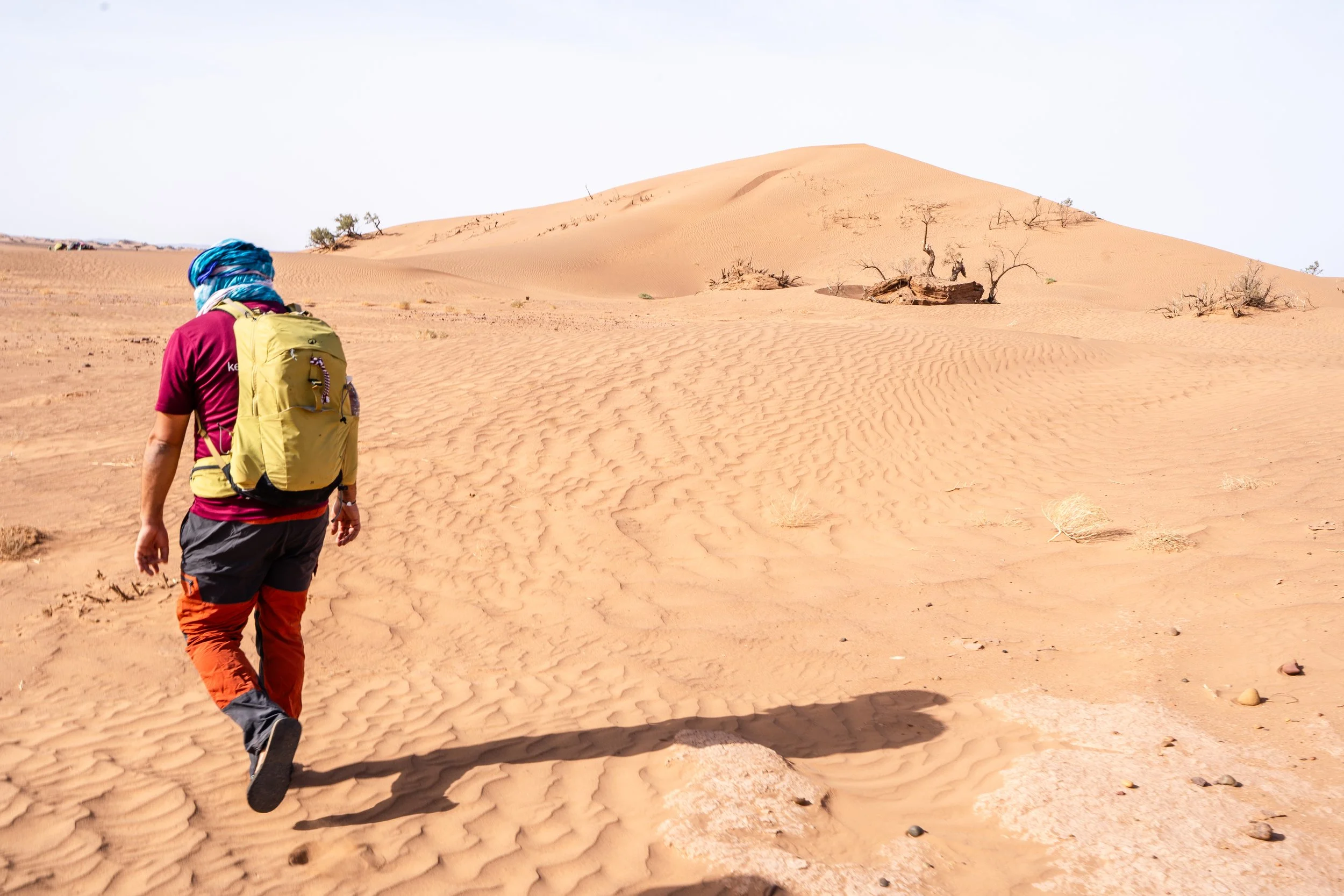
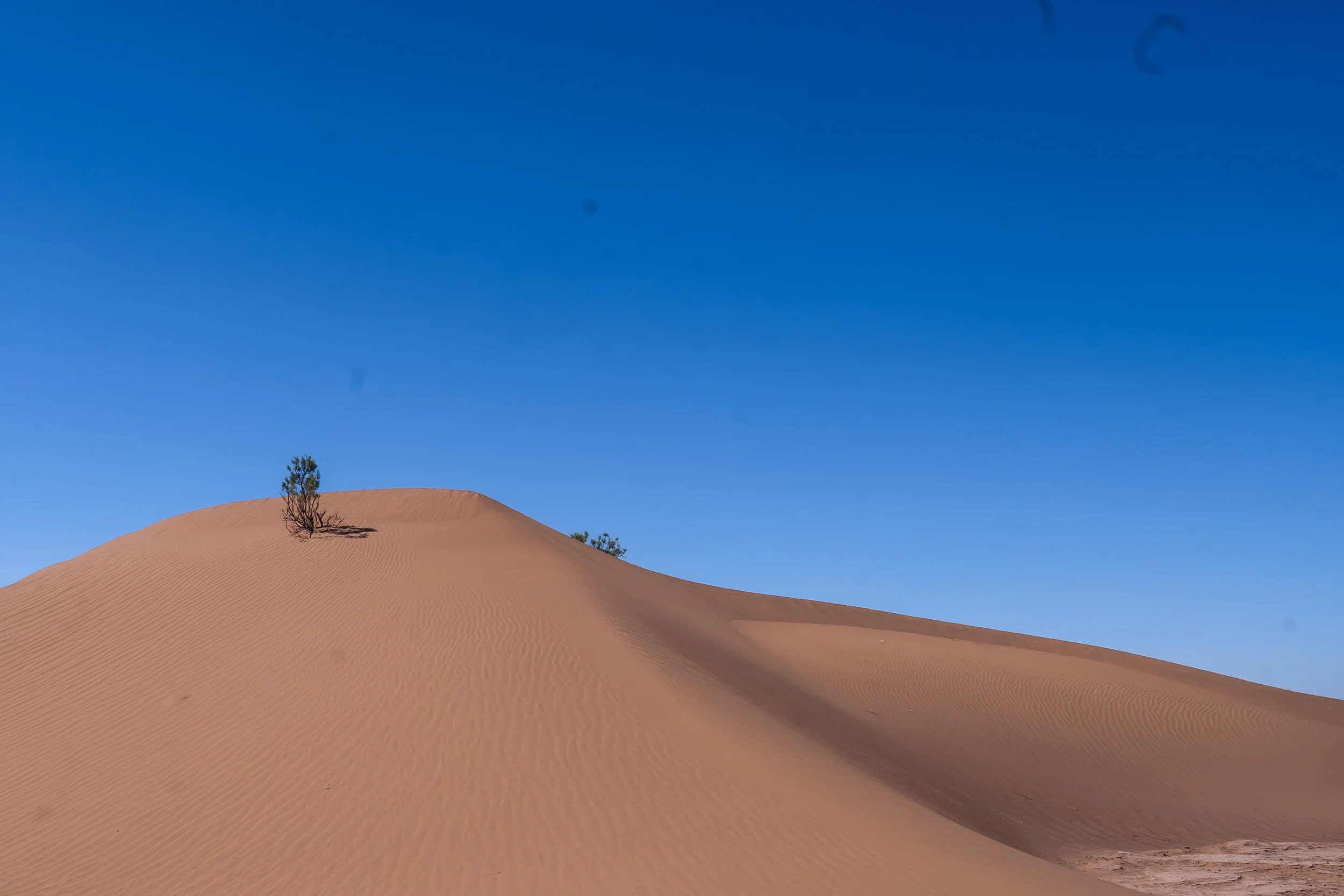
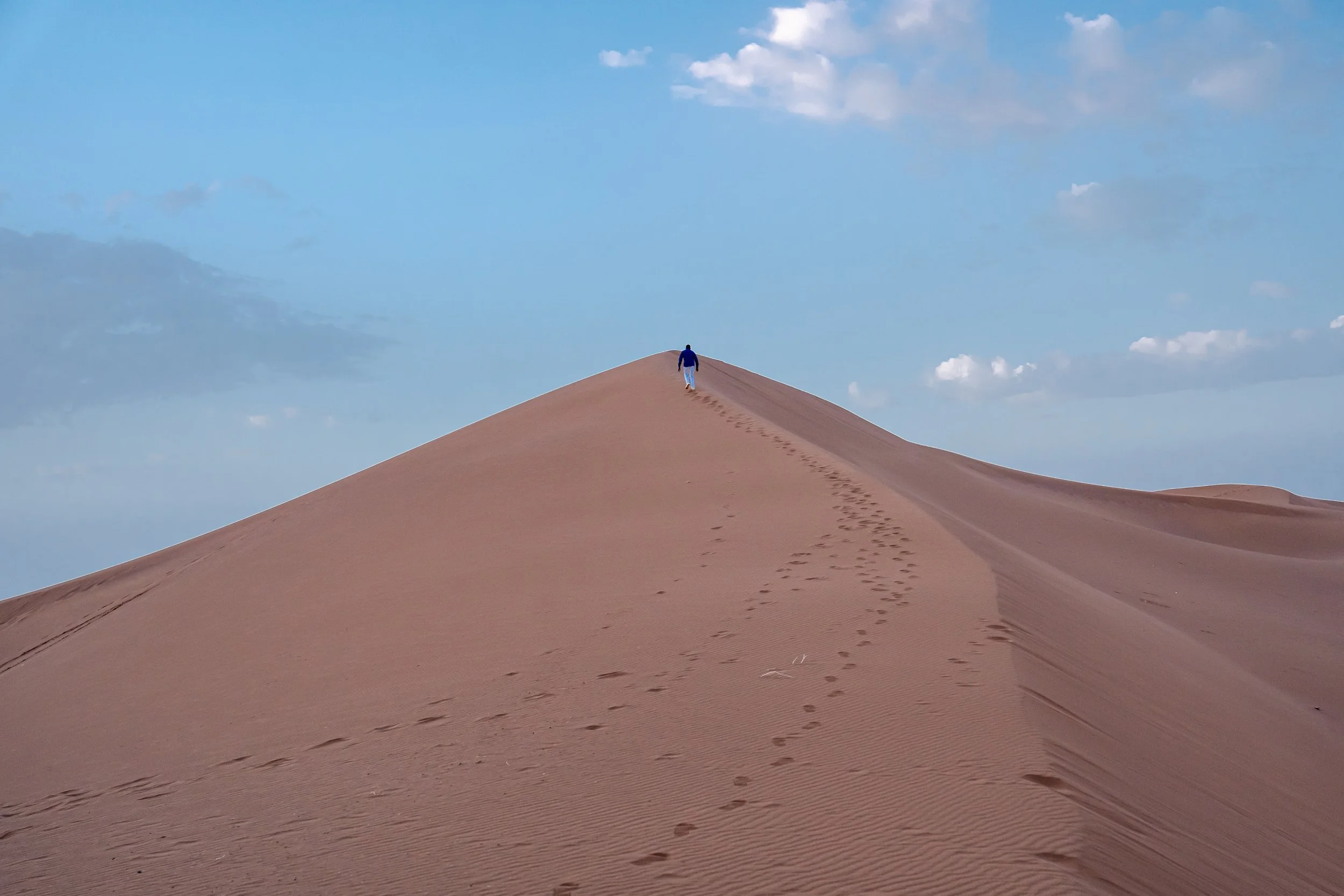
After crossing the Oued Draa, the river that threads life into the valley, the land shifted. The green palms and mud‑brick villages gave way to silence, and before us rose the first sand dune. Its golden slope shimmered under the sun, a vast wall of desert announcing the beginning of our true trek. Each step sank into the soft grains, heavier now without the river’s cool breath. The beetle remained guarded, Ven steady at the rear, Younes guiding us forward. The dune was more than terrain—it was a threshold, the Sahara’s first test, reminding us that Erg Zahar lay far ahead, hidden in the endless waves of sand.
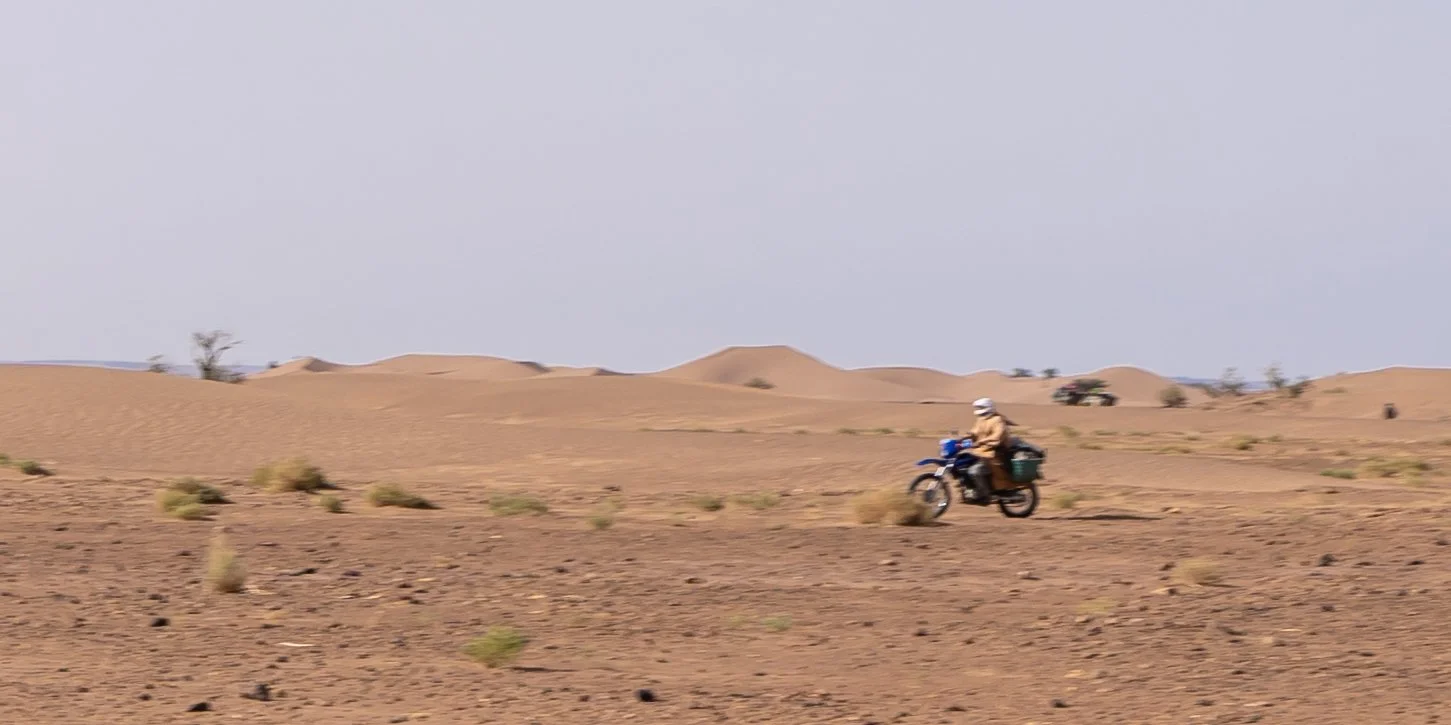
Beyond the Draa, as we climbed the first sand dune, the silence broke—the low growl of engines carried across the desert. A sandbiker appeared, his machine slicing through the grains, dust rising in his wake. The sight was sudden, sharp, a reminder of Younes’ warning. He circled like a predator, eyes fixed on the vessel that held the beetle. The group tightened instinctively, Ven steady at the rear, Danni clutching the vessel closer. My hands gripped the bike, its patched frame now a weapon of defiance. The desert, vast and indifferent, became an arena. The sandbiker’s intent was clear—he had come to take what we carried.
On the crest of that first dune beyond the Draa, the sandbiker lunged toward us, his engine roaring, dust spiraling into the sky. He circled, intent on seizing the beetle, but I met him head‑on with the bike I had claimed in Bounou. The clash was brief yet fierce—sand spraying, engines straining, the desert echoing with the fight. With a final surge, I forced him back, his machine faltering against the slope. Defeated, he turned and fled across the dunes, his roar fading into silence. The beetle remained safe, and the desert once again stretched quiet before us. It was a victory, but also a warning: the Sahara would not let us pass unchallenged.
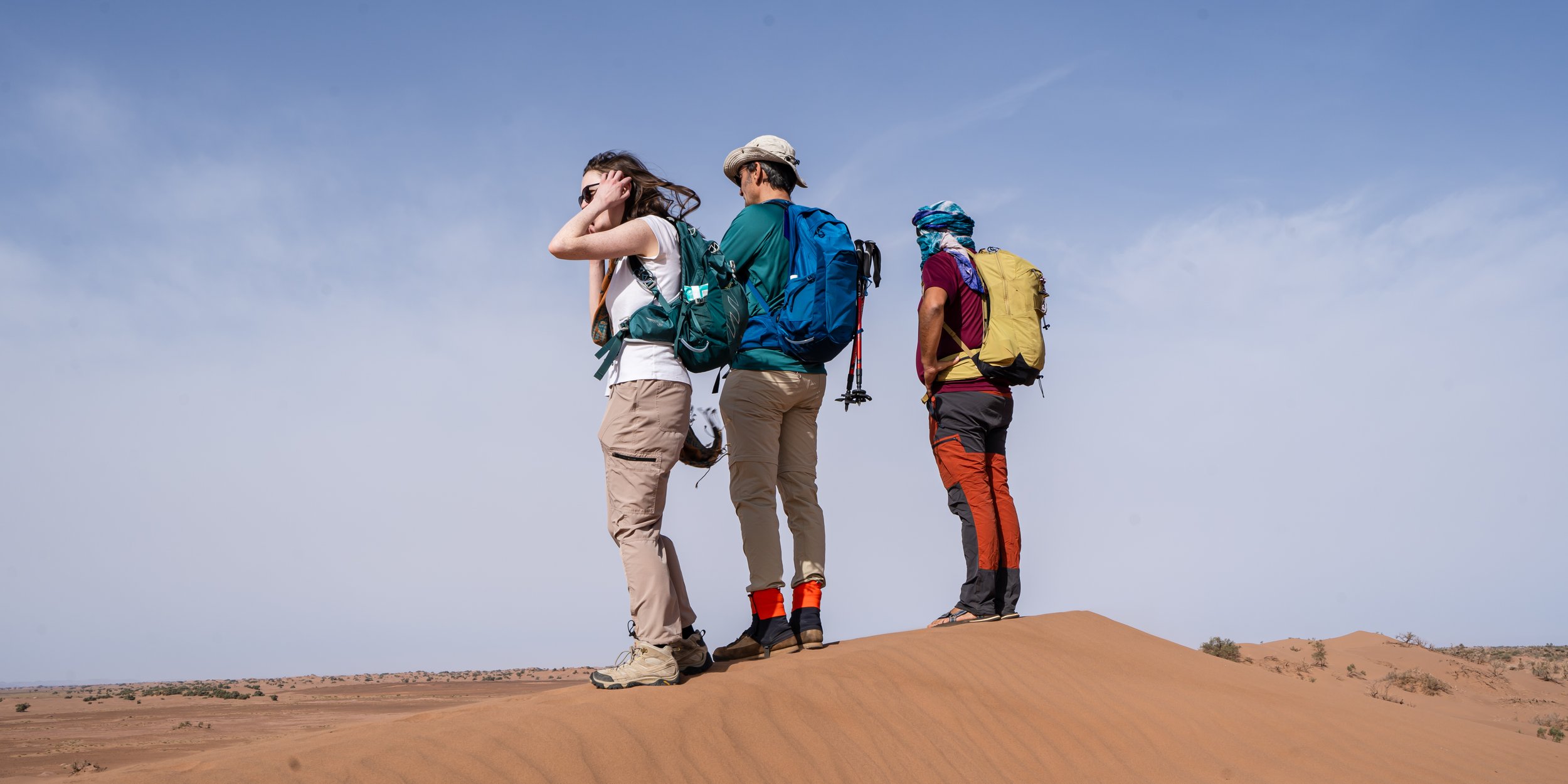
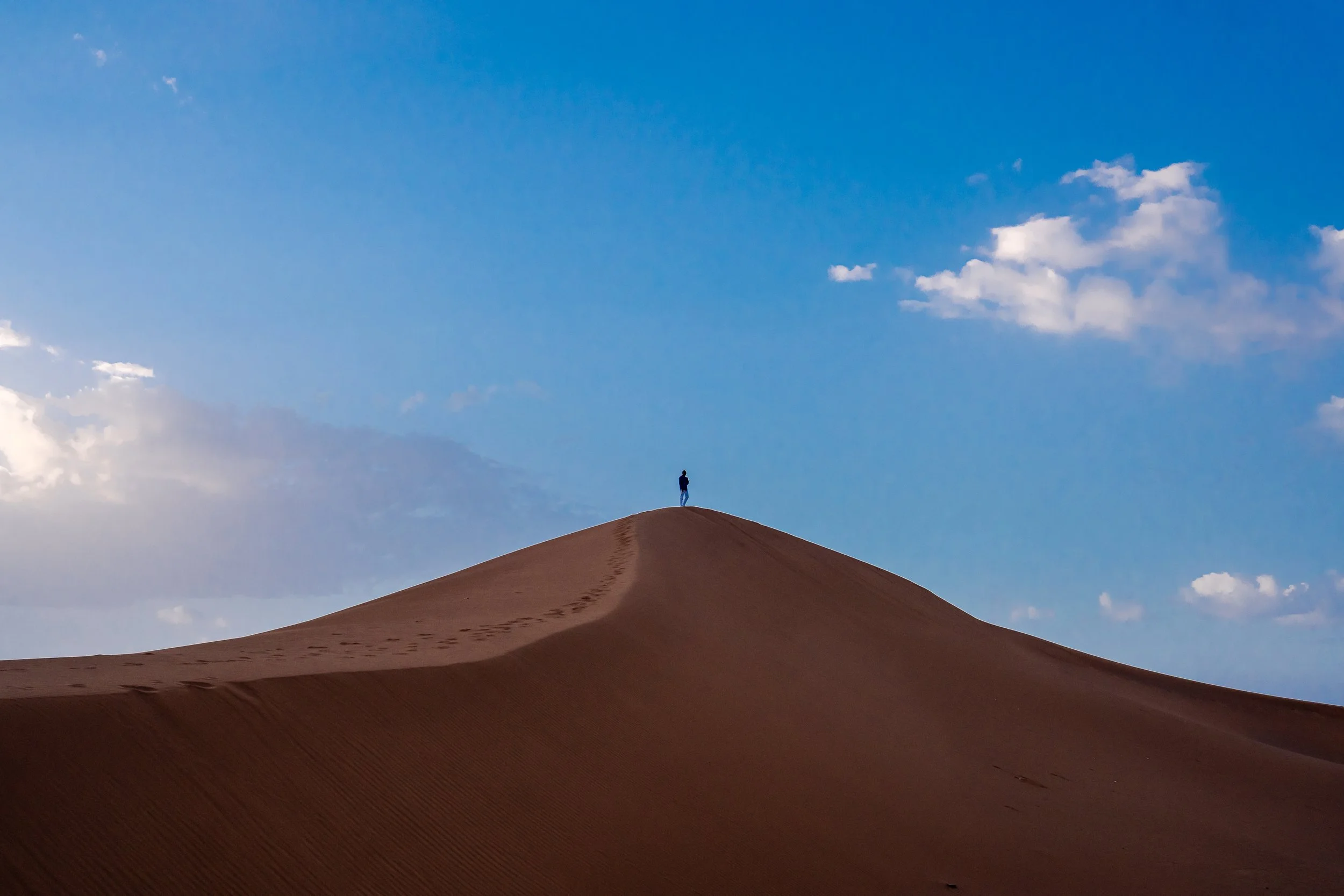
When the sandbiker finally fled, silence returned to the desert. We climbed together to the top of the first dune beyond the Draa, our breaths heavy, our steps slow. At the crest, the group paused—eyes scanning the horizon, hearts still racing from the clash. Then came a collective sigh of relief, the kind that binds companions after danger has passed. The beetle was safe, the mission intact, and for a brief moment, the vast Sahara seemed less hostile under the endless sky.
At the crest of the dune, after the sandbiker fled and our group sighed with relief, the desert gave us a gift. From behind, our own camel caravan followed faithfully, their silhouettes rising against the horizon. The handlers guided them with calm precision, and the animals moved with steady rhythm, carrying the weight of our luggages and the promise of endurance.
Their arrival was not pursuit but reassurance—our caravan had kept pace, ensuring we were never alone in the vast Sahara. With their presence, the burden lightened, and the group felt renewed strength. The mission pressed forward, guarded by vigilance, courage, and the timeless resilience of the desert’s companions.
The fight had taken my bike—it lay broken in the sand, left behind as the desert claimed it. With no wheels beneath me, I stepped back into the line of companions, joining them as we pressed forward.
The dunes gave way to rougher land, scattered with desert trees whose twisted branches reached skyward. Their sparse shade offered brief relief from the sun, and our footsteps crunched over gravel and roots. The beetle was safe among us, and though I had lost the bike, I found strength in the rhythm of the group. Together we moved onward, the Sahara testing us with every stride.
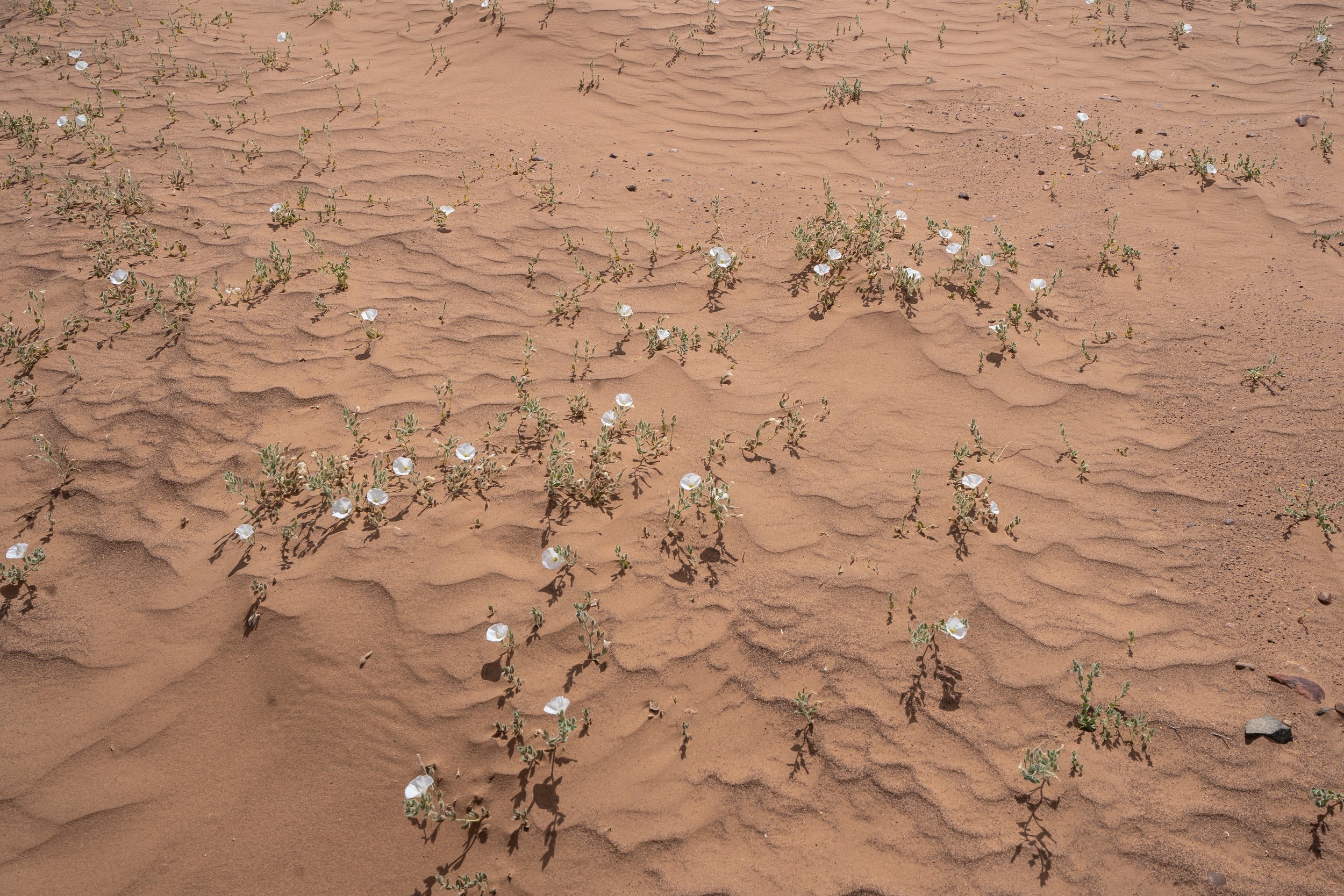
As we left the rough land behind, the desert surprised us. Not just one bloom, but a scatter of white desert flowers stretched across the plain. Their petals gleamed against the sand, fragile yet defiant, swaying lightly in the dry wind.
We slowed our pace, the group drawn to the sight. After the fight and the loss of my bike, joining the others felt complete here—among these blossoms that spoke of resilience. Each flower seemed a reminder that even in the harshest soil, life insists on beauty. Together we walked on, the mission steady, the desert unfolding in unexpected grace.
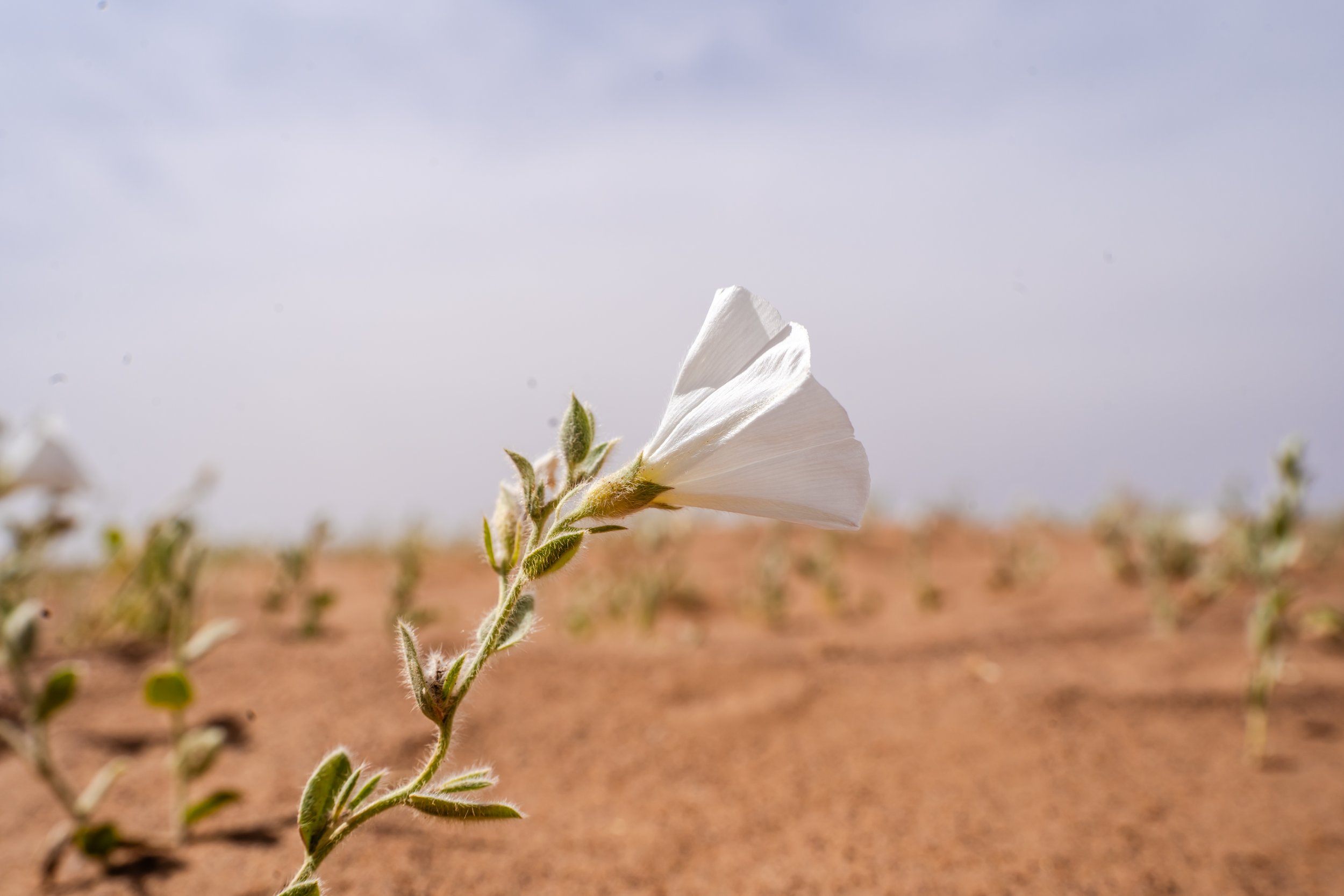
Yet, amid the multitude, one flower drew my gaze. It stood slightly apart, its stem bent but unbroken, petals pure and luminous in the harsh light. The group pressed forward, but I carried the image of that lone bloom with me, a symbol of survival and hope amid the desert’s trials.
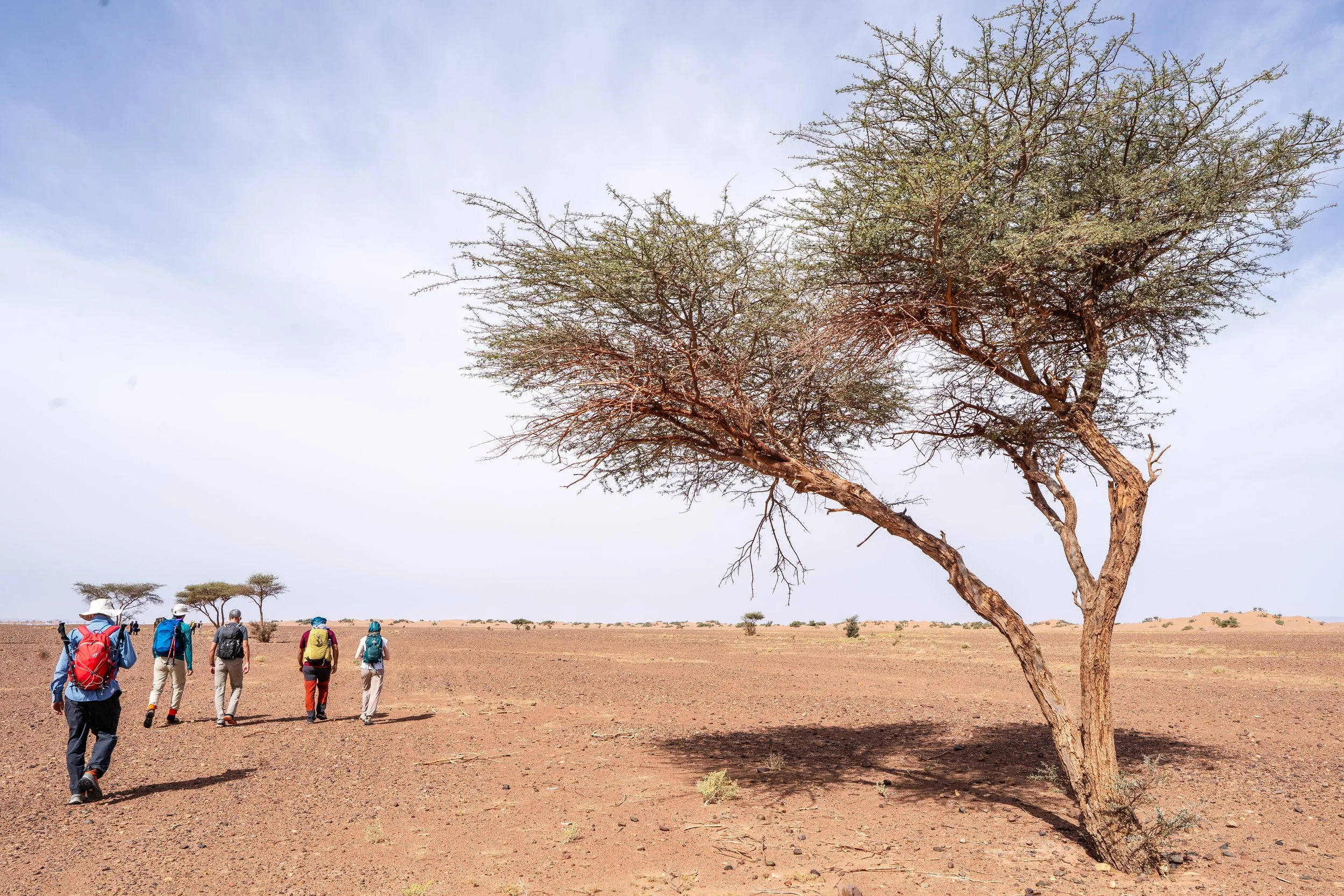
After the fight and the long walk across rough land, my bike lost to the sands, I stayed close with the group. The dunes had faded behind us, and scattered desert trees marked the plain. Their twisted branches stretched wide, offering rare patches of shade.
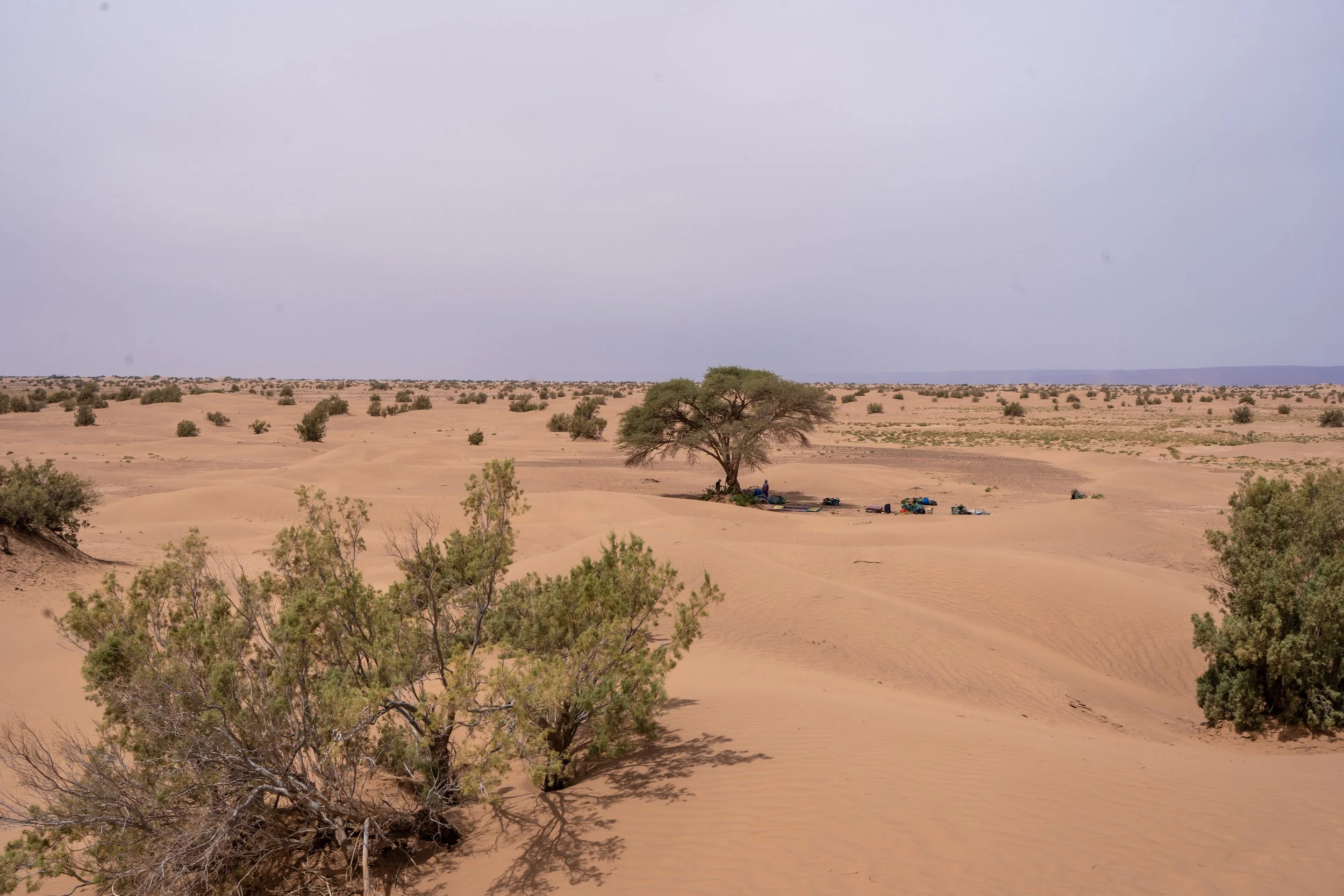
We came to one such tree and paused, grateful for its shelter. Beneath its canopy, the air cooled slightly, the harsh sun softened. The group settled into the shade, breaths steadying, the beetle safe among us. For a moment, the desert’s trials eased—the silence broken only by the rustle of dry leaves above.
The camels reached us. Their loads held sacks of grain, vegetables —raw materials for our lunch. Each step they carried was a promise of sustenance, their endurance a lifeline in the barren land.
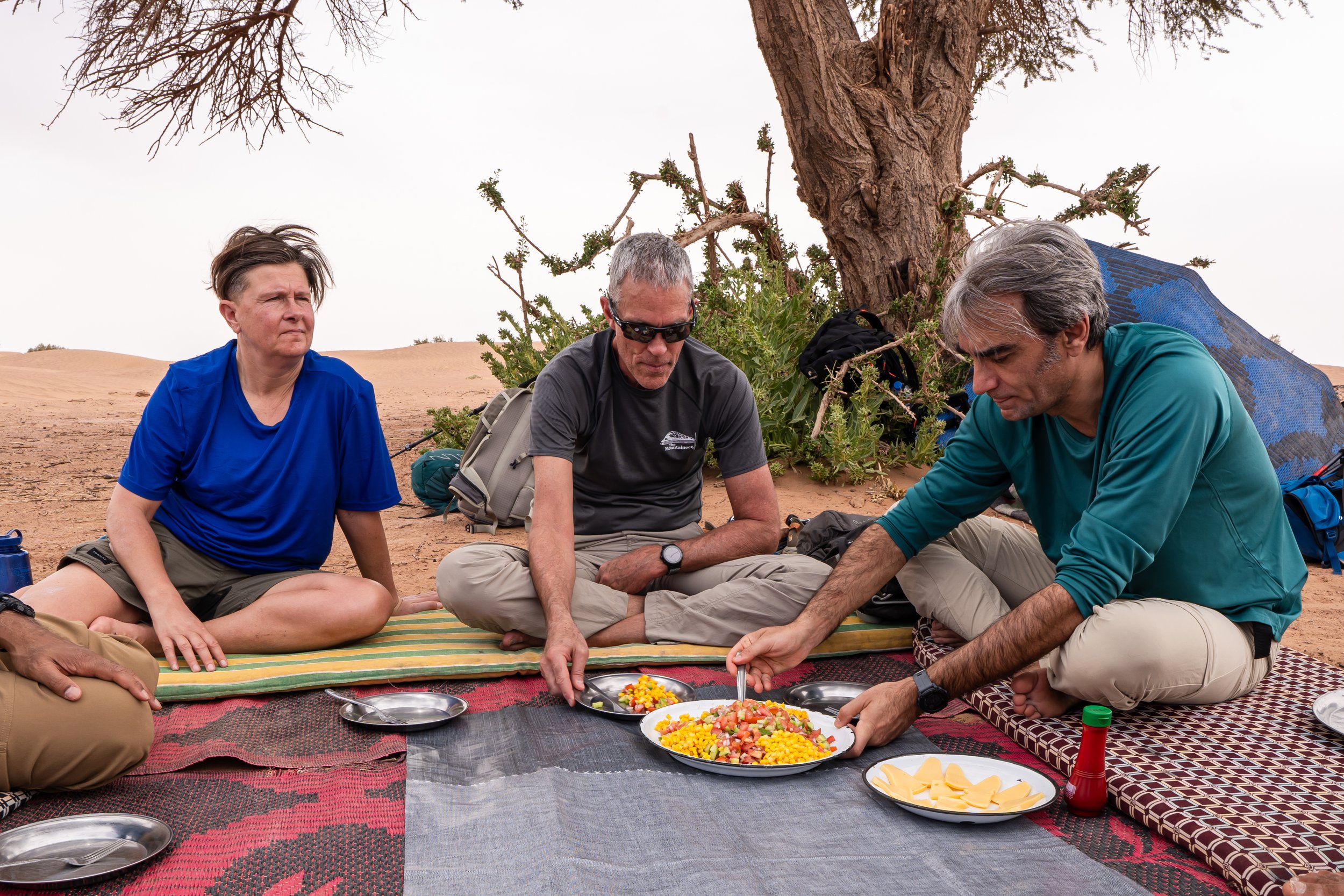
Under the wide canopy of the Tamarisk tree, we found shelter from the desert sun. Its branches spread like a veil, casting cool shade over the rough ground where we settled. The handlers unpacked the bundles, and prepared lunch. It was a simple lunch, yet beneath the Tamarisk tree it became a moment of renewal, a pause of strength before the journey pressed onward.
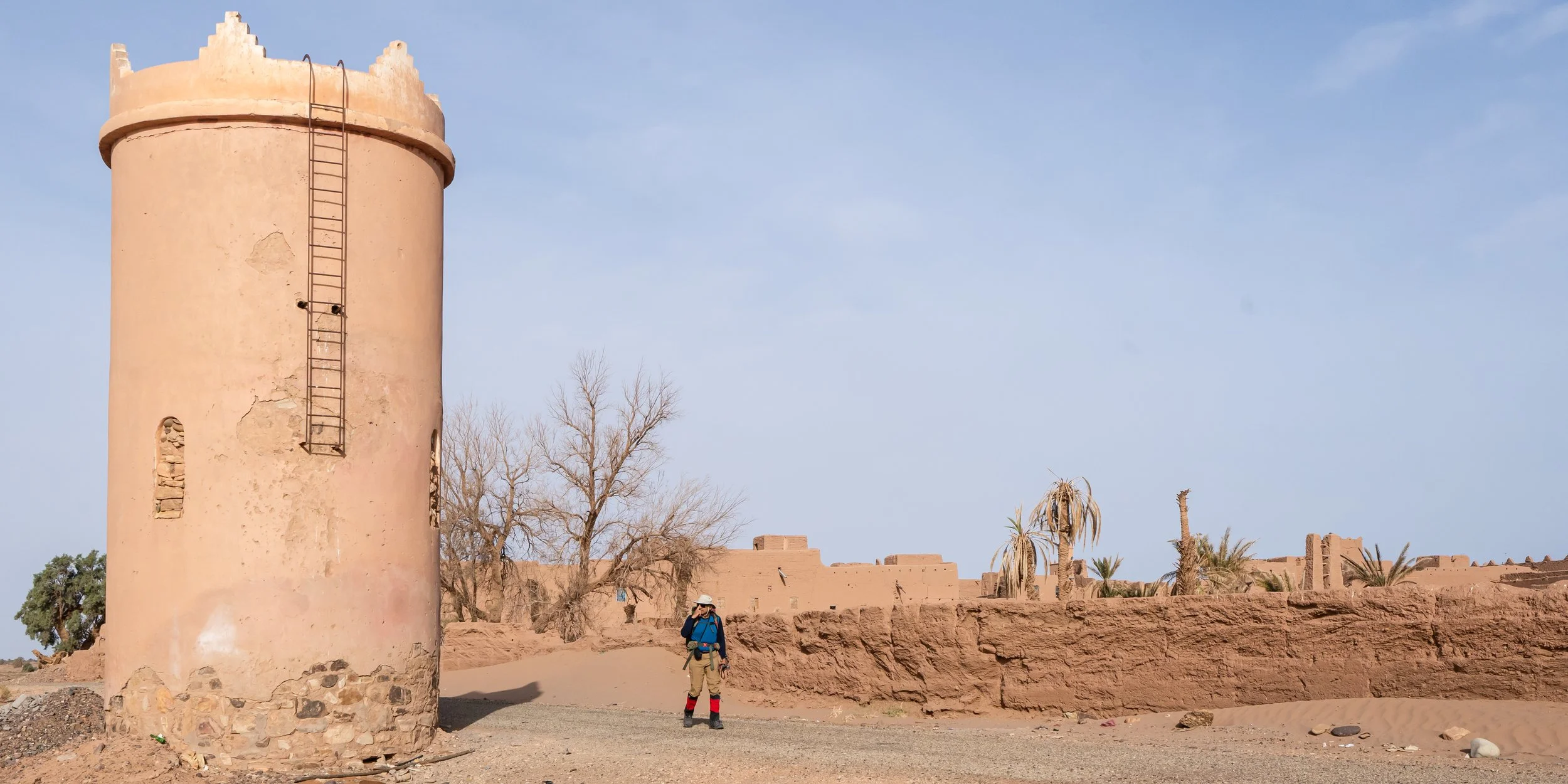
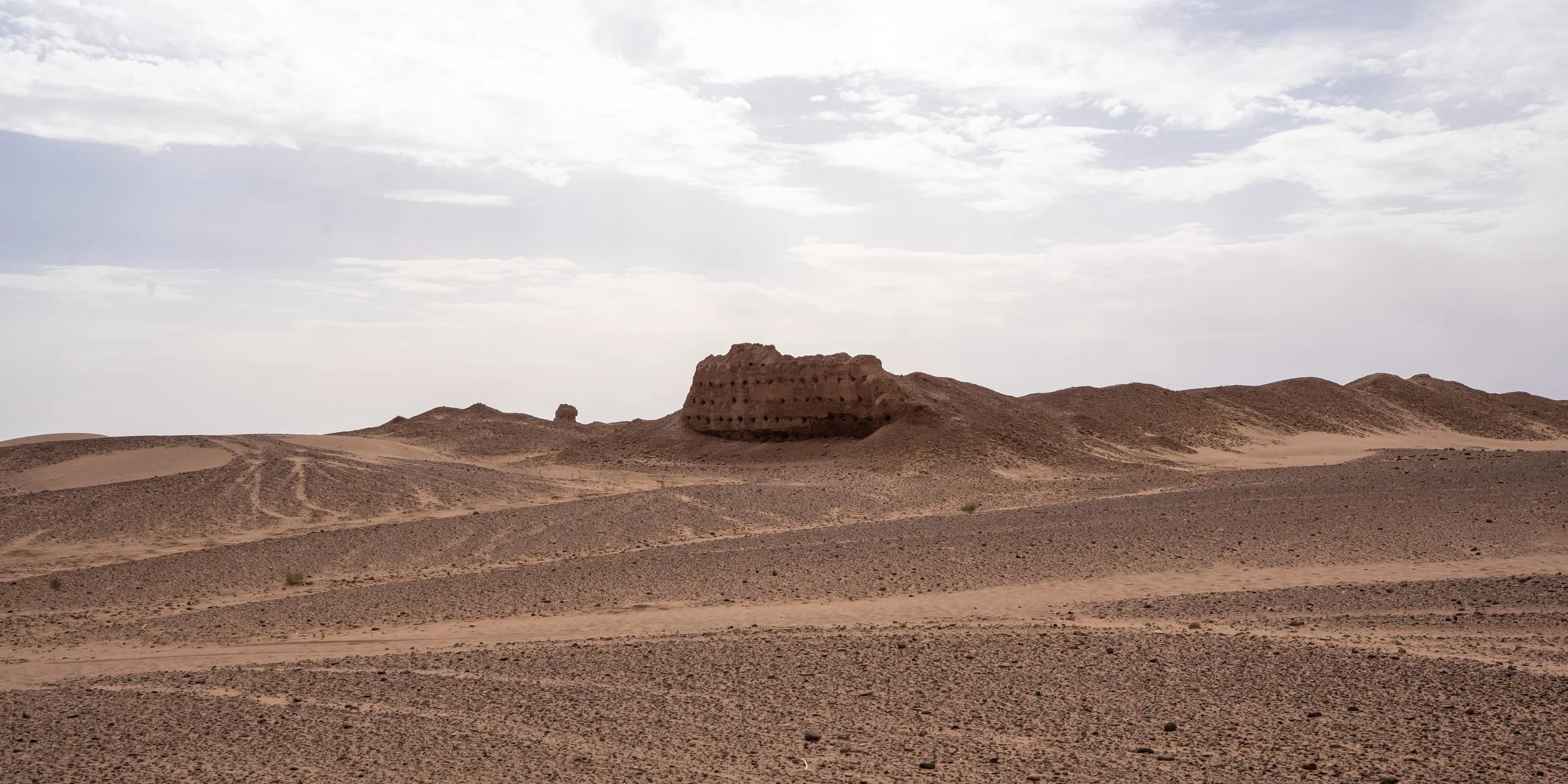
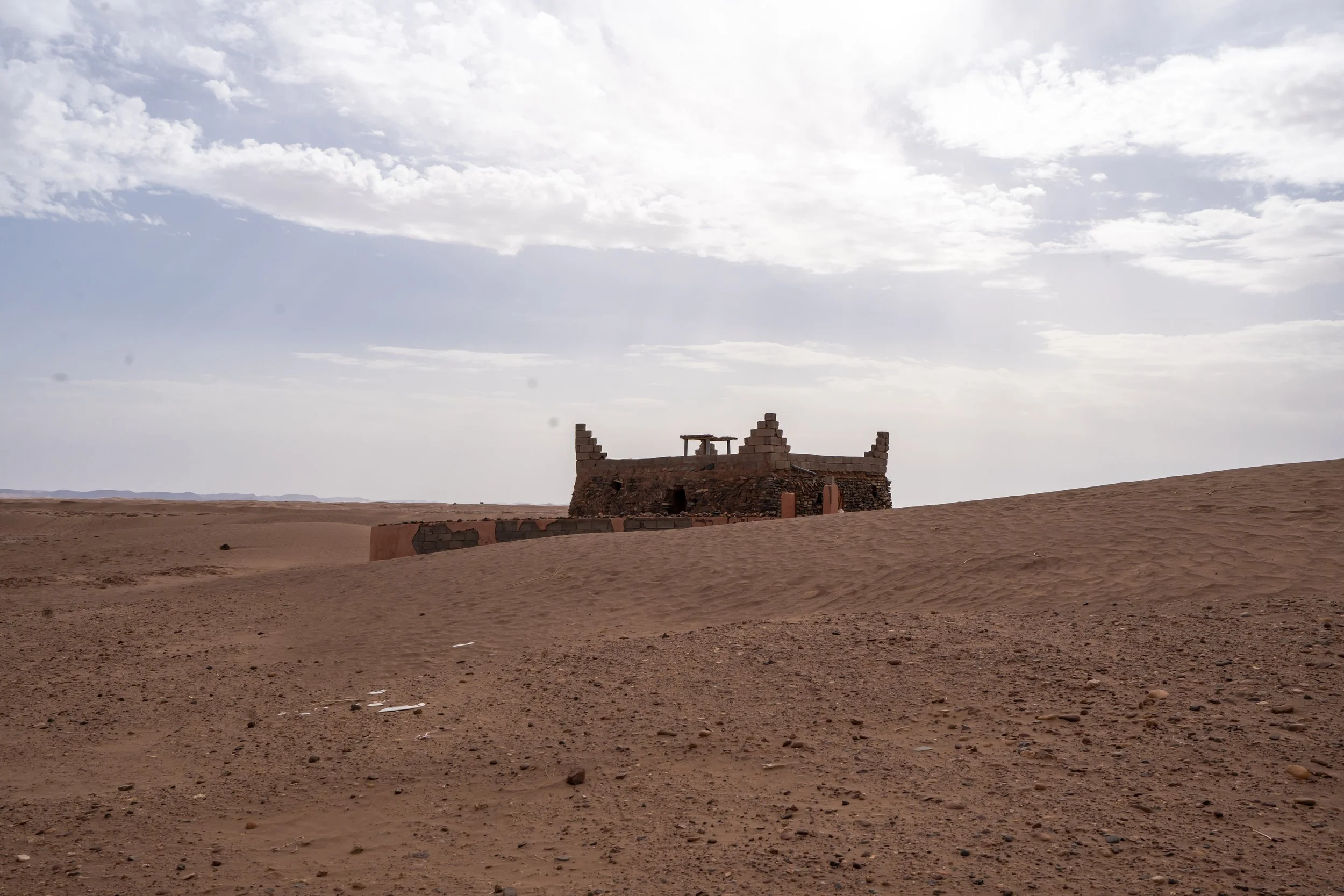
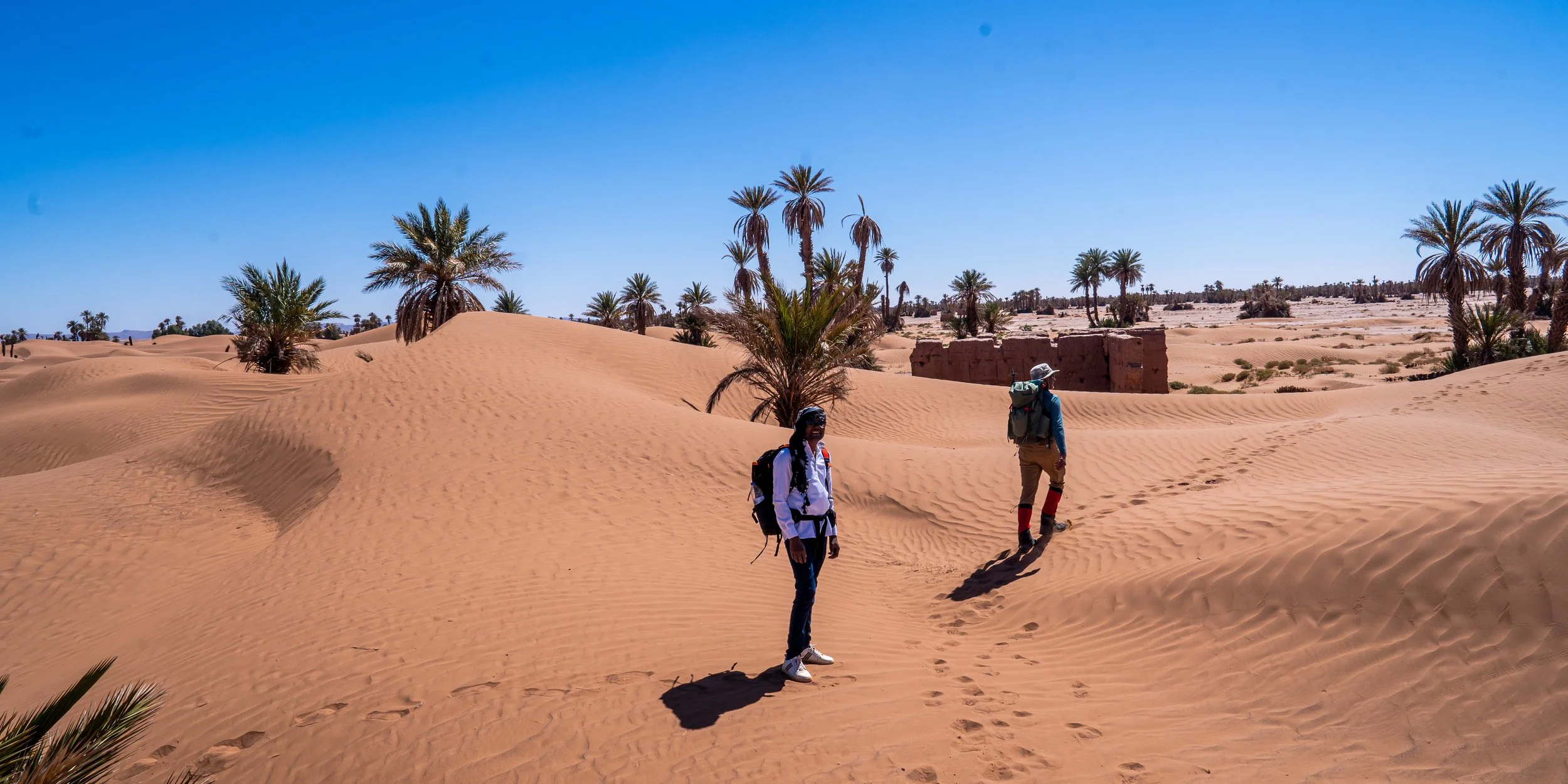
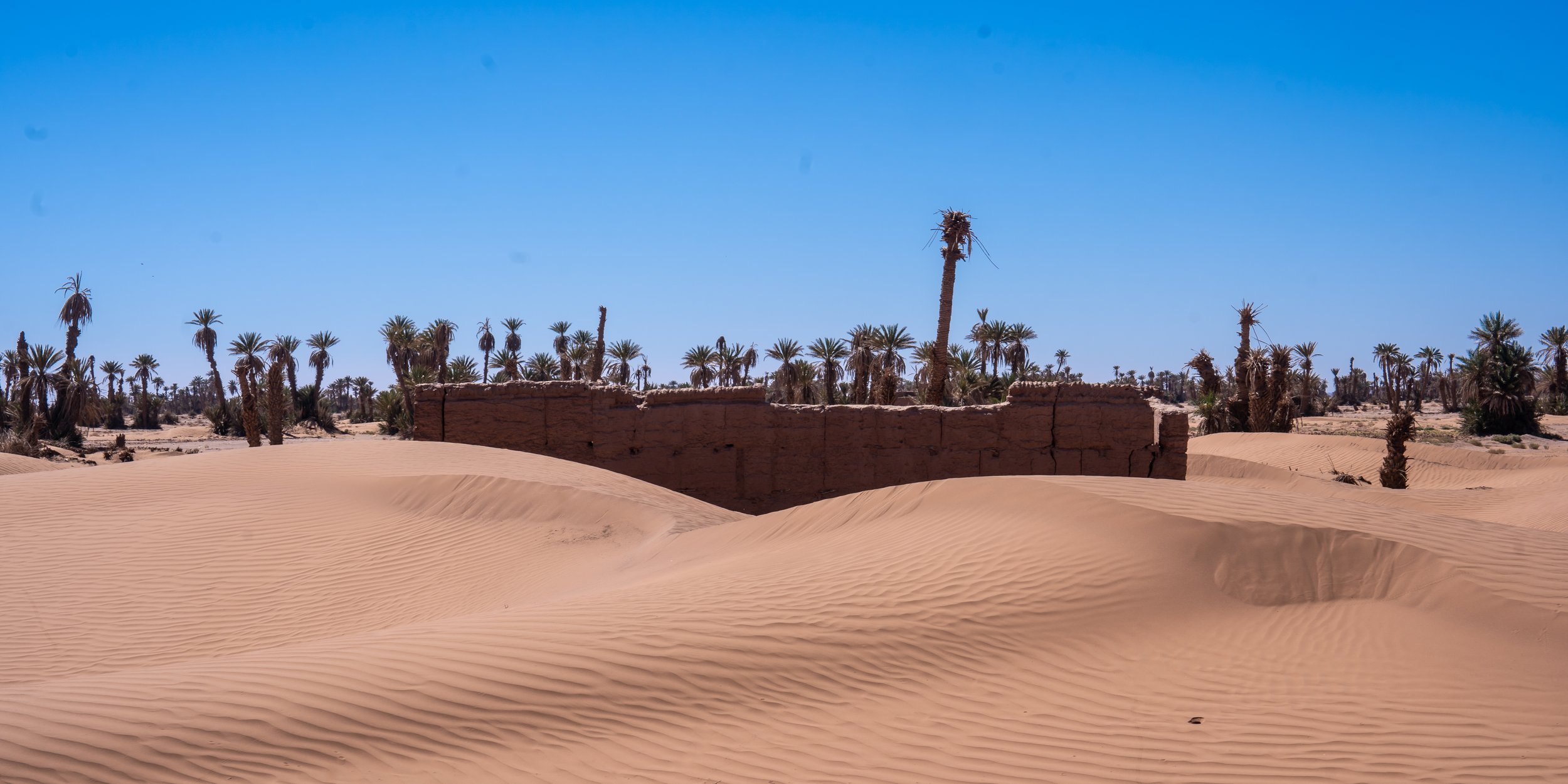
After our lunch beneath the Tamarisk tree, we pressed onward across the rough land. The desert stretched wide, its silence broken only by the crunch of our steps and the steady rhythm of the camels. Then, rising from the sands, we saw it—a weathered structure of clay and stone, scarred by time yet still standing. Its walls were pierced with openings, like watchful eyes gazing across the barren plain. The ruin seemed both fragile and eternal, a reminder that even here, where the desert erases most traces of life, human hands had once built and endured.
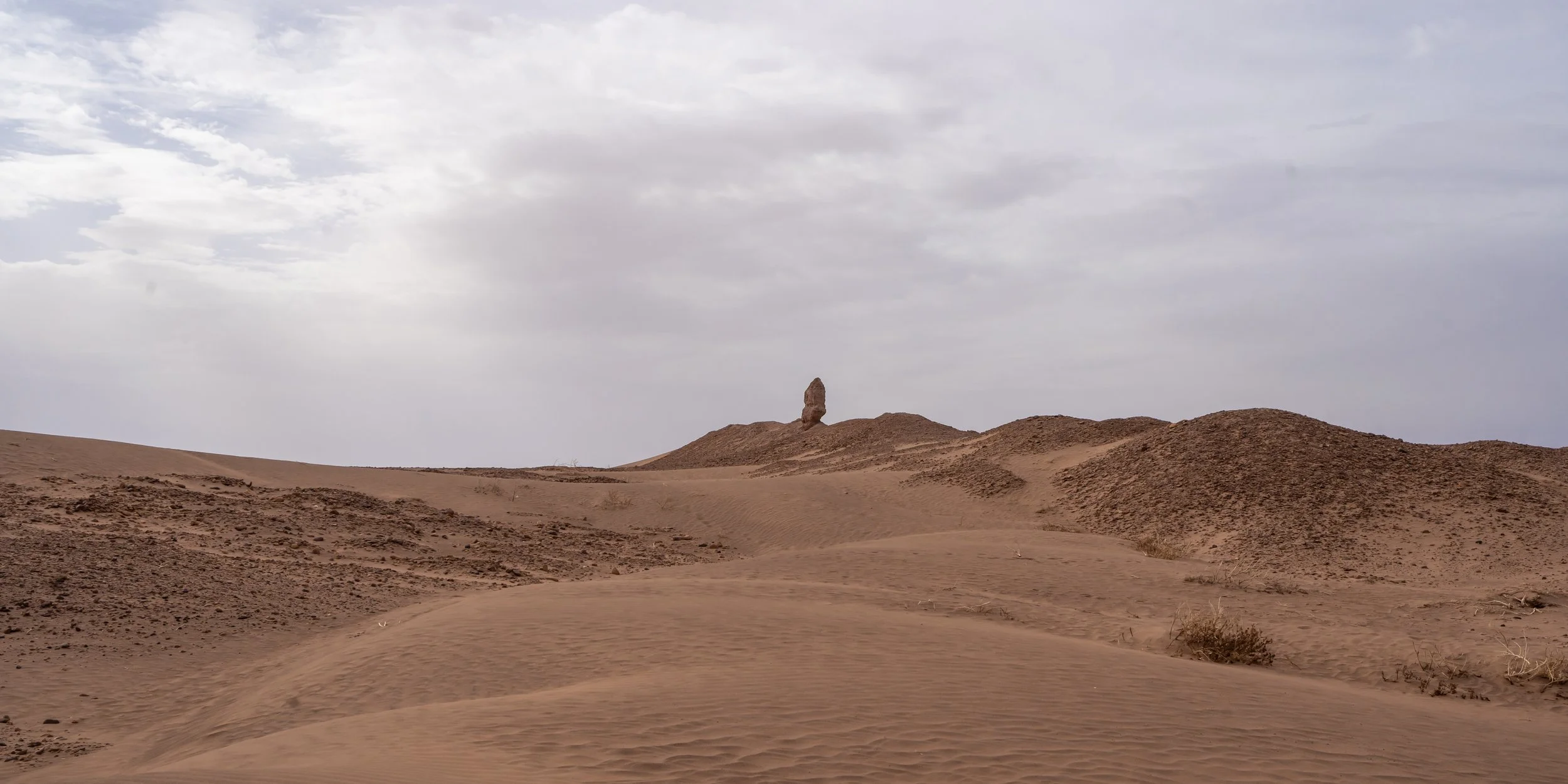
After leaving the ruins behind, our path led us deeper into the dunes. The sky grew muted, clouds filtering the light, and the land stretched in silence. Then, rising from the sandy plain, we saw it—a solitary vertical rock formation, tall and defiant against the smooth terrain. It stood like a sentinel, shaped by wind and time, its presence commanding in the emptiness.
We reached the tomb of Sidi Naji, its clay walls rising solemnly from the desert sands. Weathered by time yet dignified, it stood as a place of reverence, carrying centuries of memory. The group slowed in silence, aware that this was more than a landmark—it was a sacred pause in our journey, a reminder of faith and endurance in the vast Sahara.
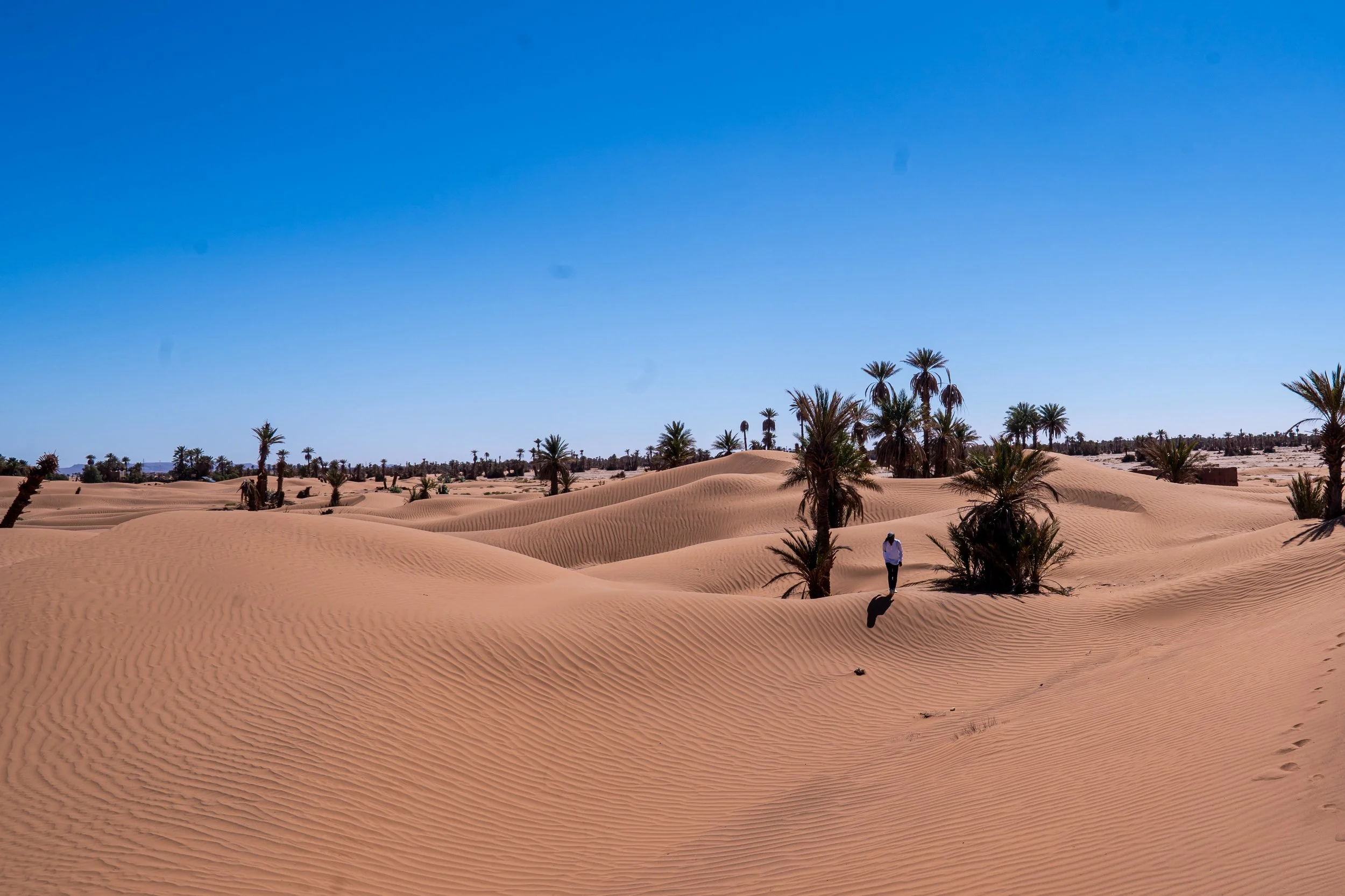
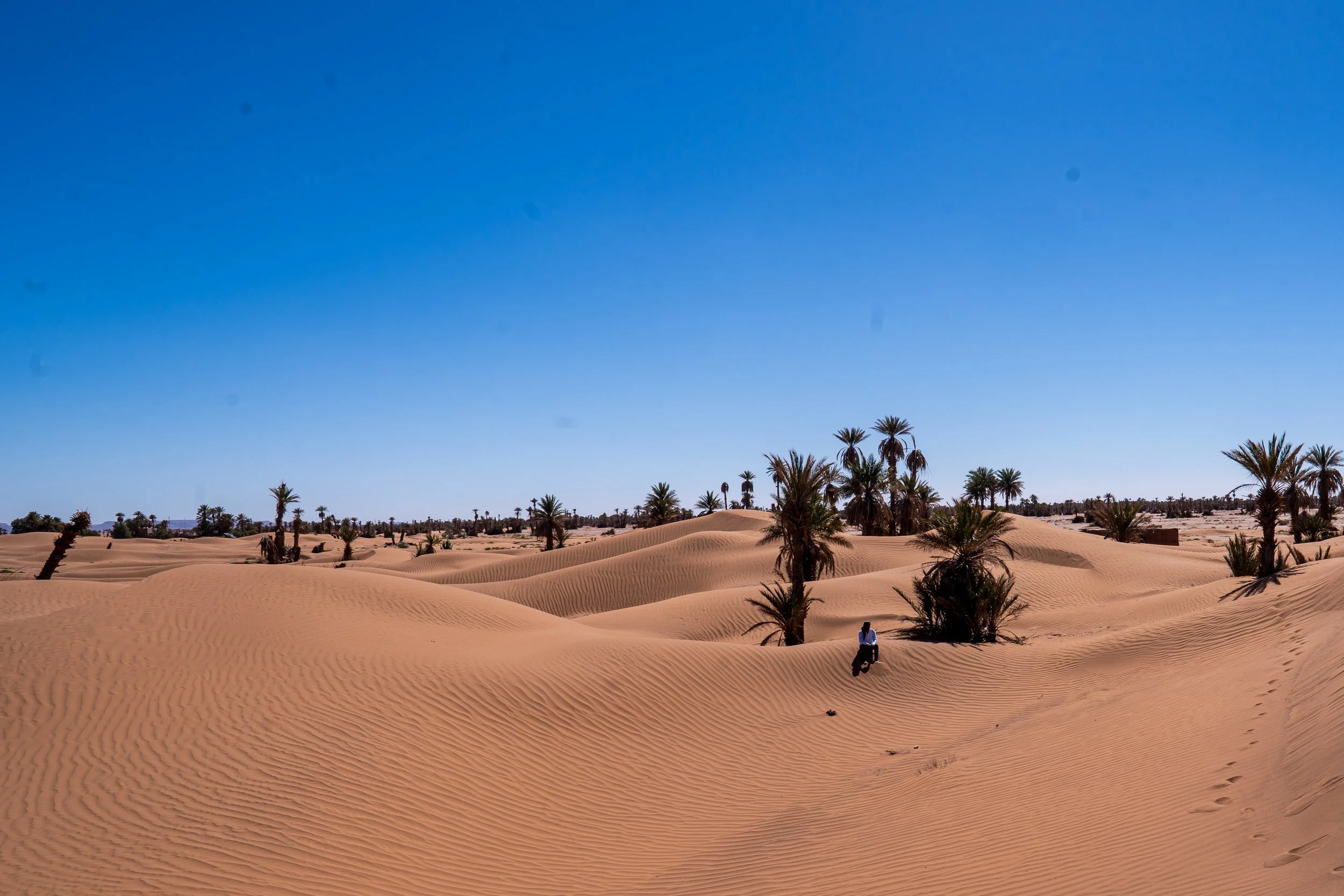
A little further, we reached the sand dunes, their curves glowing softly under the muted sky. The camels settled, and the group chose this place to stop for the day. In the quiet of the desert evening, Younes prepared green mint tea.
The steam rose from the pot, carrying the sweet scent of sugar and fresh leaves. We gathered in a circle, cups in hand, and as tradition guided us, we poured from high to raise bubbles, then said “B’Saha” before sipping.
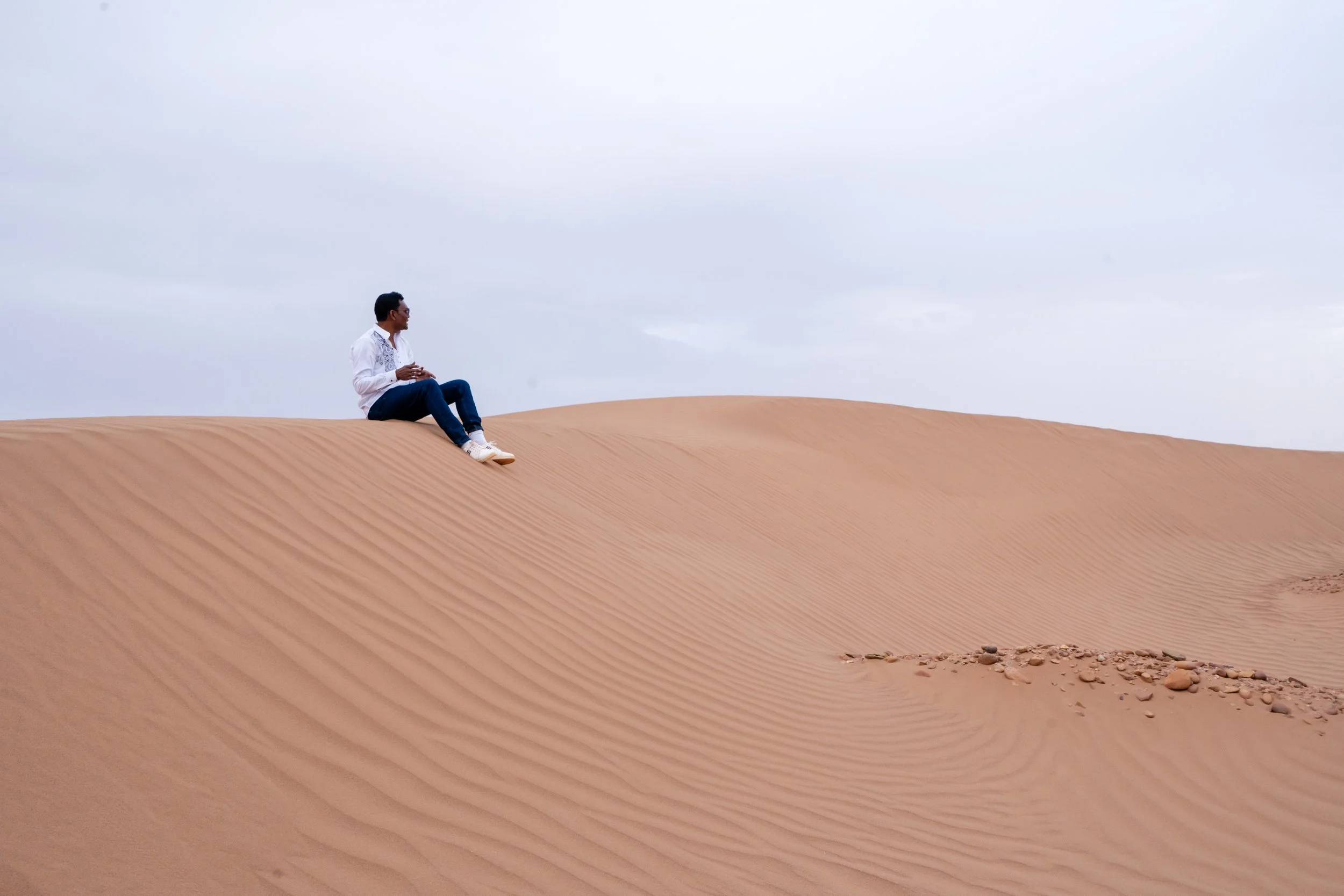
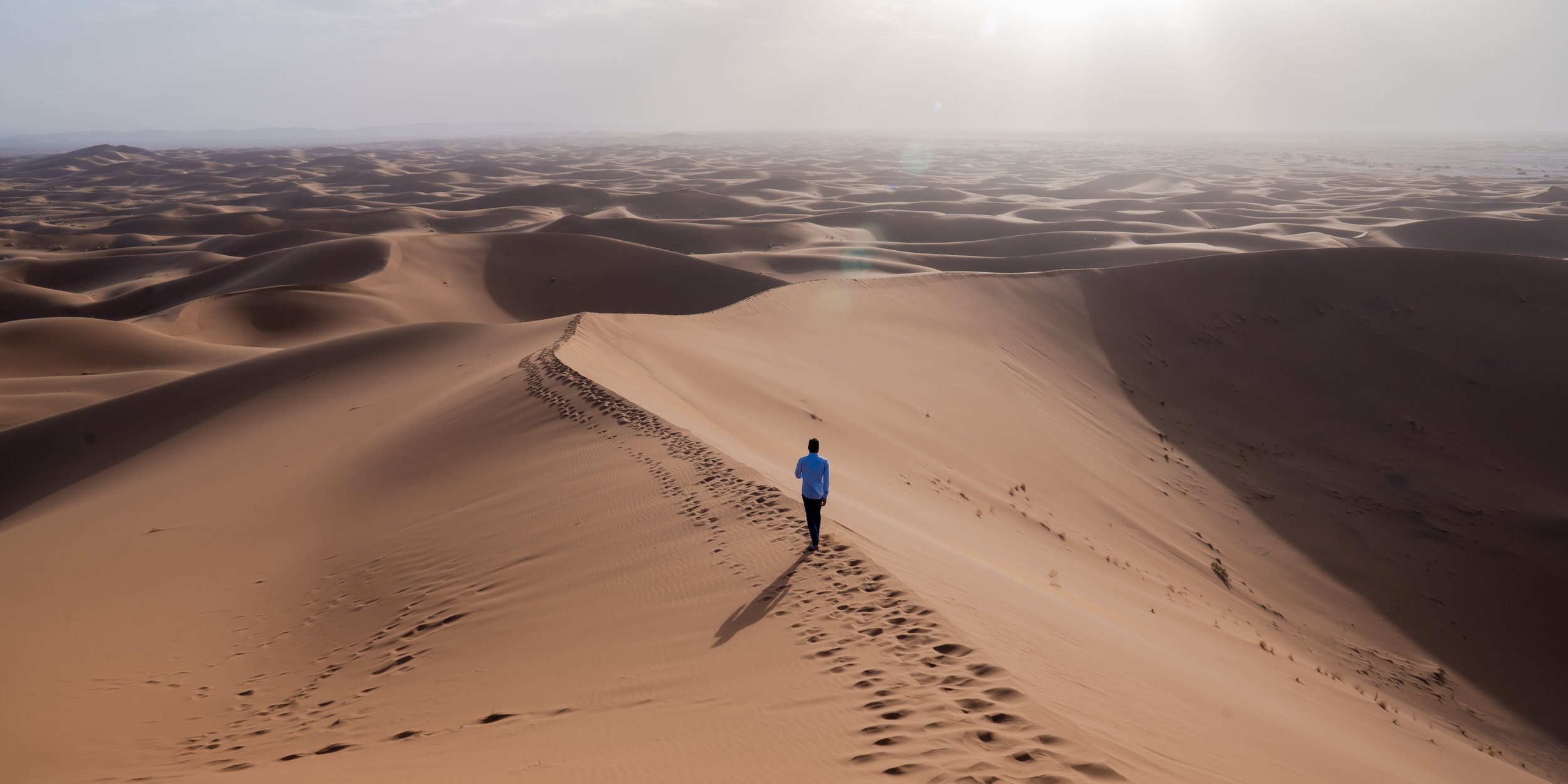
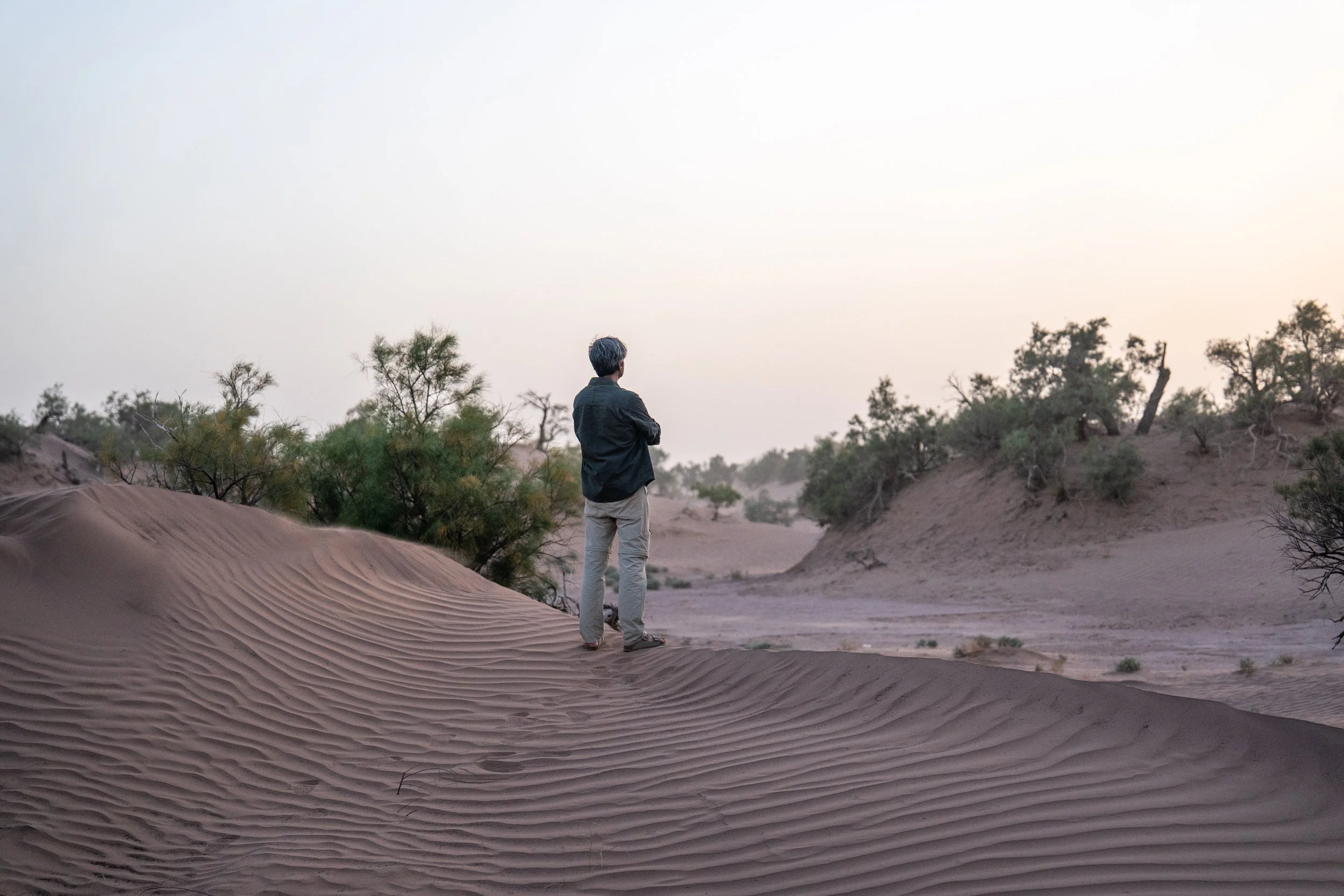
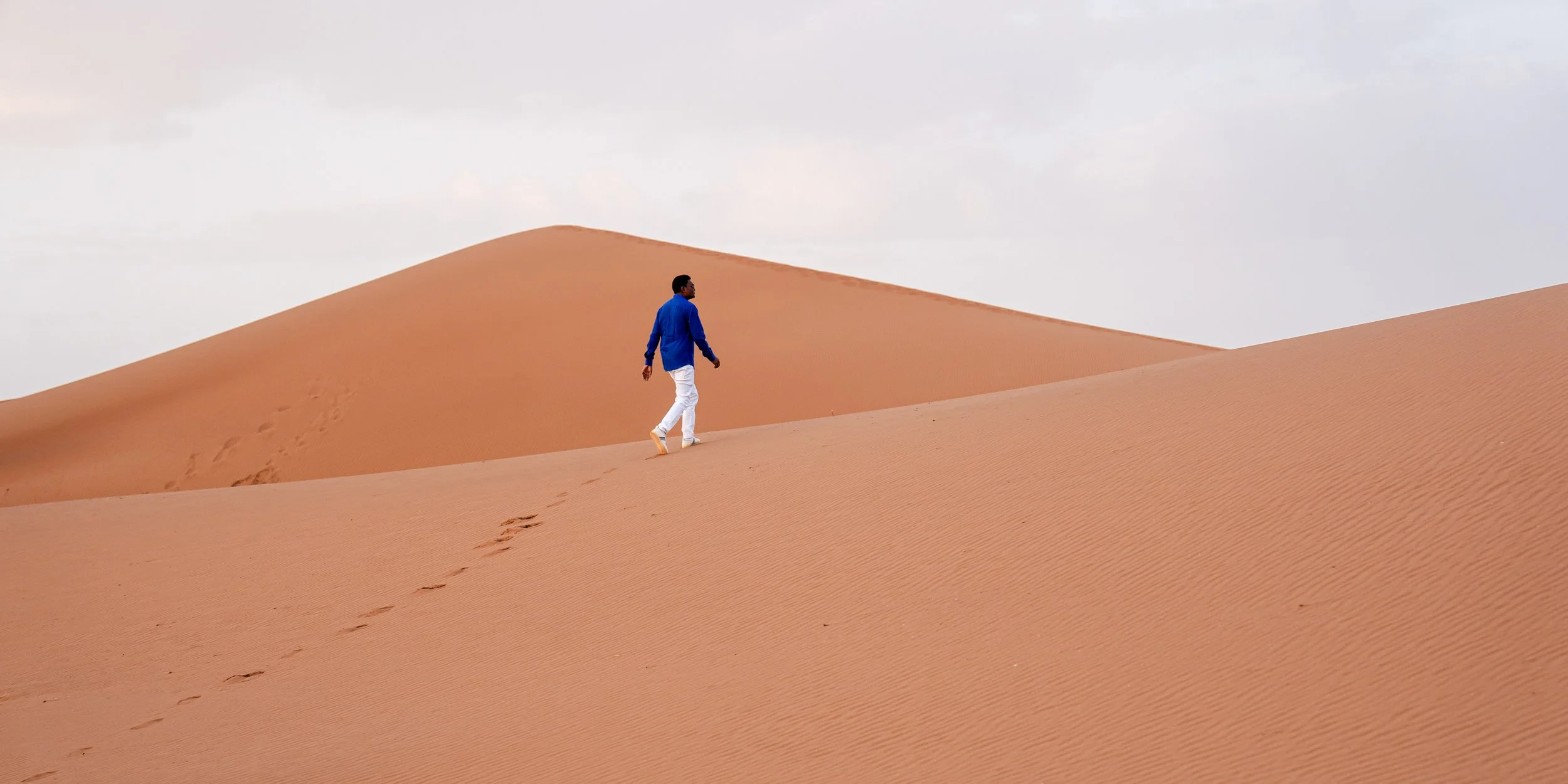
In the evening, I climbed to the top of the sand dune. The desert stretched endlessly, its curves glowing under the fading light. As the sun sank toward the horizon, the sky turned shades of gold and crimson, casting long shadows across the dunes. From that height, the silence felt deeper, the vastness more profound. The day’s struggles—the fight, the lost bike, the long march—seemed distant. Watching the sun set over the Sahara, I felt both small and infinite, a traveler carried by the desert’s timeless rhythm.
After watching the sun sink behind the dunes, I descended slowly, the sand cool beneath my feet. The desert had fallen into silence, its vastness wrapped in twilight. Our campfire flickered faintly in the distance, guiding me back. I reached our tent, its fabric swaying gently in the evening breeze. Inside, the group was already gathered, the beetle safe, the camels resting nearby. The day’s journey—flowers, ruins, dunes, and tea—now folded into memory. In the quiet of the tent, I felt the desert’s rhythm settle, preparing us for what awaited tomorrow.
The next morning, we rose early in the desert camp. The camels were loaded with supplies, and the handlers checked the bundles of grain, water, and tents. The air was cool, the dunes glowing faintly under the first light. Younes reminded us that the trek ahead would be long and demanding. Erg Zahar awaited—a vast sea of sand, shifting and endless. We tightened our scarves, adjusted our packs, and gathered in silence. The beetle was safe, the mission intact, and with the desert stretching before us, we prepared to step into the heart of the Sahara.
As the day unfolded, the dunes shifted in color. What began as pale yellow slowly deepened, glowing into a rich reddish hue under the desert sun. The Sahara seemed alive, its sands burning with light, each crest and slope transformed into waves of fire. The camels moved steadily across this vast sea, their shadows stretching long. For us, the changing dunes were more than scenery—they were a sign of the desert’s living spirit, reminding us that every step carried us deeper into its timeless rhythm.
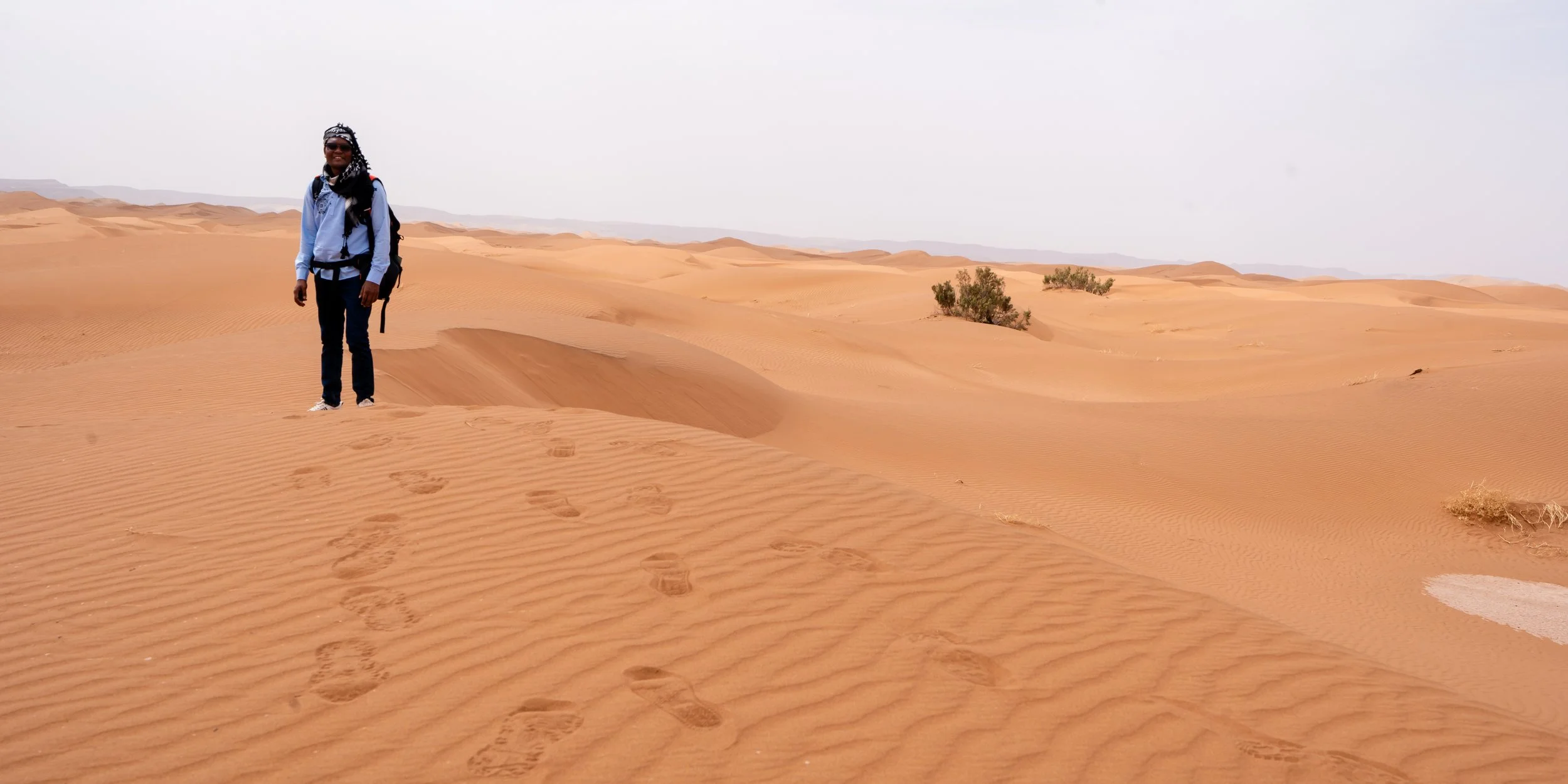
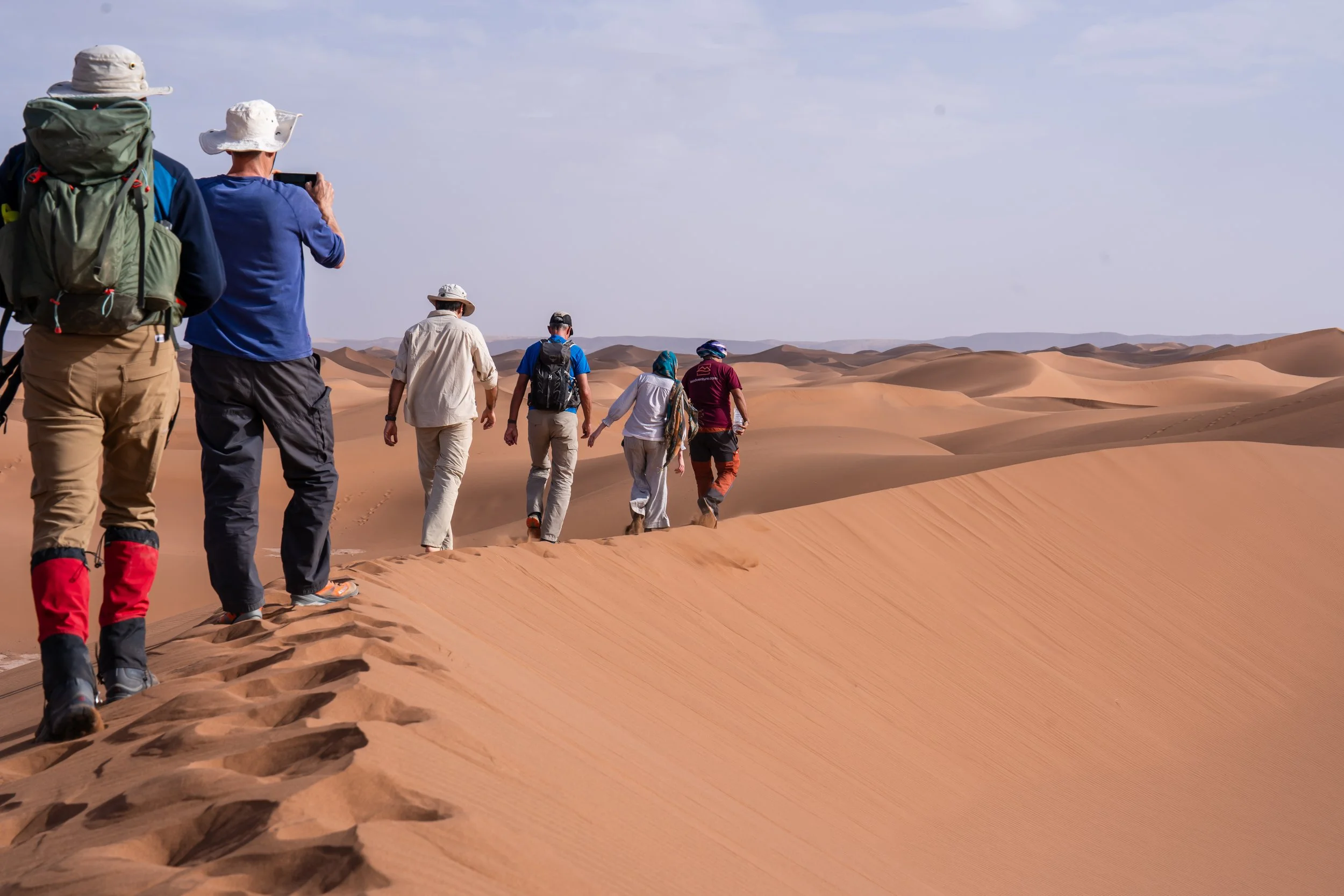
We continued across the dunes, each step sinking into the soft ridges. The desert wind carried grains of sand that slipped inside our shoes, rubbing against our feet as we walked. Though the sand slowed us, it was part of the Sahara’s rhythm—its way of reminding us that every journey here demands endurance. With the beetle safe and the group together, we kept moving, the reddish dunes stretching endlessly ahead.
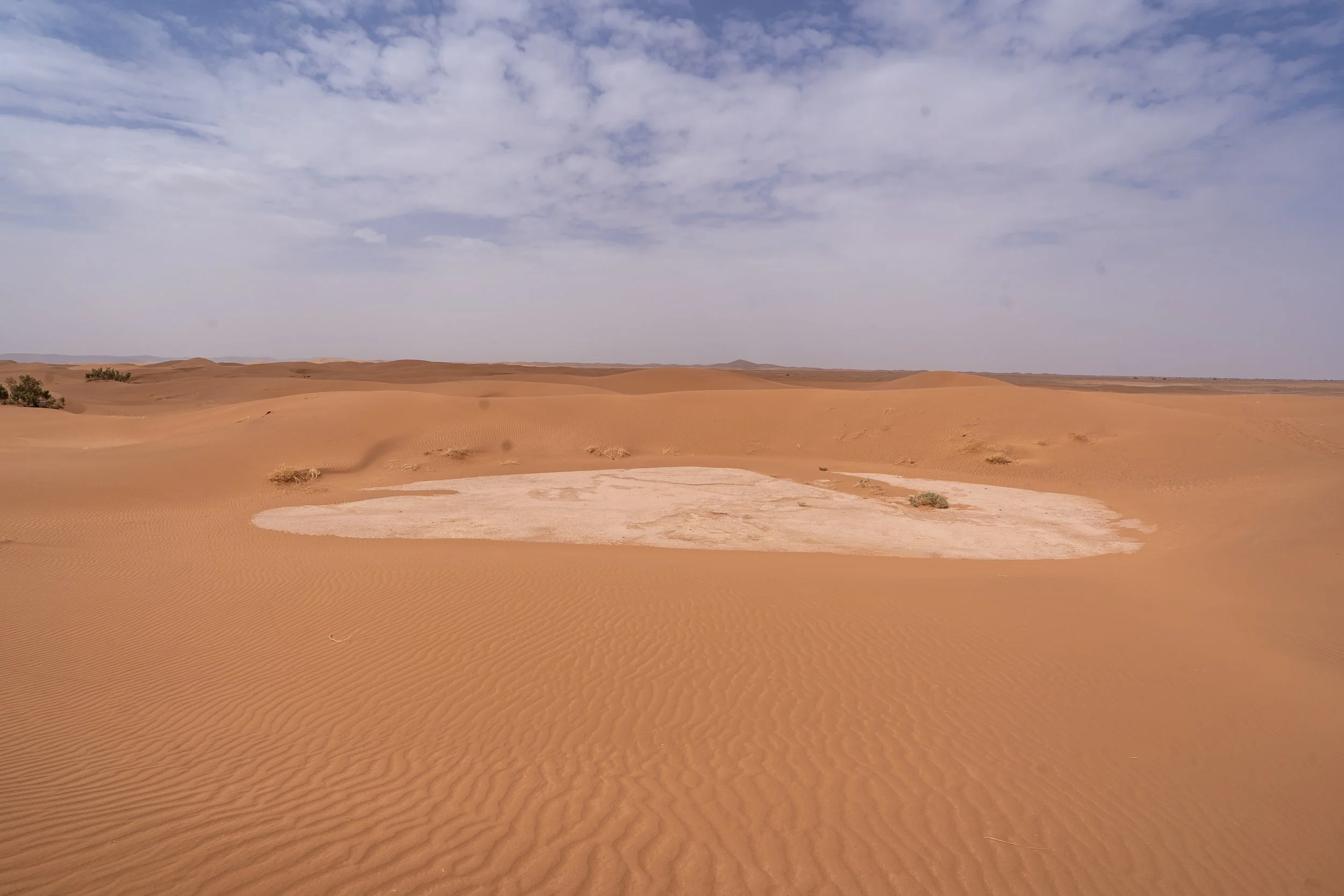
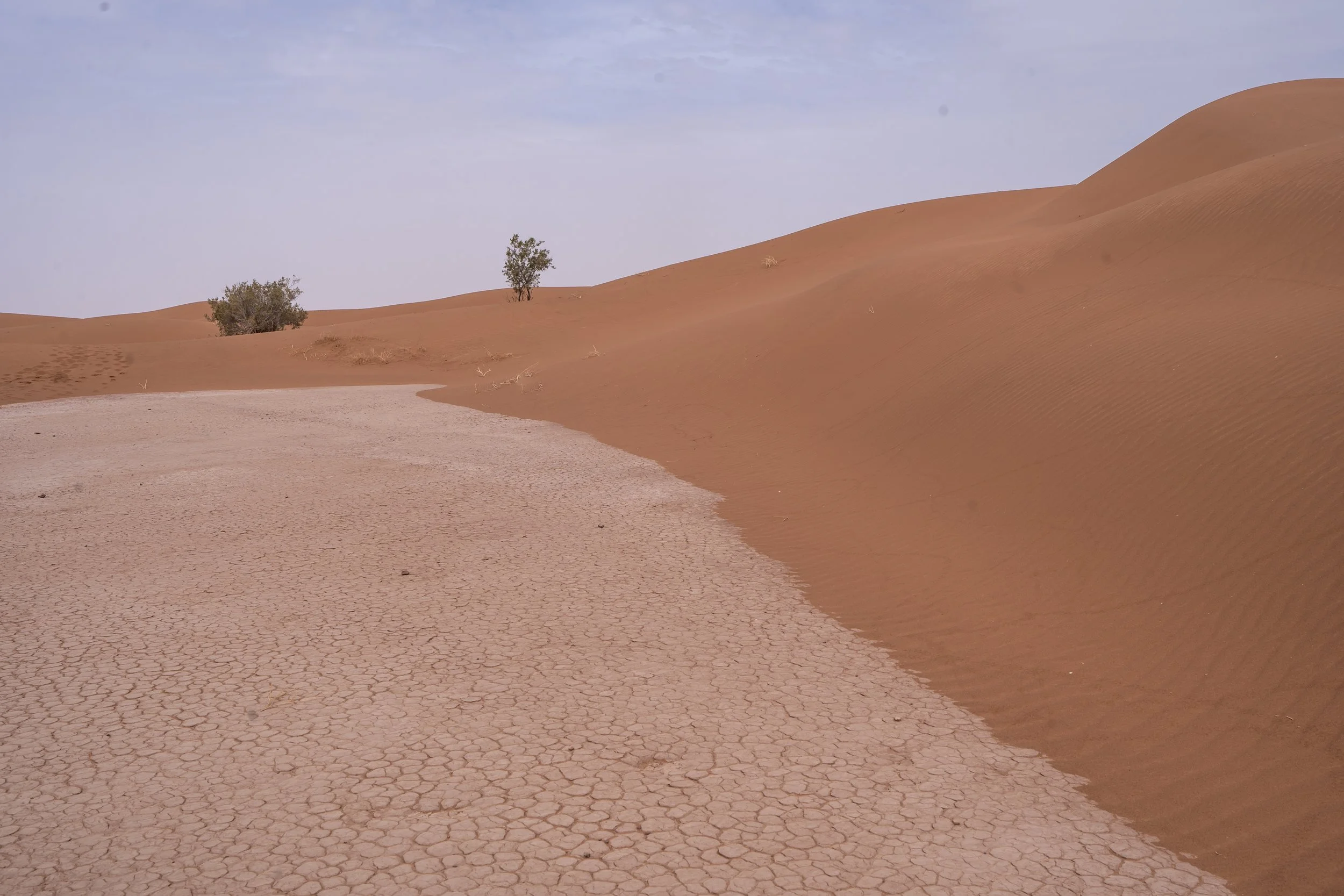
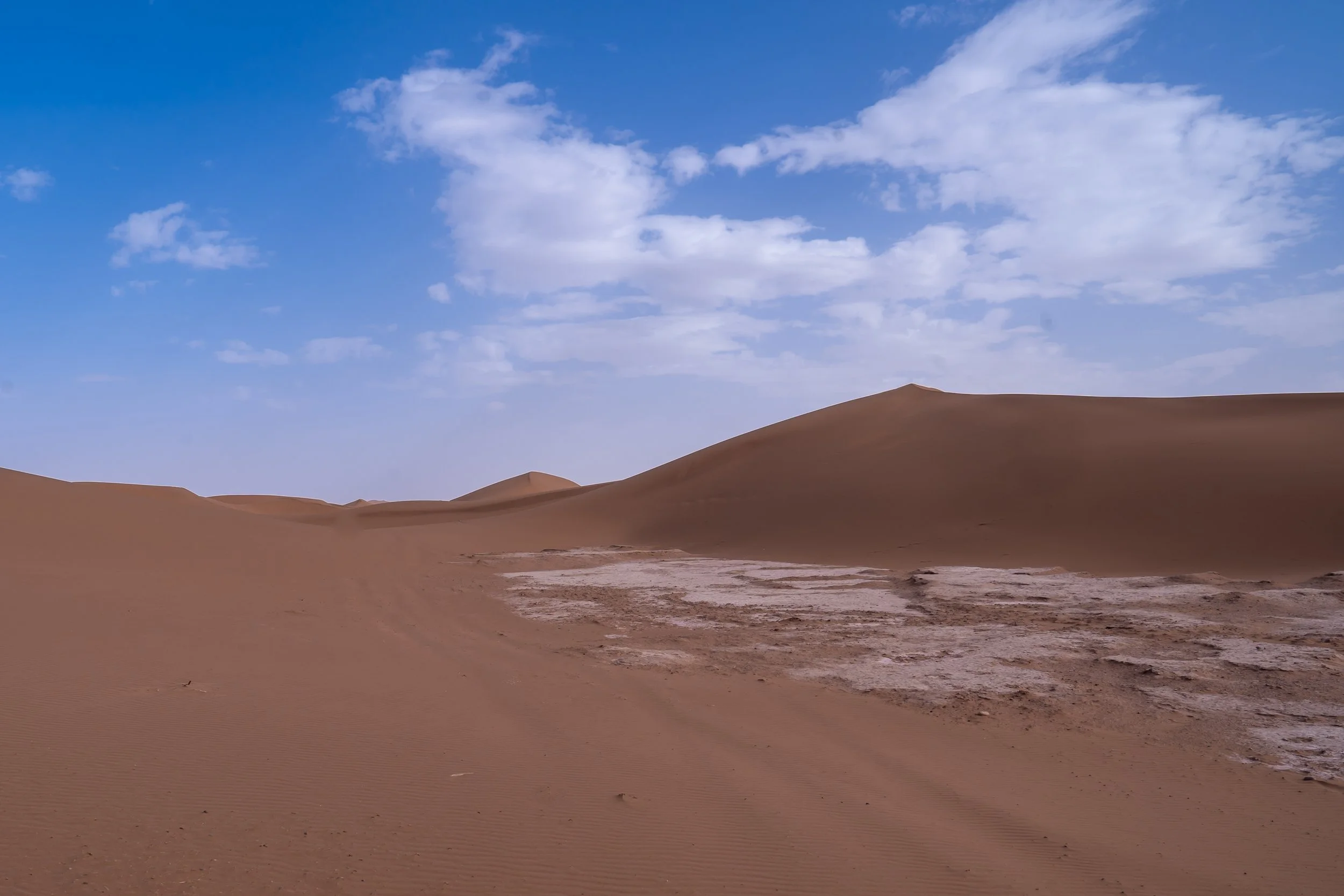
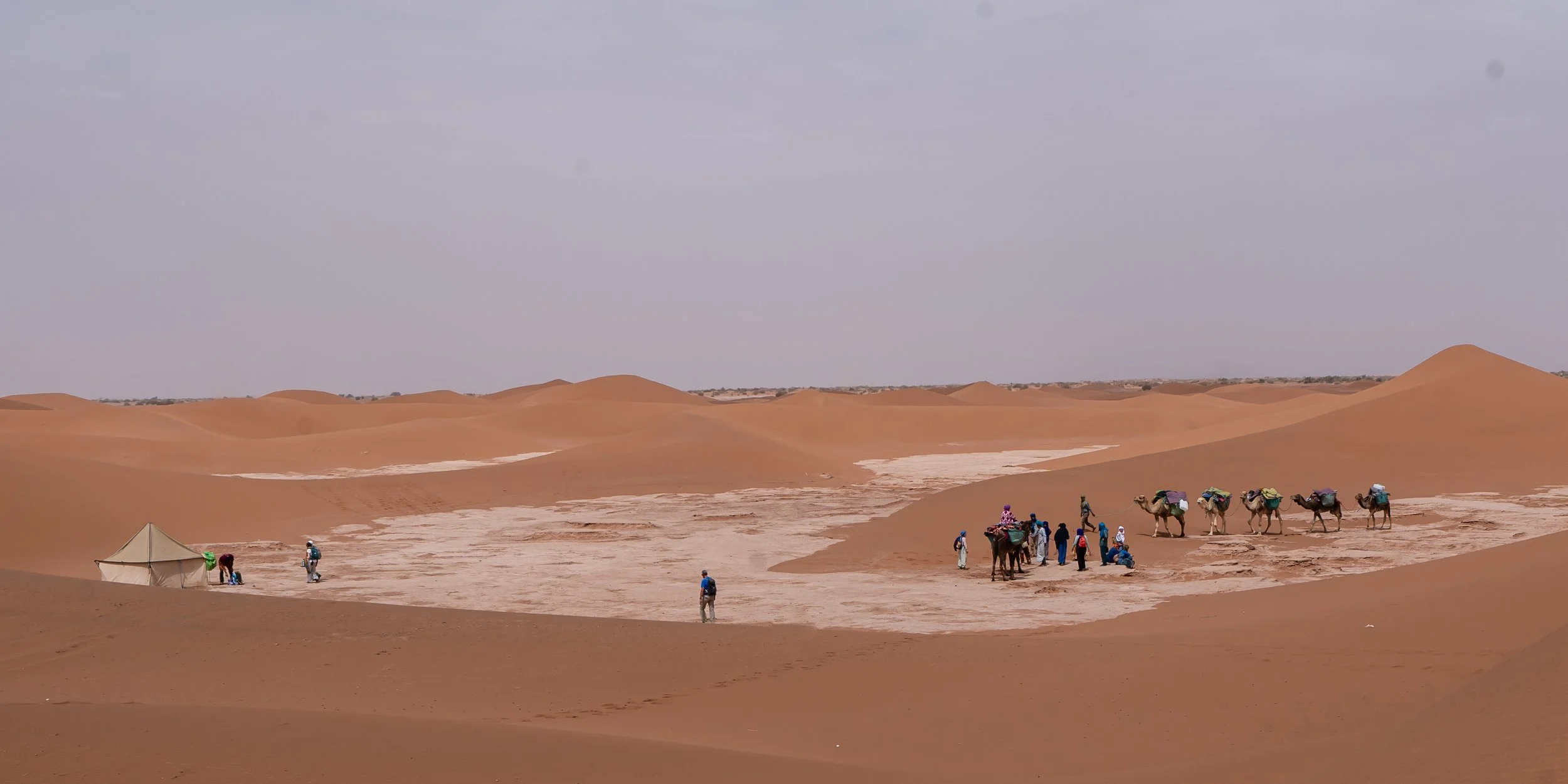
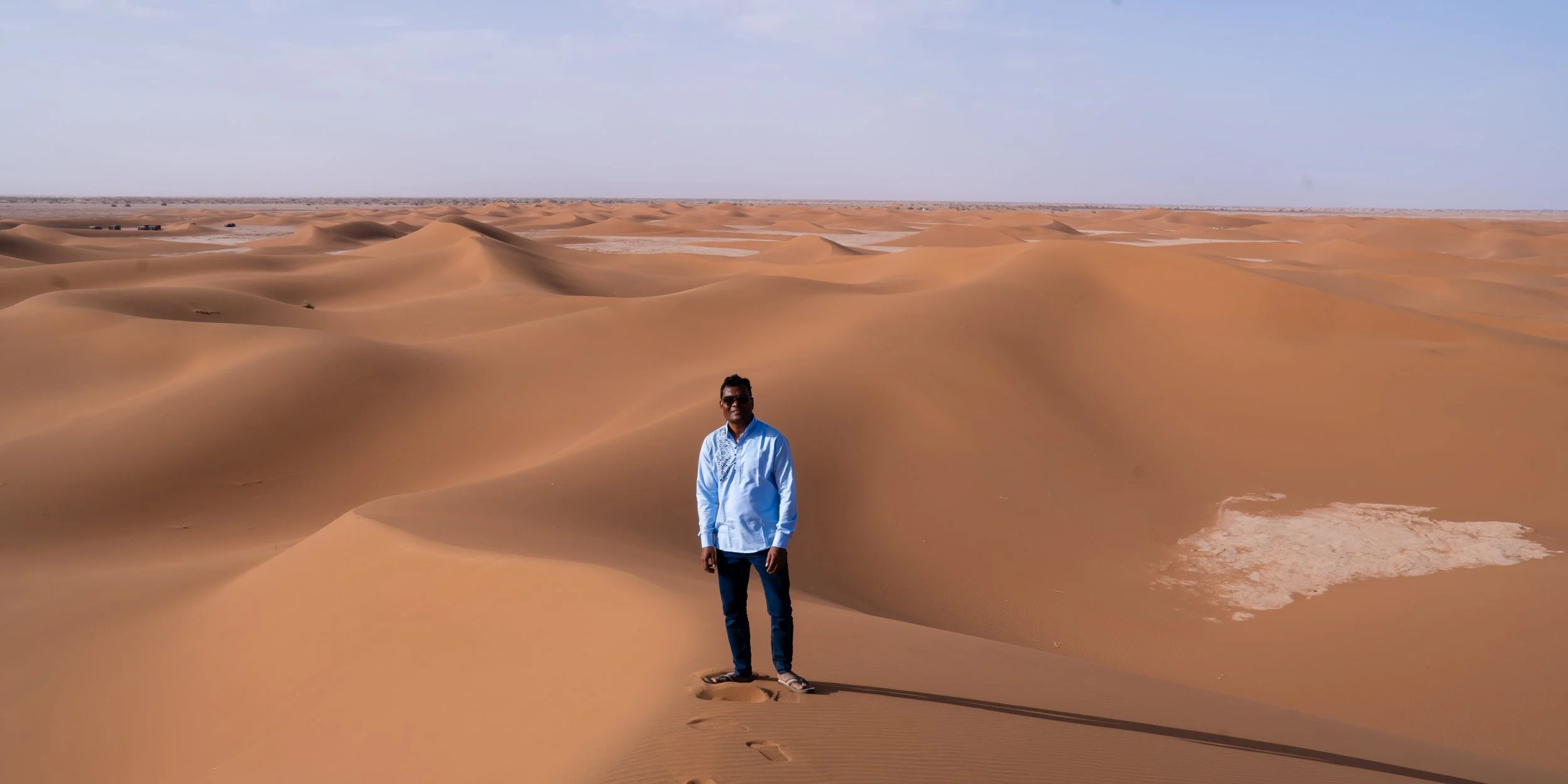
As we moved forward, the dunes broke into stretches of hardened ground. These land patches lay bare, dried and cracked, standing in stark contrast to the flowing sands around them. The camels stepped firmly across the solid earth, while we felt brief relief from sinking into the dunes. Yet the silence of those patches carried its own weight—a reminder of the desert’s emptiness, where even the land itself seemed stripped to its bones.
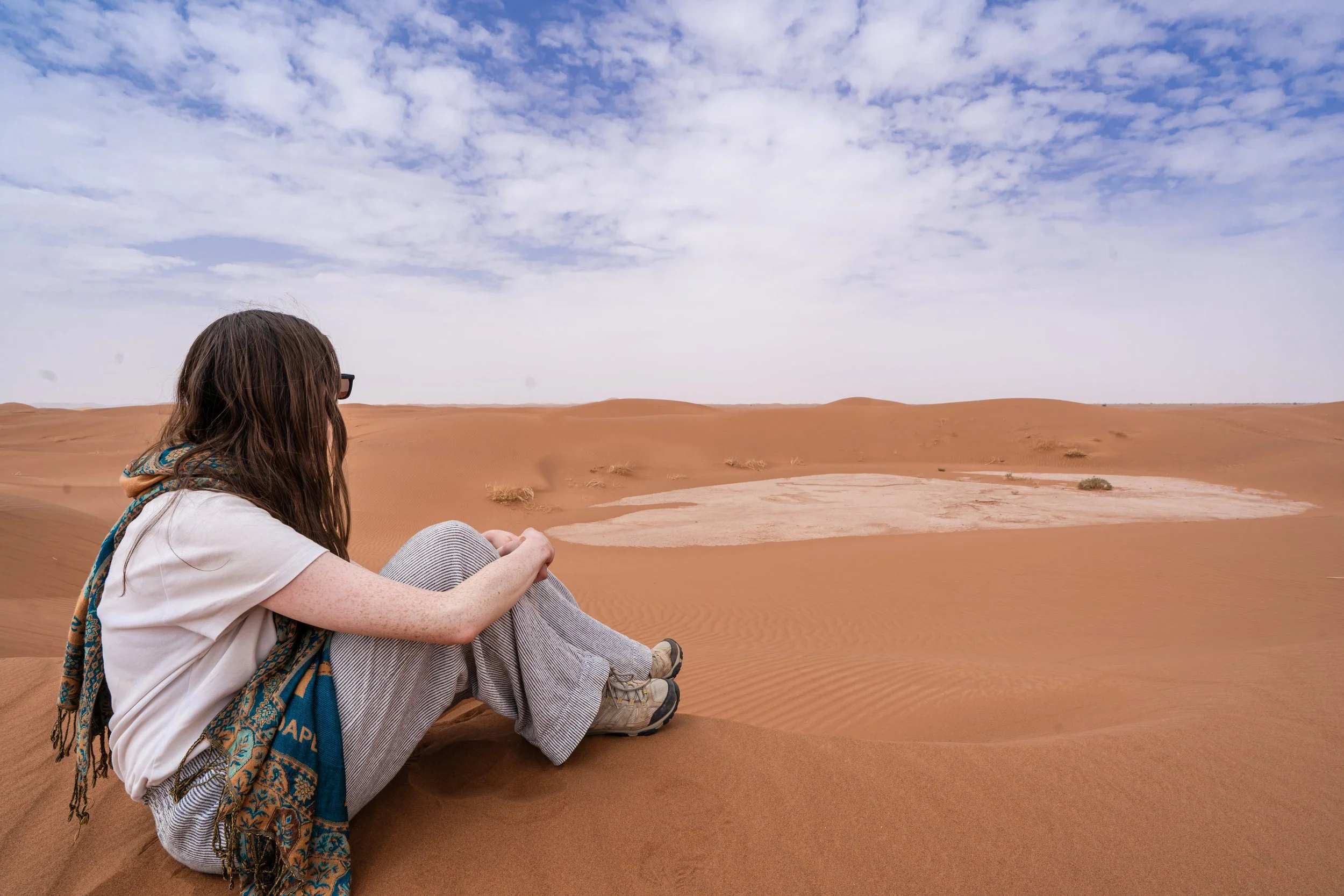
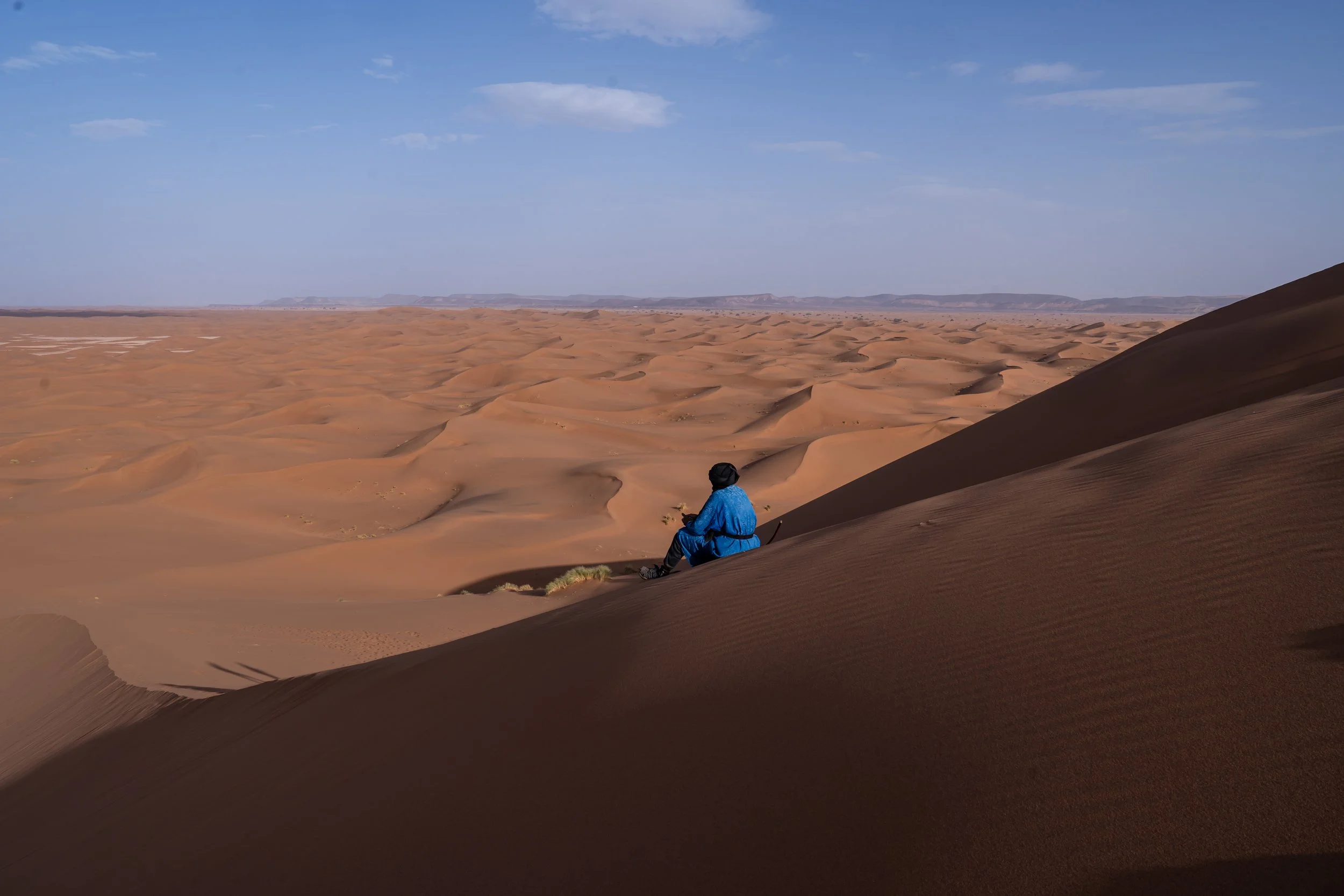
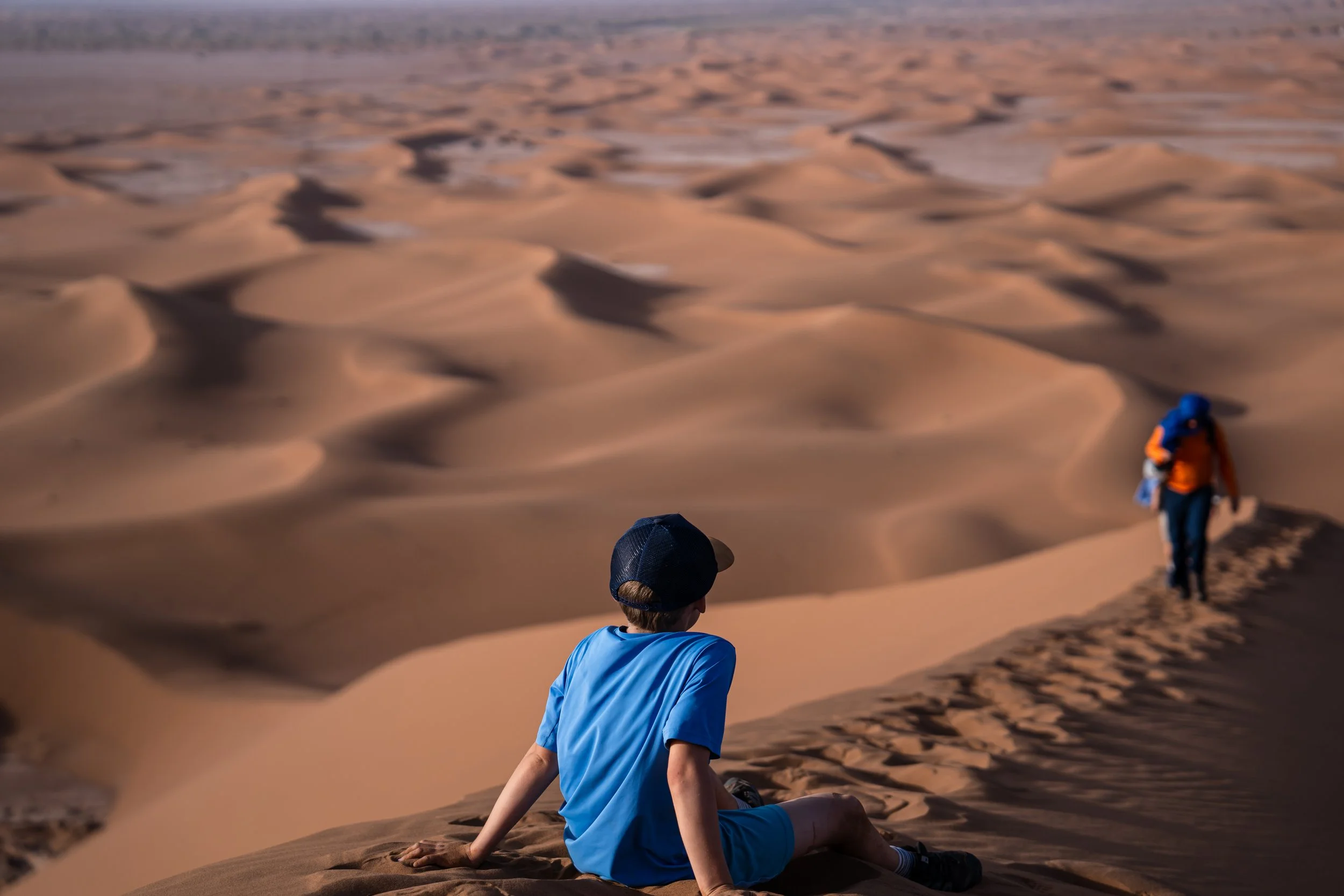
Danni paused atop the dune, her gaze sweeping across the vast expanse. The sands glowed reddish under the fading light, broken only by the dry patches scattered between ridges. She sat quietly, taking in the immensity of the desert, its silence and shifting colors.
As we moved further, the desert unfolded with greater clarity. The dunes rose in reddish waves, their curves glowing under the sun, while dry patches stretched starkly between them. The contrast grew sharper now—rolling sands flowing like an ocean, broken by islands of hardened earth.
As we pressed onward, the desert offered a fleeting glimpse of life. A fennec darted across the sands—its small frame swift, ears sharp against the reddish glow. For a moment it seemed suspended between dunes and dry patches, then vanished into the vast silence. Its sudden appearance reminded us that even in the emptiness, the Sahara holds secrets—quick, elusive, and gone before we could follow.
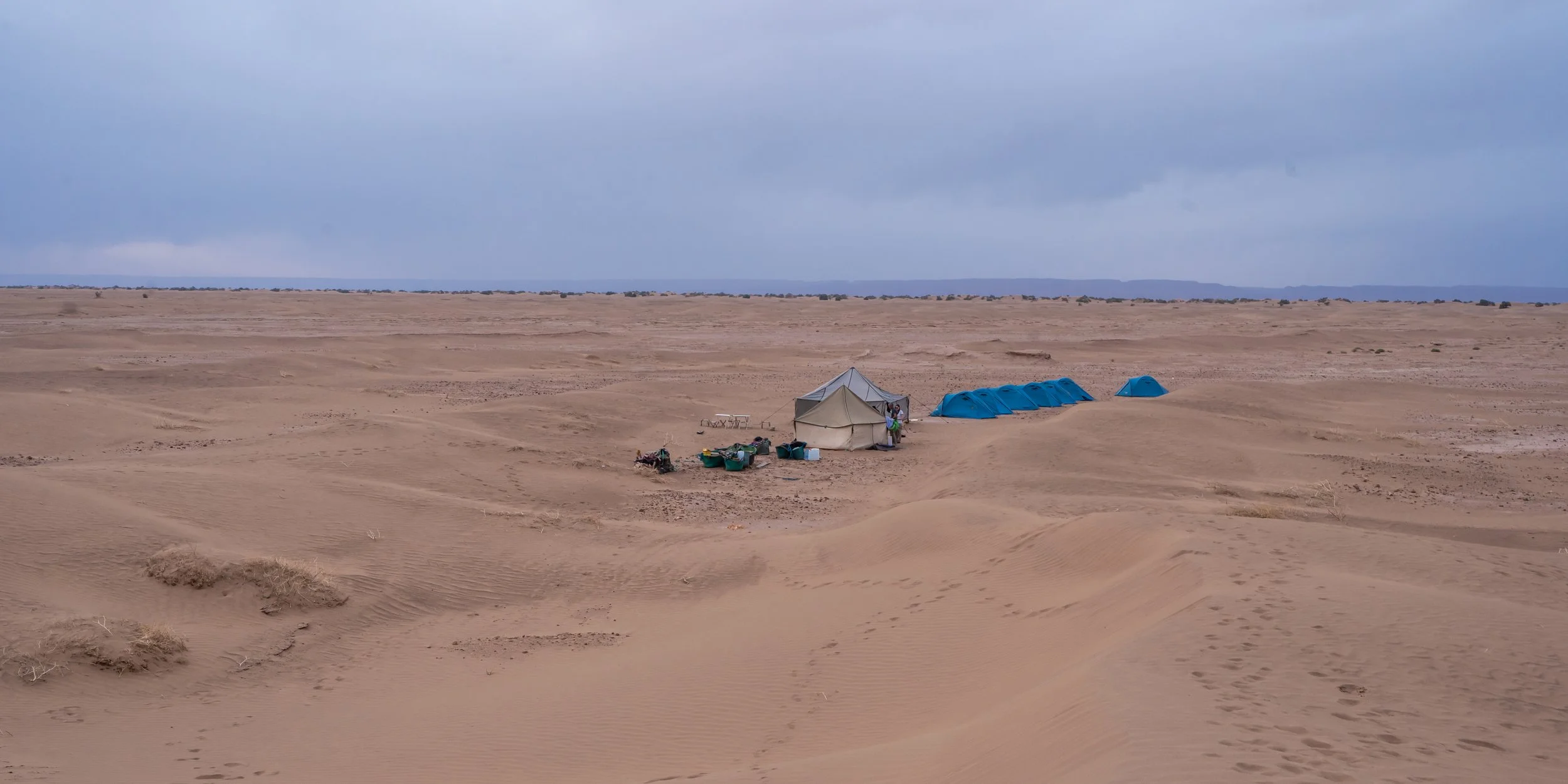
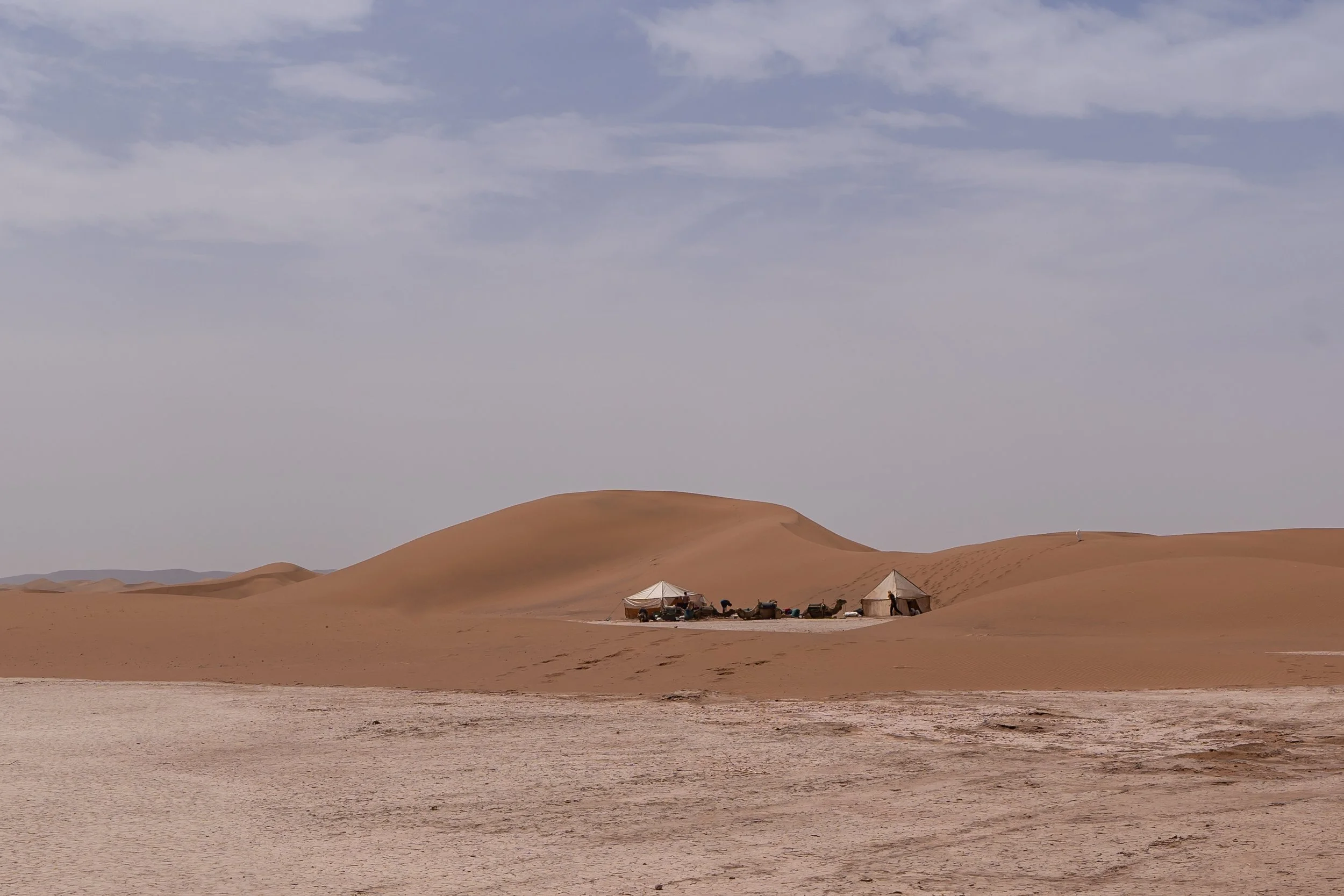
By the afternoon, we reached our camp among the dunes. The tents stood ready, their canvas steady against the desert wind, while the camels knelt to be unloaded. Supplies were gathered, and the firewood stacked for the evening. The reddish sands surrounded us, broken by dry patches that stretched into silence. After the long journey, the camp felt like a small island of order in the vast emptiness—a place to pause, to prepare, and to watch the desert shift under the fading light.
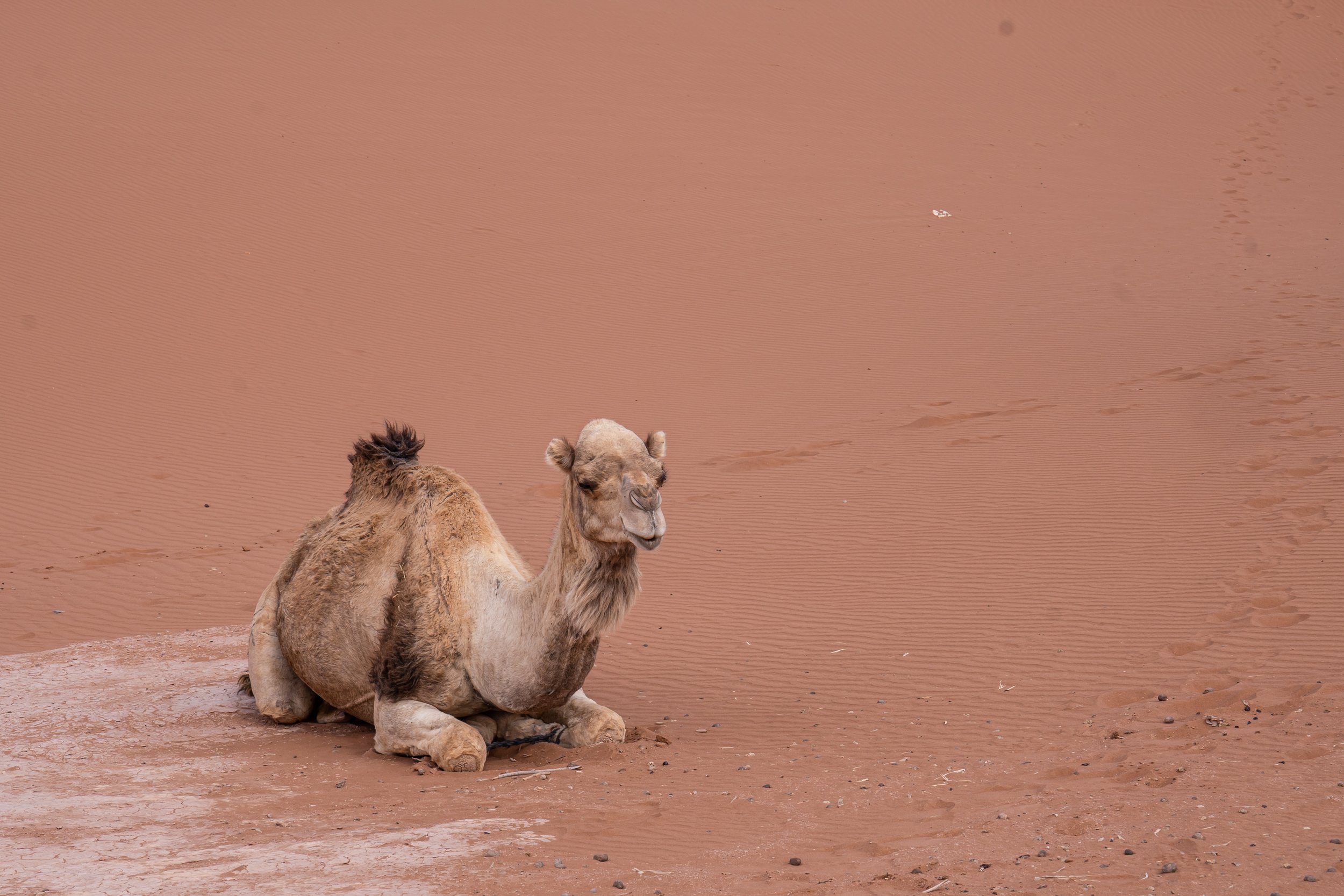
We gathered for lunch beneath the canvas shade, the reddish dunes glowing beyond. Bread and chicken were shared, the meal simple yet comforting after the long trek. Soon after, we lay down for a nap, the silence of the desert wrapping around us. Nearby, the dromedary camels folded their legs and sank into the sand. Even they seemed to surrender to the stillness, their great frames resting quietly as the afternoon drifted on.
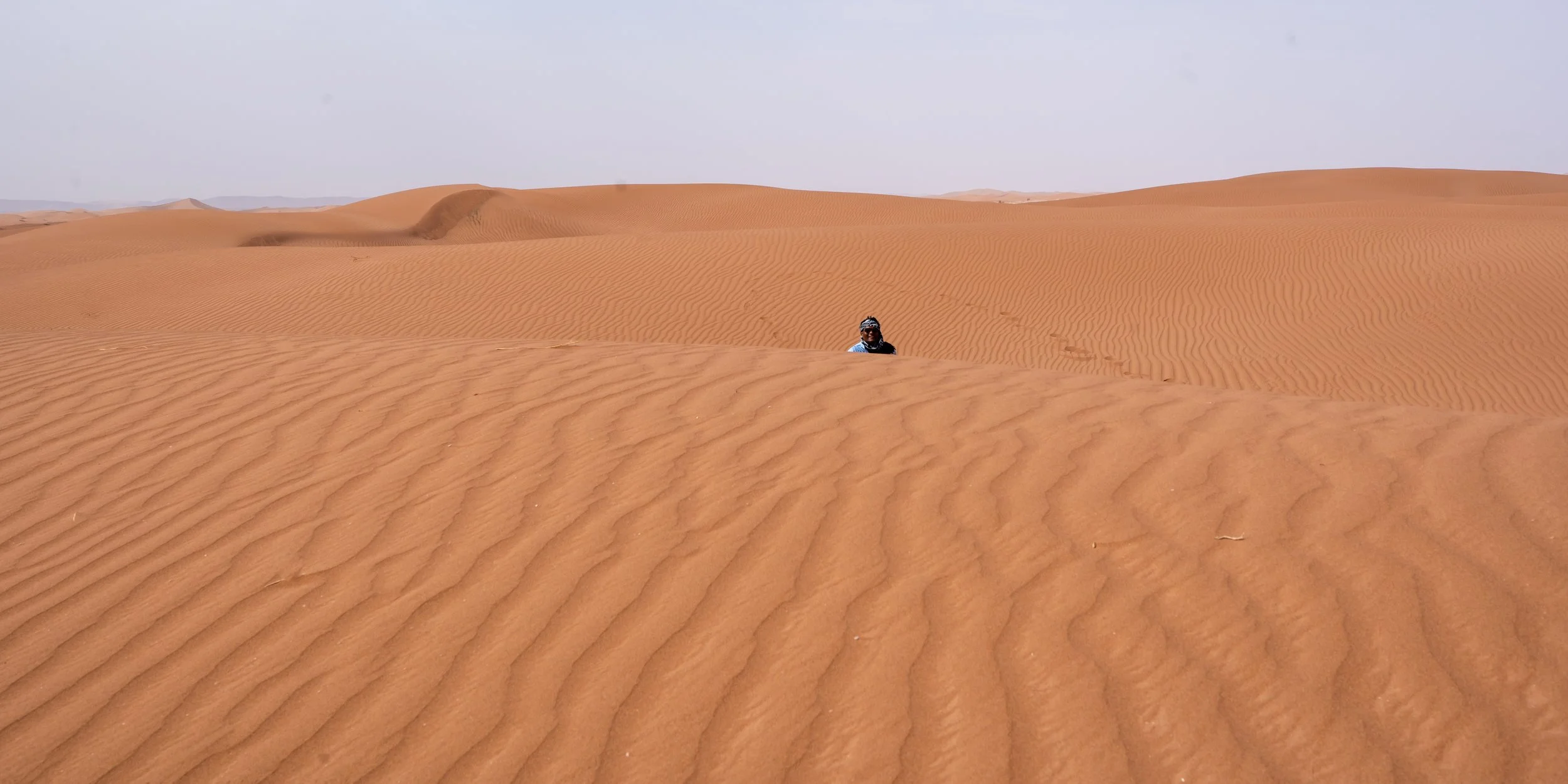
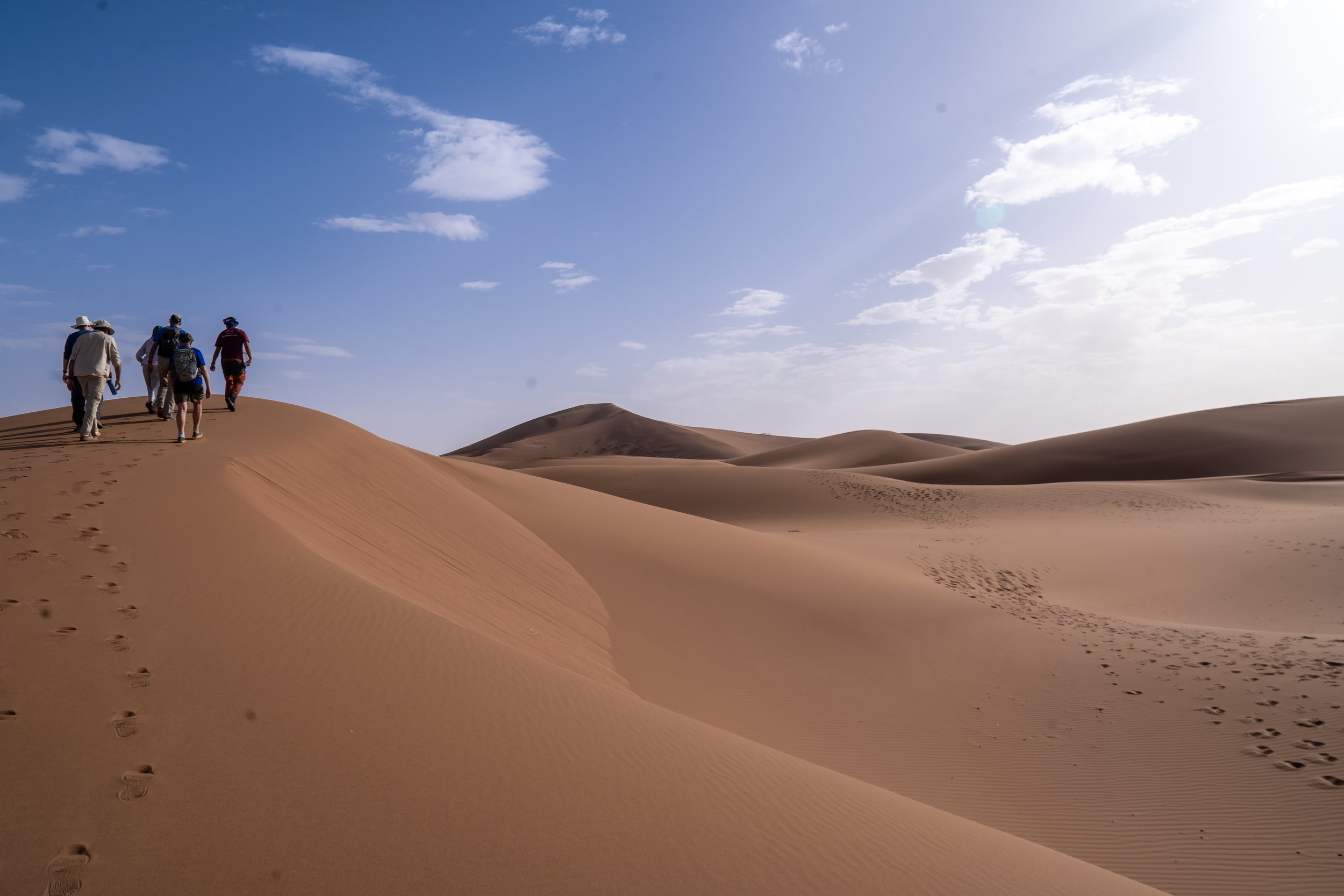
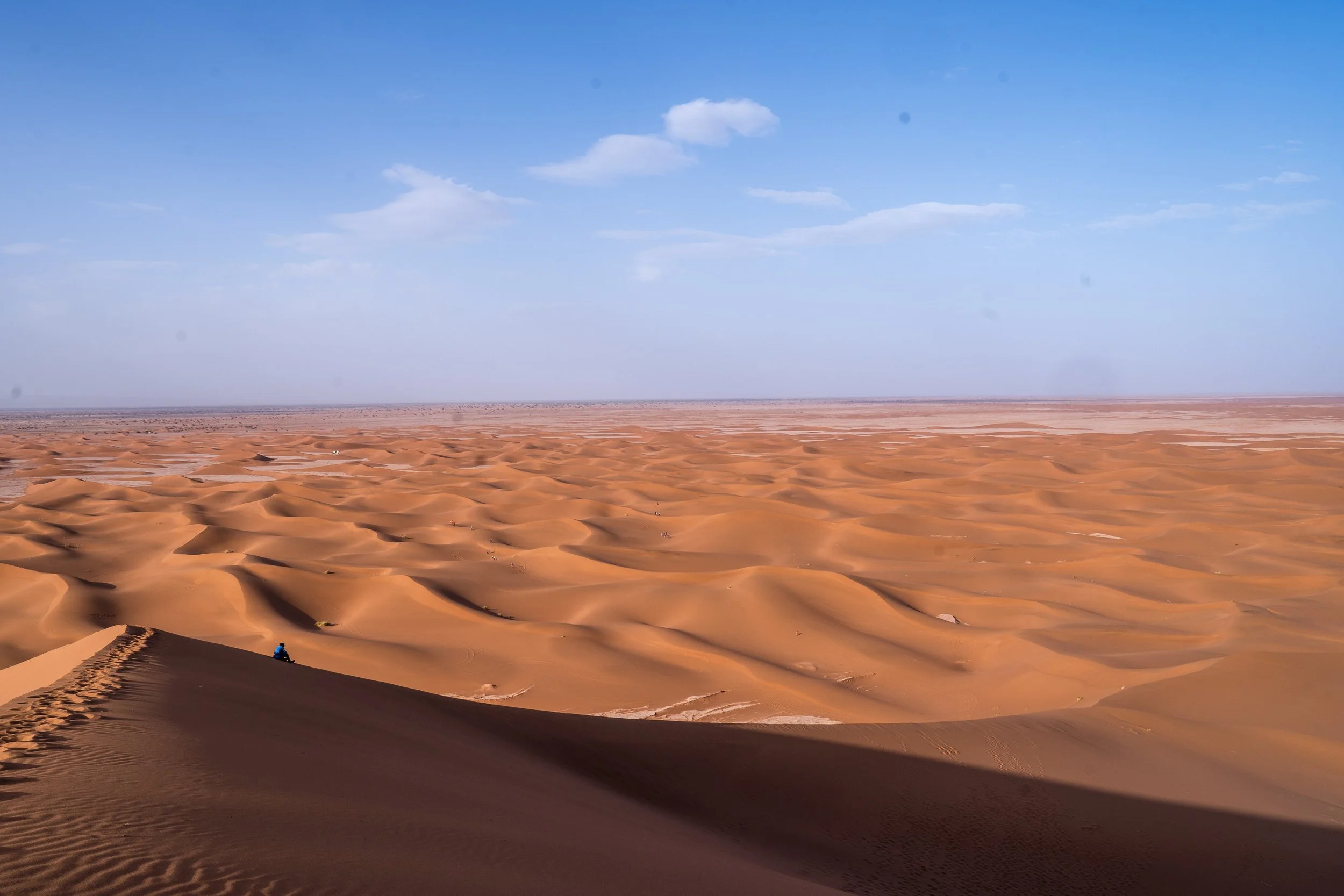
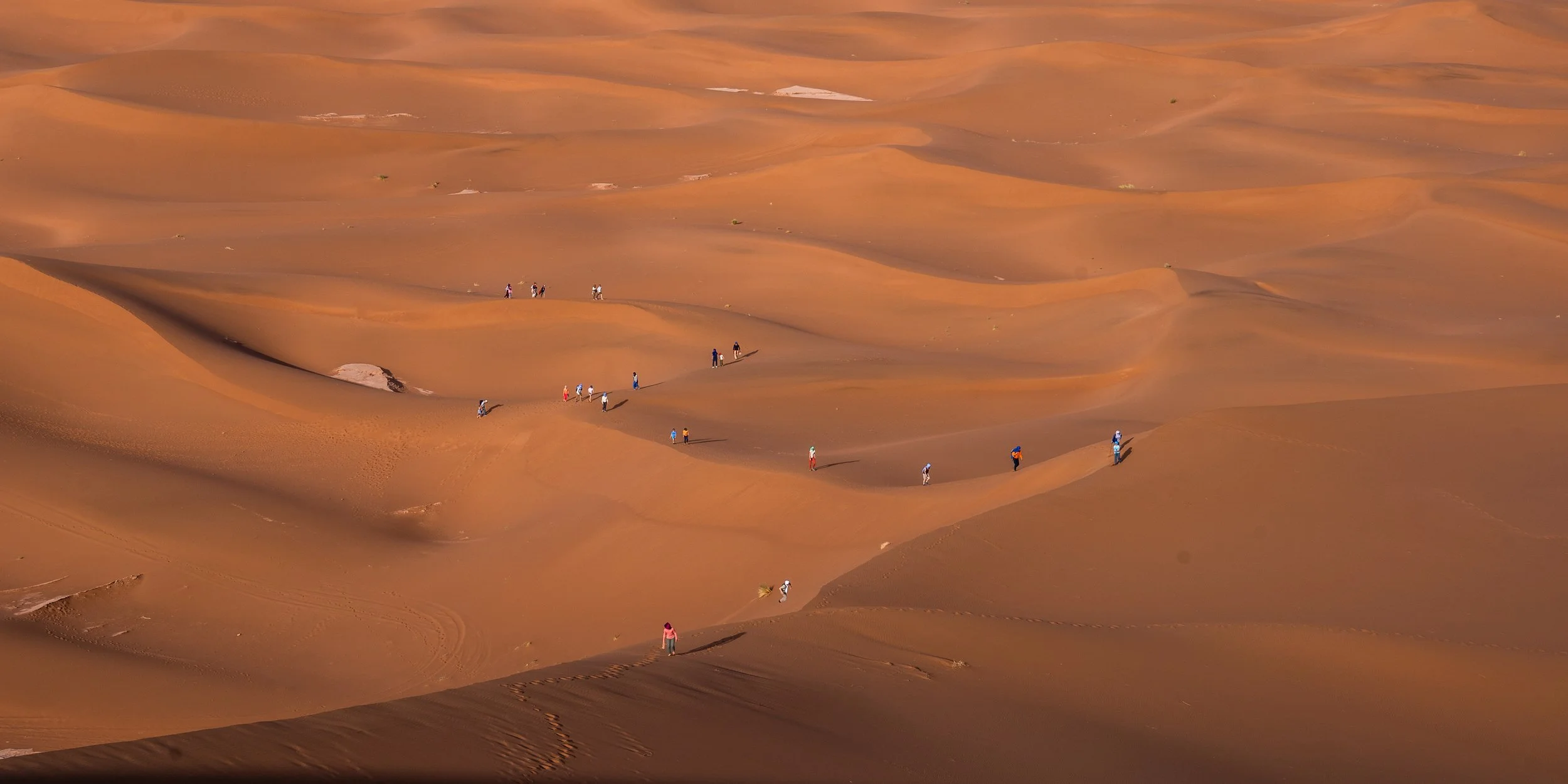
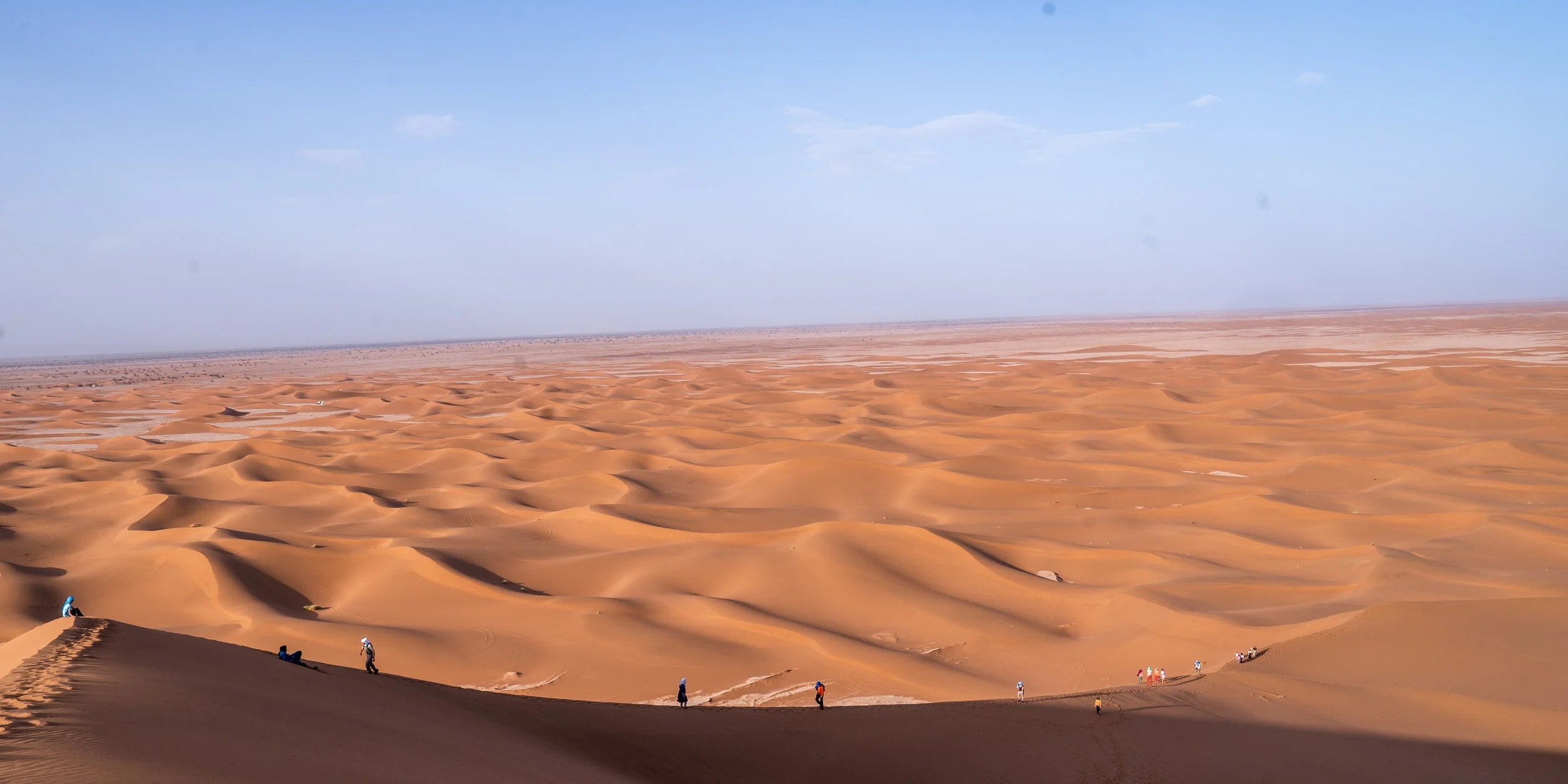
No more dry patches lay ahead. The dunes rose in clear, sweeping curves, and we found ourselves moving along their crests. Each step carried us higher, the sand glowing under the afternoon light, the ridges stretching endlessly in both directions. From above, the desert unfolded in pure form—waves of sand rolling into distance, silent and immense, as if the earth itself had become an ocean frozen in motion.
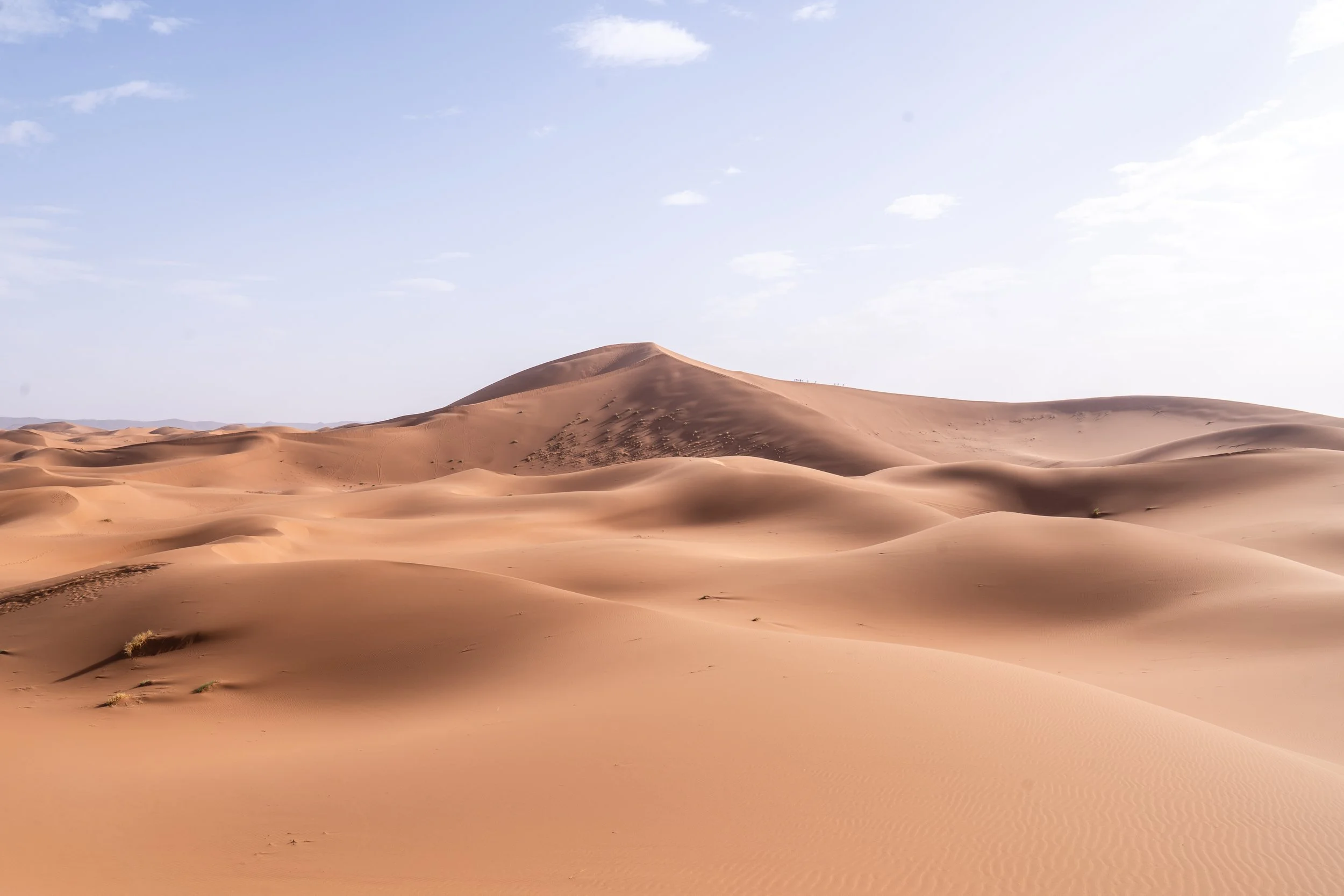
By afternoon, the desert revealed its grandeur. From the crest of the dunes, the vast form of Erg Zahar rose into view—immense ridges shimmering under the sun, their curves flowing like waves frozen in motion. The sands glowed with a reddish hue, stretching endlessly, while the wind carried a hushed silence across the expanse. It felt as though the desert had unveiled its heart, a monumental landscape commanding awe as we moved closer into its embrace.
Unlike the smaller dunes that shift and reshape with the winds, Erg Zahar stood immovable—its vast ridges anchored in place for centuries. Rising like a monument of sand, it held its form against time, a silent witness to the desert’s endless changes. The smaller dunes around it seemed transient, flowing and fading, but Erg Zahar remained steadfast, a colossal presence that defined the horizon and reminded us of the Sahara’s permanence amid its shifting seas of sand.
The long walk across the dunes left its mark—blisters forming with each step on the shifting sand. Back at the tent, I slipped off my shoes, leaving them aside, and eased into slippers instead. The desert’s silence pressed close, but the change brought relief. Even as the great Erg Zahar loomed beyond, I carried on, lighter now, though the sting of the journey lingered with every stride.
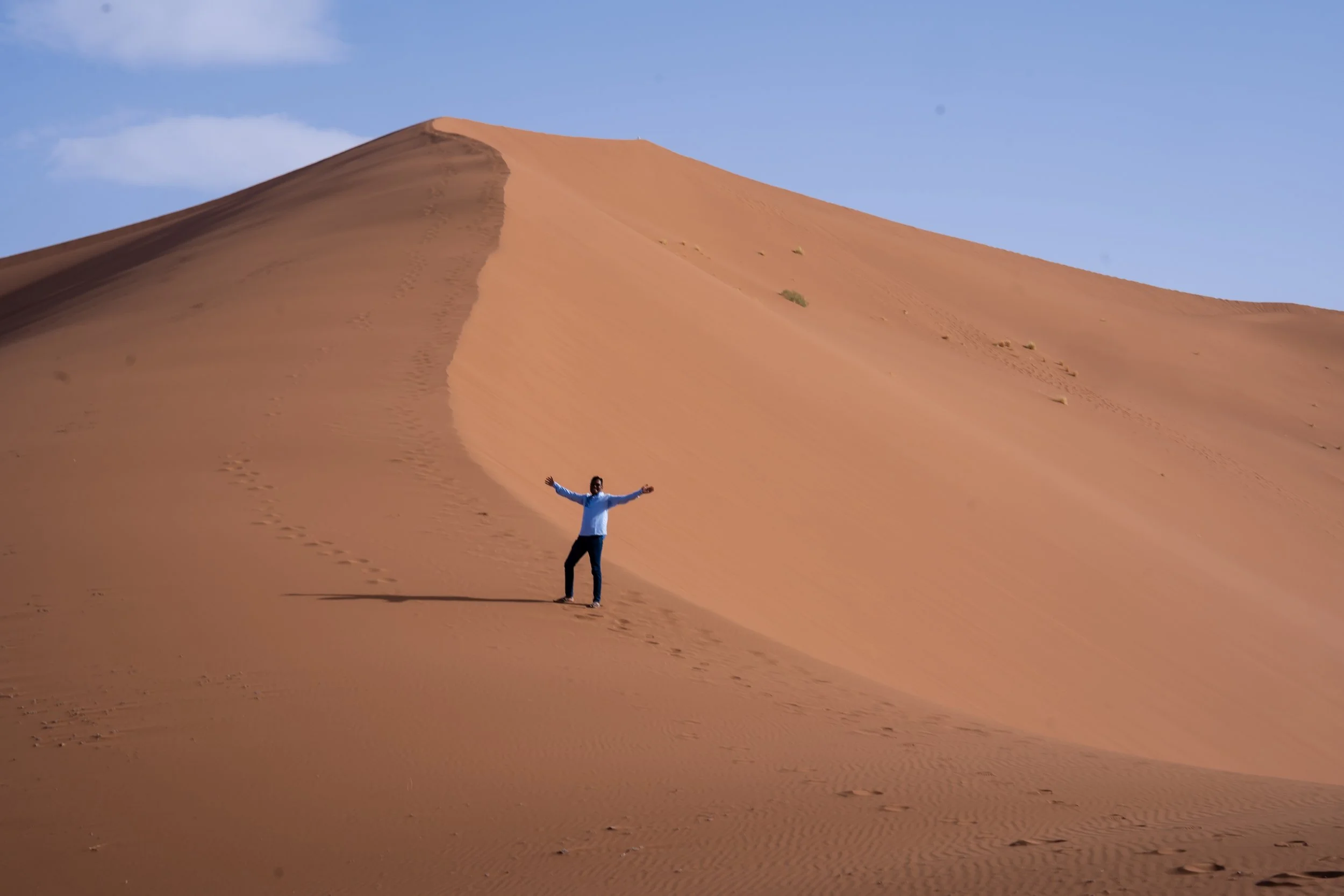
The climb began with the sun still high, its light pouring over the vast dune. Erg Zahar towered above us, nearly 250 meters of shifting sand rising like a monument against the sky. Each step sank deep, the slope demanding strength and patience, the air heavy with silence.
At the middle of Erg Zahar, we paused, the climb already heavy on our legs. The dune rose steeply above, its crest still distant, but from this height the desert stretched in vast silence. It was here we asked the Berber guide to look for the other party. His eyes scanned the horizon with calm certainty, trained to read the subtle lines of sand and shadow. While we caught our breath, he moved lightly across the slope, his figure blending into the golden ridges, carrying our search into the immensity of the Sahara.
Midway up Erg Zahar, the climb slowed, and the Berber guide lay down upon the slope itself. His body rested against the warm sand, but his eyes remained sharp, scanning the horizon with quiet intent. From that vantage, he seemed part of the dune—still, patient, yet alive with awareness. While we caught our breath, he watched for the other party, his presence steady as the desert itself, a guardian figure etched into the vast silence of the Sahara.
Midway up Erg Zahar, the Berber lay quietly on the slope, his eyes fixed on the horizon. The desert shimmered in silence, but then—movement at the foothill caught his gaze. Another team was visible, their figures small against the vast base of the dune. He raised his arm, giving us the signal. In that moment, the immensity of the Sahara seemed to shrink, the distance bridged by his watchful presence. The sight of the other party brought relief, a reminder that even in this boundless desert, connections could be found.
From the foothill, the other party began their climb. Their figures moved steadily, small against the immensity of Erg Zahar, each step sinking into the slope of sand. The dune rose above them like a vast wall, its crest glowing in the fading light. The Berber, still lying midway on the dune, watched closely. When he saw their progress, he gave us another signal—calm and assured—showing that they were making their way upward. The desert, silent and endless, seemed to pause as two groups slowly converged upon the towering height of Erg Zahar.
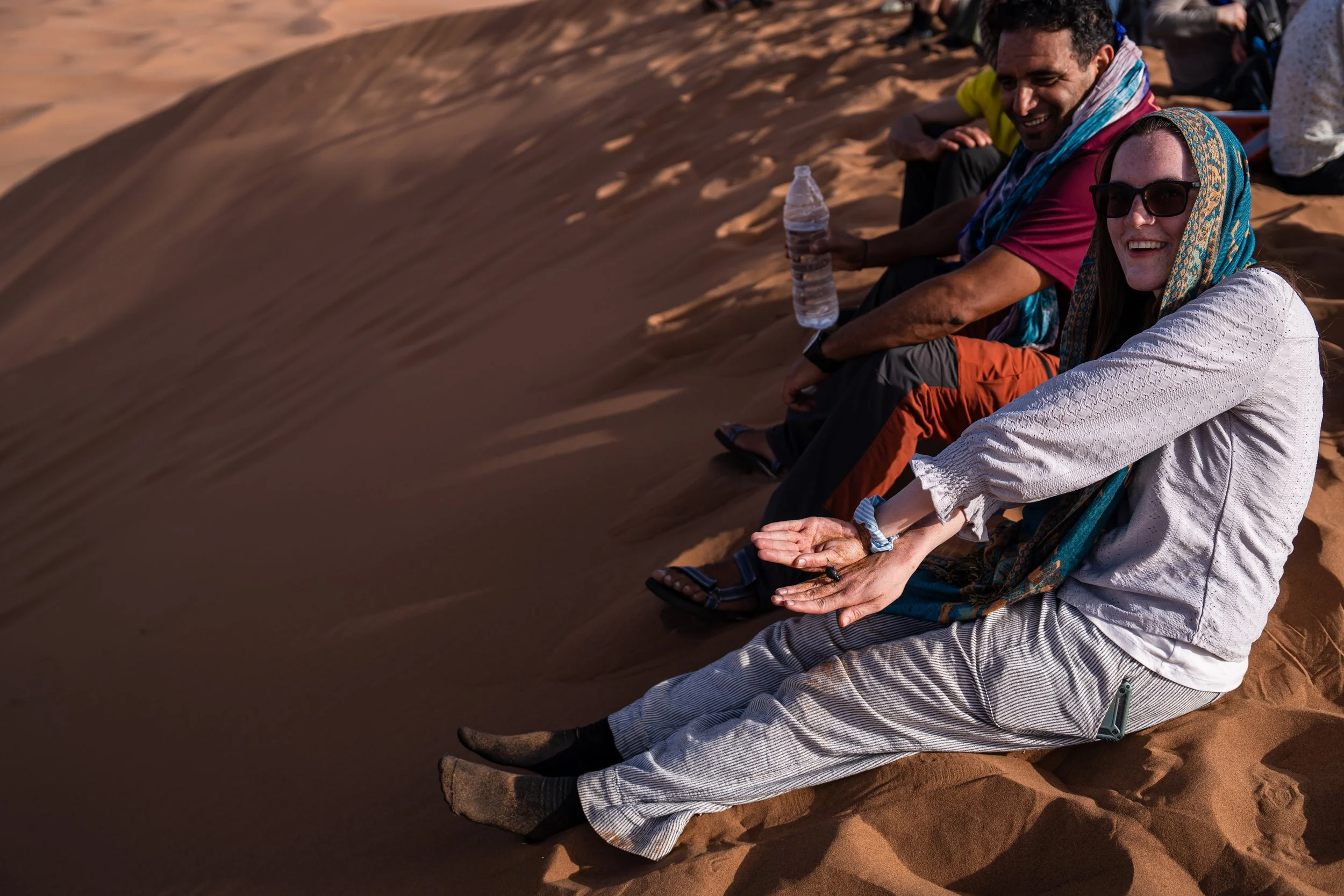
Midway up Erg Zahar, as the other party slowly climbed from the foothill, Danni with deliberate care, she took out the beetle, its shell catching the desert light in a faint shimmer. Around her, the sand seemed to hush, as if the vast dune itself acknowledged the fragile life she carried.
When the other party reached closer, Danni stepped forward. With deliberate care, she extended her hands, offering the beetle as though it were a sacred trust. The handover was quiet, almost ritualistic—the fragile creature passing from one guardian to another, binding us together in the vast silence of the Sahara. In that moment, the immensity of Erg Zahar seemed to pause, acknowledging the transfer of responsibility, as if the dune itself bore witness to the continuity of the journey.
At last, the mission was complete. The beetle had been handed over, the signal exchanged, and the desert’s silence seemed to acknowledge the moment. We lingered at the summit of Erg Zahar, nearly 250 meters above the sands, waiting for the sunset. The sky deepened into gold and crimson, shadows stretching across the endless ridges. From that height, the Sahara unfolded in boundless majesty, a panorama of silence and light.
When the sun finally dipped below the horizon, we began our descent. The sand softened underfoot, the air cooling with twilight. Step by step, we returned to our camp, the day’s journey folded into memory—its trials, its watchfulness, and its triumph carried with us into the night.
The next day, the desert woke in silence, its sands cool beneath the early light. I sat in the tent, tending to the blisters from yesterday’s climb. A strip of Compede pressed gently against the sore skin, sealing the sting, promising relief.
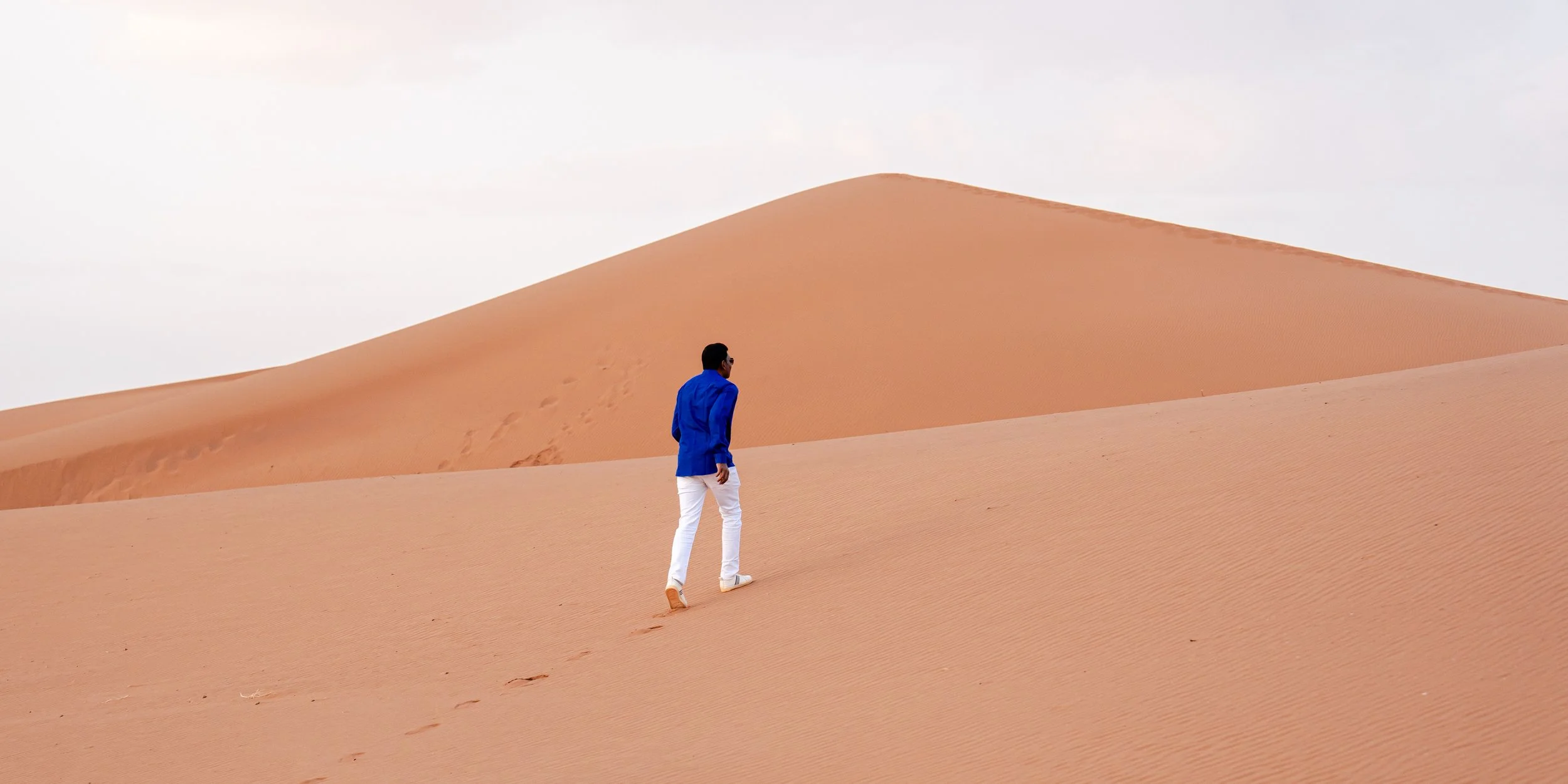
With shoes laced once more, I stepped out into the dawn. The horizon glowed faintly, and nearby dunes rose like gentle waves waiting to be crossed. I chose one, smaller than Erg Zahar yet still demanding, and began the ascent. Each step carried the weight of yesterday’s trials, but also the quiet determination of a new morning—proof that the journey continued, blistered feet and all.
At the crest, I paused. The horizon blazed with color—gold spilling into crimson, shadows stretching long across the sands. The sunrise was not hurried; it unfolded slowly, as if the Sahara itself breathed in rhythm with the light.
After the sunrise bathed the dunes in gold, I began my way down. The sand gave beneath each step, soft and yielding, carrying me gently toward the base. The air was cooler now, the desert calm after its fiery display of dawn. The climb had tested me, but the descent felt like release—each stride easing the weight of yesterday’s blisters, each breath filled with the stillness of morning. By the time I reached the tent, the Sahara had returned to silence, holding the memory of the ascent and the sunrise within its endless waves of sand.
Morning, the desert was calm, but the questions lingered. Issues were not yet resolved, and the thought of a sandstorm during our return weighed heavily.
Step by step, I climbed again, the slope rising beneath me like a test of resolve. Each grain of sand seemed to whisper of the storm that might come, of the desert’s sudden fury. From the height, I scanned the horizon, searching for signs in the shifting light—clouds of dust, restless winds, the desert’s warning.
From the top of Sand Dune, the horizon stretched in restless silence. I scanned the vast expanse, the dunes rolling endlessly into shadow and light. Subtle movements in the distance—dust rising, the air shifting—spoke of what might come. It was clear: a sandstorm was likely. The desert, always unpredictable, had given its warning. Standing there, I felt the weight of readiness settle in—our return would not be simple, and the Sahara was reminding us that vigilance was the price of passage.
Without hesitation, we rushed toward another route for our return. The sand beneath us seemed to quicken, each step carrying urgency. The vast silence of the Sahara was broken only by our movement, a race against the storm’s approach. Choosing a new path was not just survival, but trust—in the Younes, in each other, and in the desert’s warnings.
Younes gathered us together, his voice steady, his presence commanding. He spoke of our next step—how the route must change, how vigilance would be our shield against the shifting sands. His words were not hurried, but deliberate, each instruction woven with the weight of experience. Listening to Younes, we felt both caution and resolve: the path ahead was uncertain, but with his guidance, we were ready to face it.
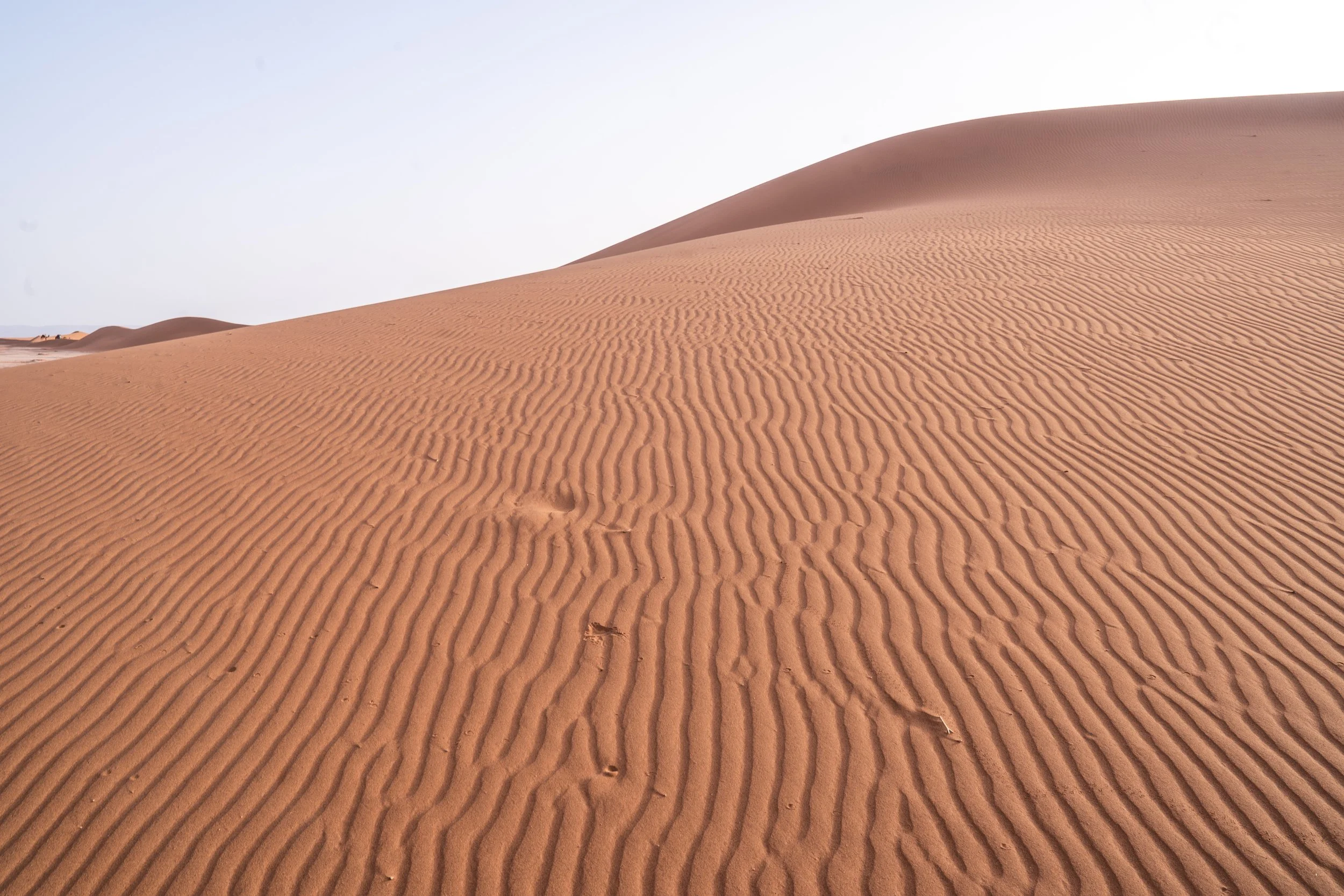
On our return, the dunes revealed their hidden textures. Fine linings traced the slopes—delicate ridges shaped by wind, etched patterns that shimmered under the desert light. Each line seemed like a memory of the storm that might come, a silent record of the Sahara’s restless breath.
As we pressed onward, our camels moved alongside us, their steady rhythm matching the urgency of our return. The dunes bore the faint linings of wind, and each step of the caravan seemed to echo the desert’s pulse. Their loads swayed gently—grain, water, and tents—yet their endurance never faltered. In their presence, the vast Sahara felt less daunting. Together, we advanced, humans and camels bound by necessity and trust, navigating the shifting sands toward safety before the storm could rise.
Sahara is never predictable, and we knew that if the storm struck while the caravan was near, we could install our camp. The tents, carried patiently by the camels, were more than canvas—they were our refuge, our shield against the desert’s fury. In that plan lay reassurance: even if the sands rose in chaos, we had the means to carve out a pocket of order, a fragile island of safety in the storm’s vastness.
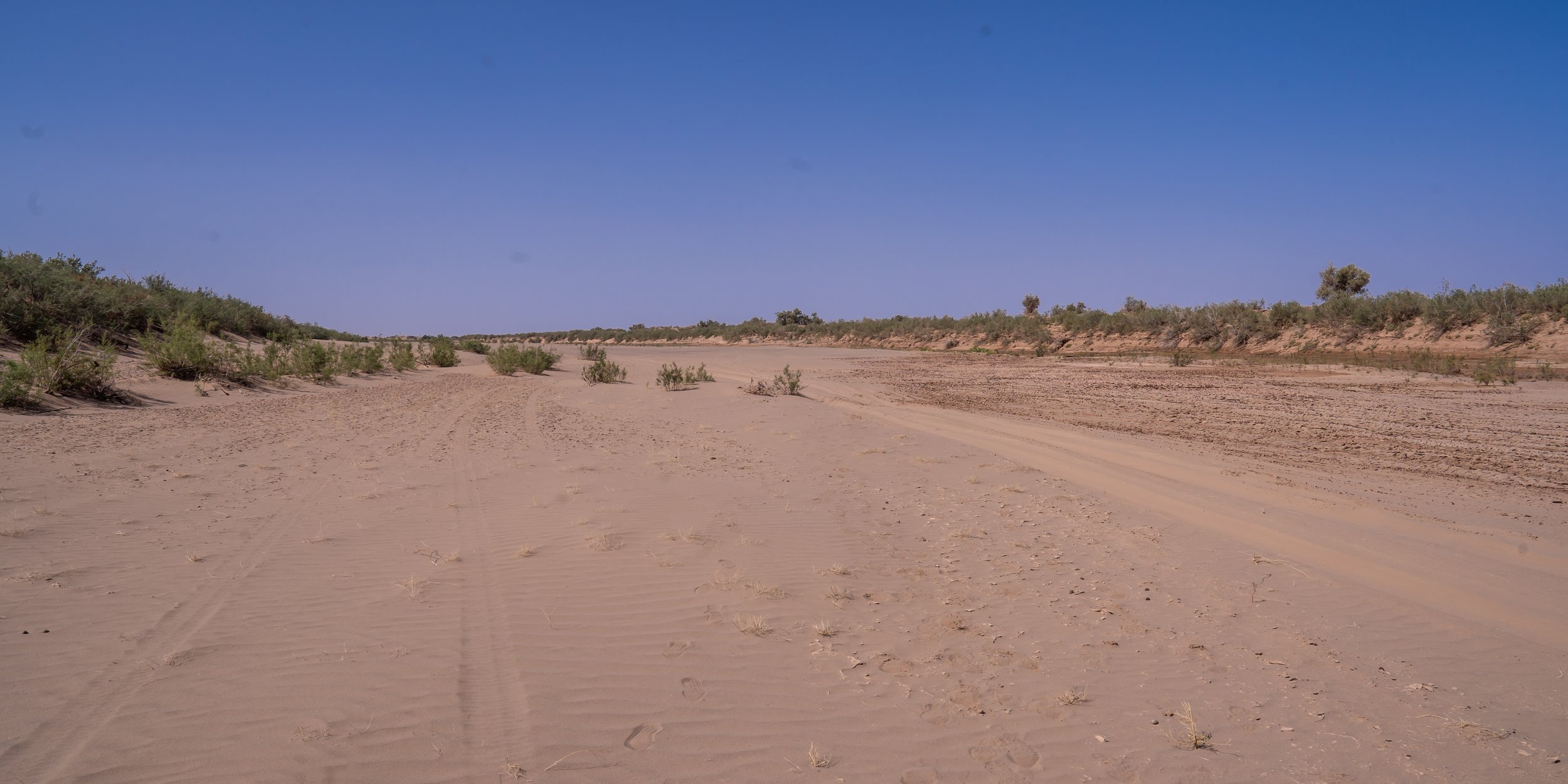
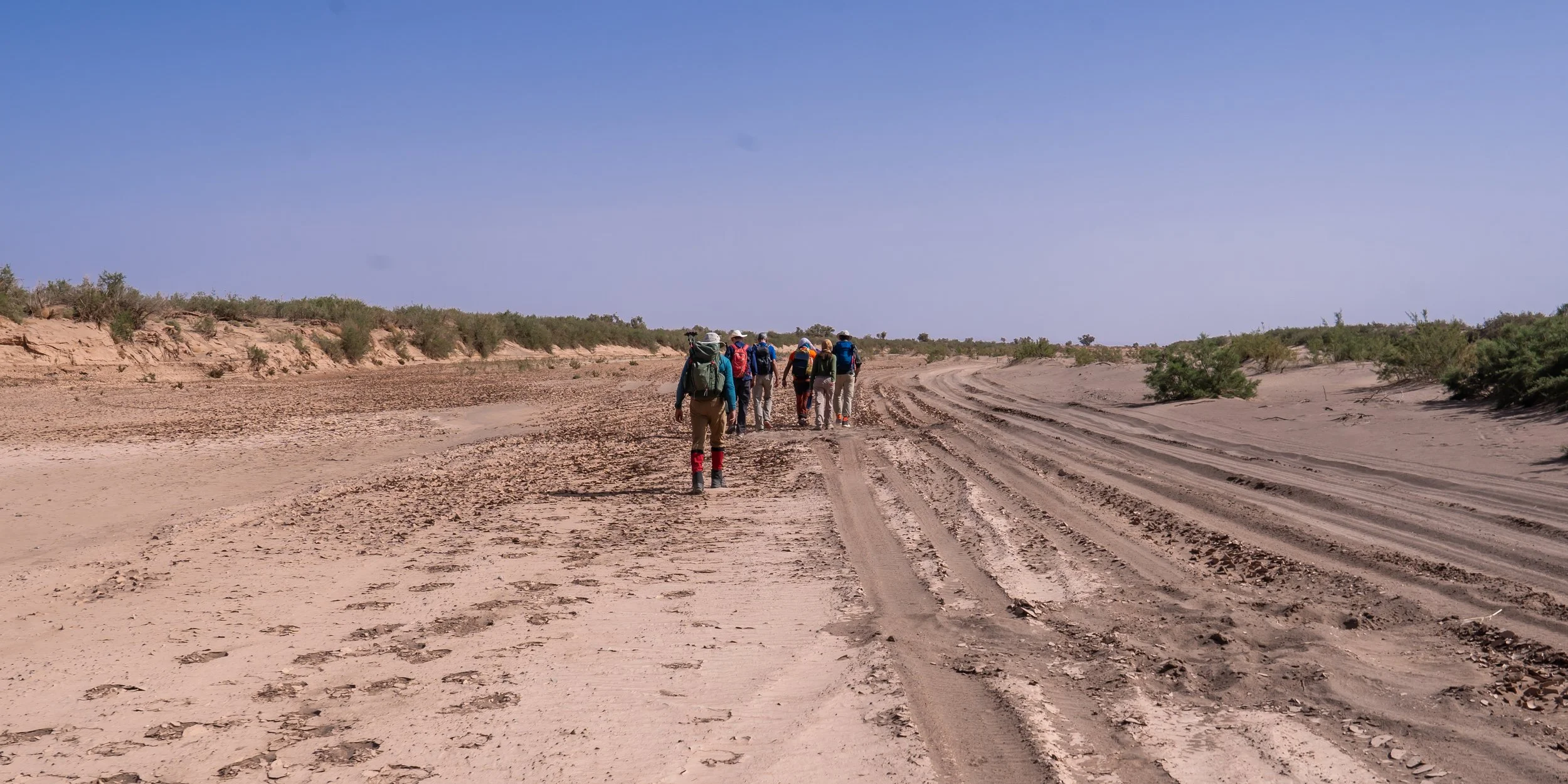
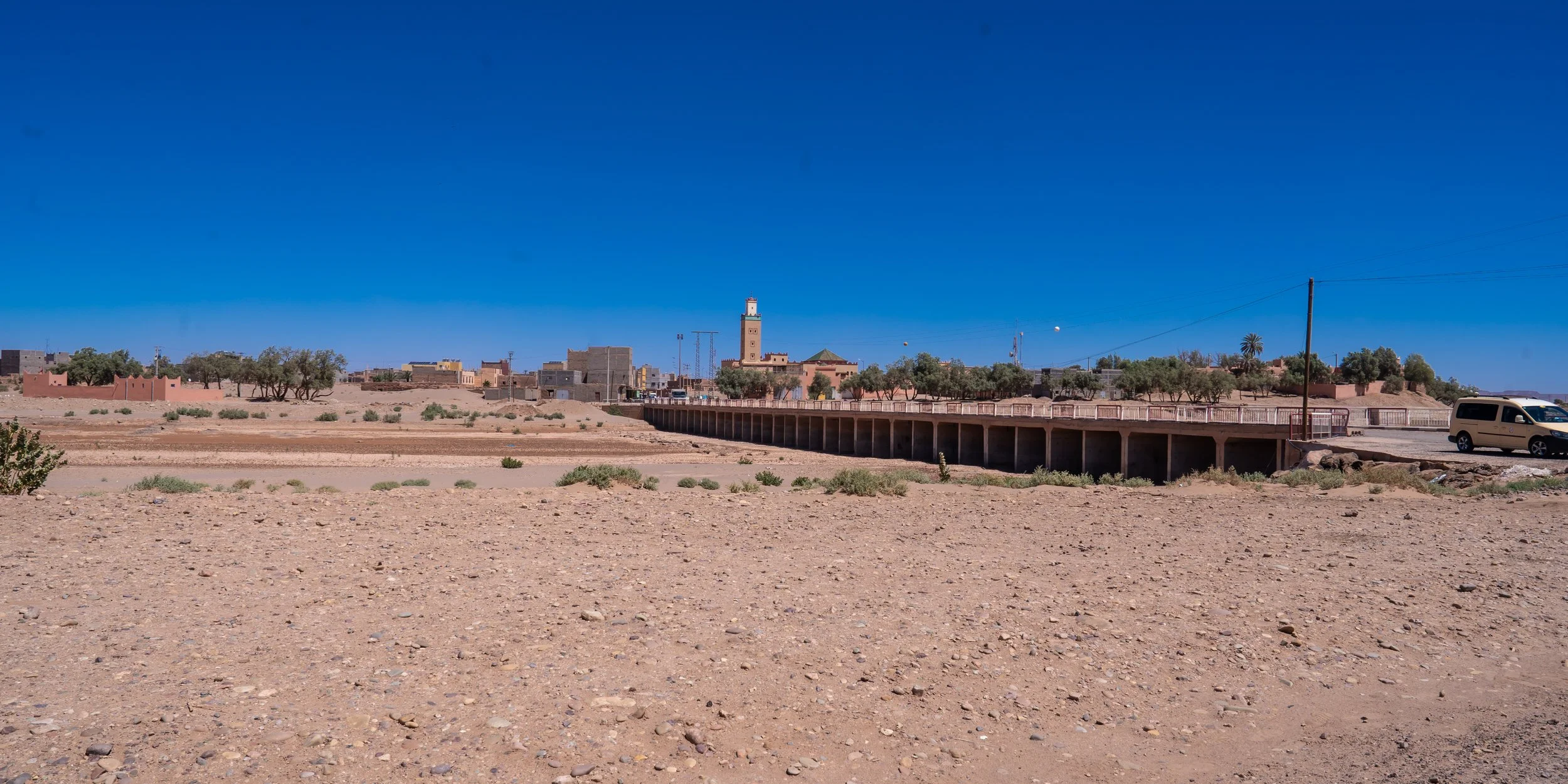
As we moved along the Draa river, its bed stretched wide and silent, but no water flowed. The palms still lined its edges, their roots clinging to memory, yet the river itself was only dust and stone.
The emptiness carried its own weight—reminding us that in the Sahara, even lifelines can vanish. What once was a flowing guide had become a hollow path, and we walked beside it knowing that survival here depended not on the river’s promise, but on our own vigilance and the caravan’s endurance.
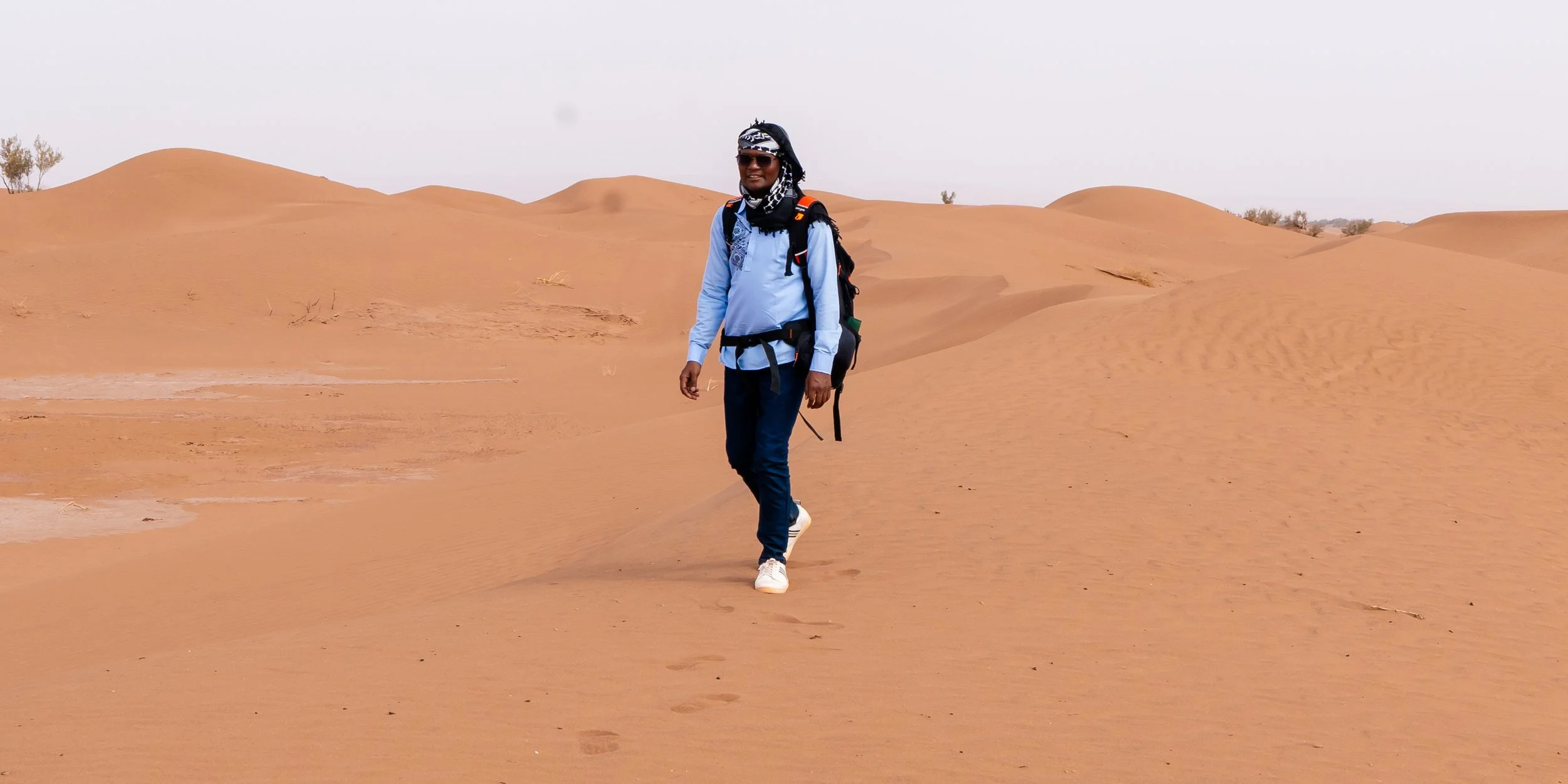
At noon, the desert turned fierce. The sandstorm rose suddenly, swallowing the horizon in a haze of dust. We wrapped our faces—towels pulled tight, my shemag shielding against the sting of flying grains. The wind howled, relentless, and for two long hours we endured, each breath a struggle against the storm’s fury. Then, as abruptly as it began, the storm paused. Silence returned, the dunes reshaped by its passing. We pressed forward, weary but resolute, until the smaller dunes of Tilhatine came into view—gentler slopes, a promise of rest after the desert’s trial. Matteo lingered, his gaze turned back toward the path we had crossed. The lines in the sand, the emptied bed of the Draa, the fury of noon’s storm—all seemed to weigh on him.
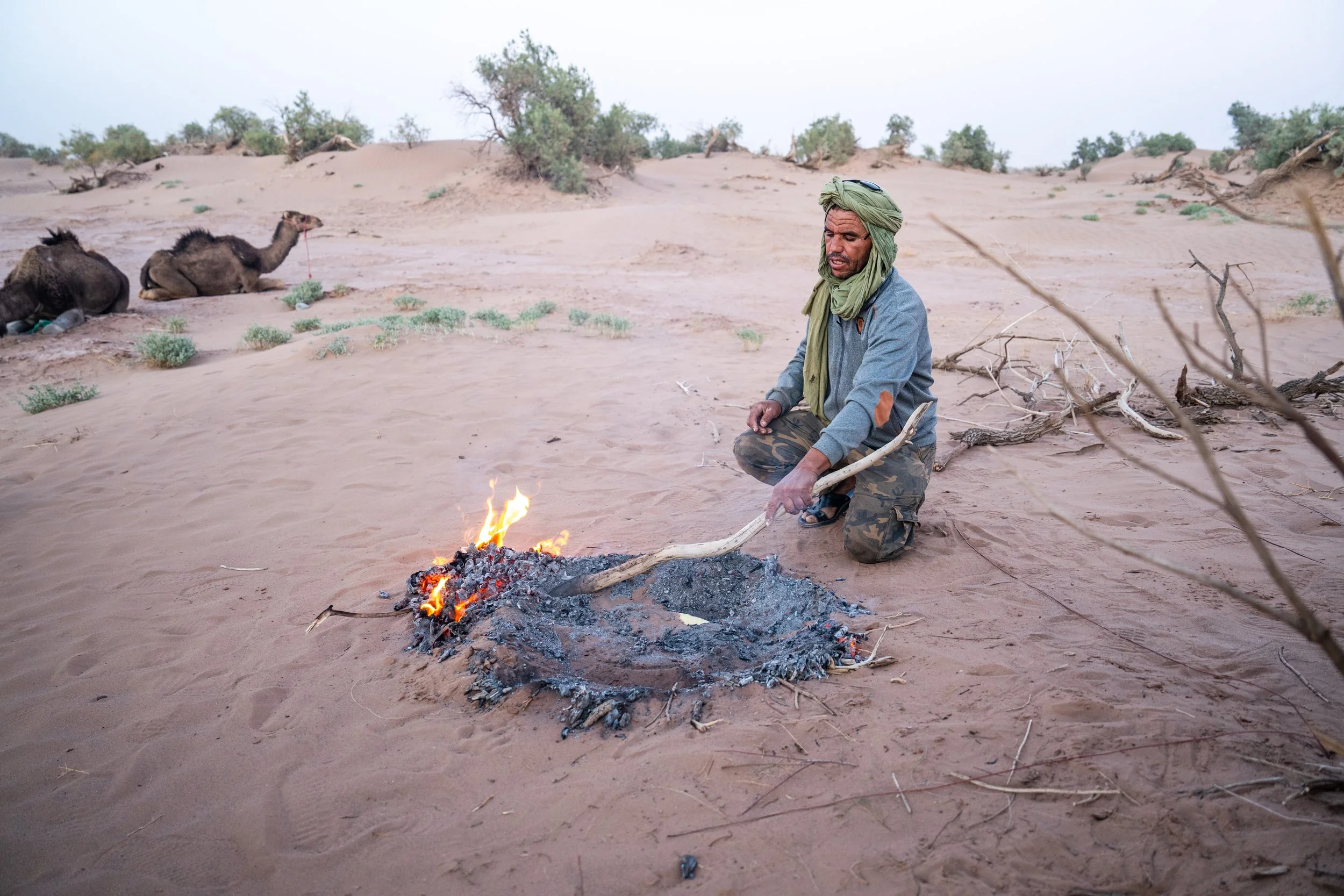
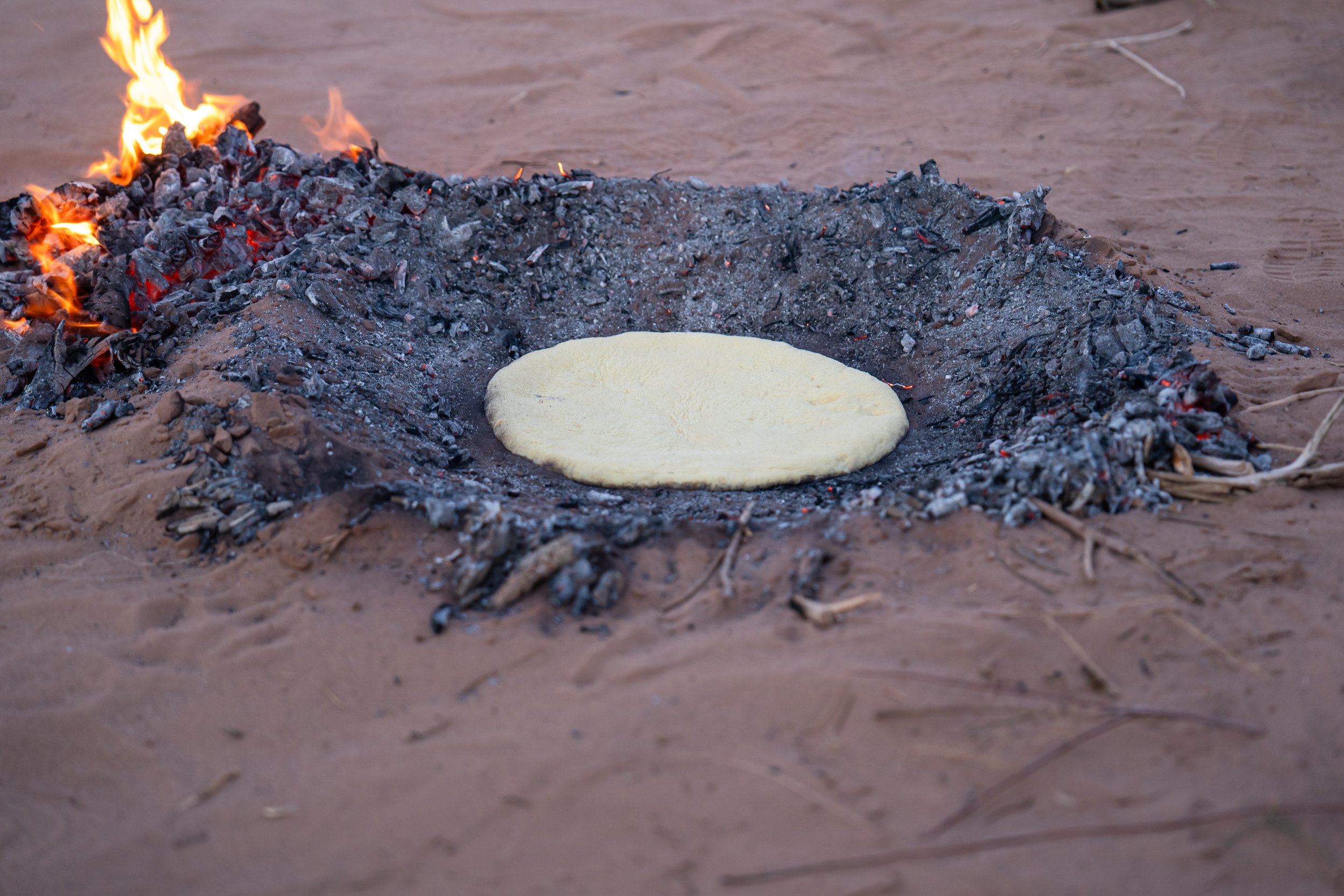
At Tilhatine, the desert still carried the silence of the storm. Hussain gathered dry wood, stacking it carefully upon the sand. With practiced hands, he sparked the fire, its flames rising against the vast emptiness. Over the glowing embers, he placed the dough. The heat licked at its surface, baking it slowly, the aroma drifting into the desert air. It was a simple act, yet profound—bread born from fire on the sands, sustenance carved out of resilience. In that moment, the desert gave not only trial, but nourishment.
When the bread was ready, Hussain cut it into pieces, the crust still warm from the fire on the sand. We gathered close, each taking a portion, the simple meal carrying a sense of comfort after the storm and the long trek. The taste was earthy, touched by smoke, yet it felt more than food—it was resilience made tangible. In that moment, eating together beneath the vast silence of Tilhatine’s dunes, the caravan was bound not just by the journey, but by the bread that sustained us.
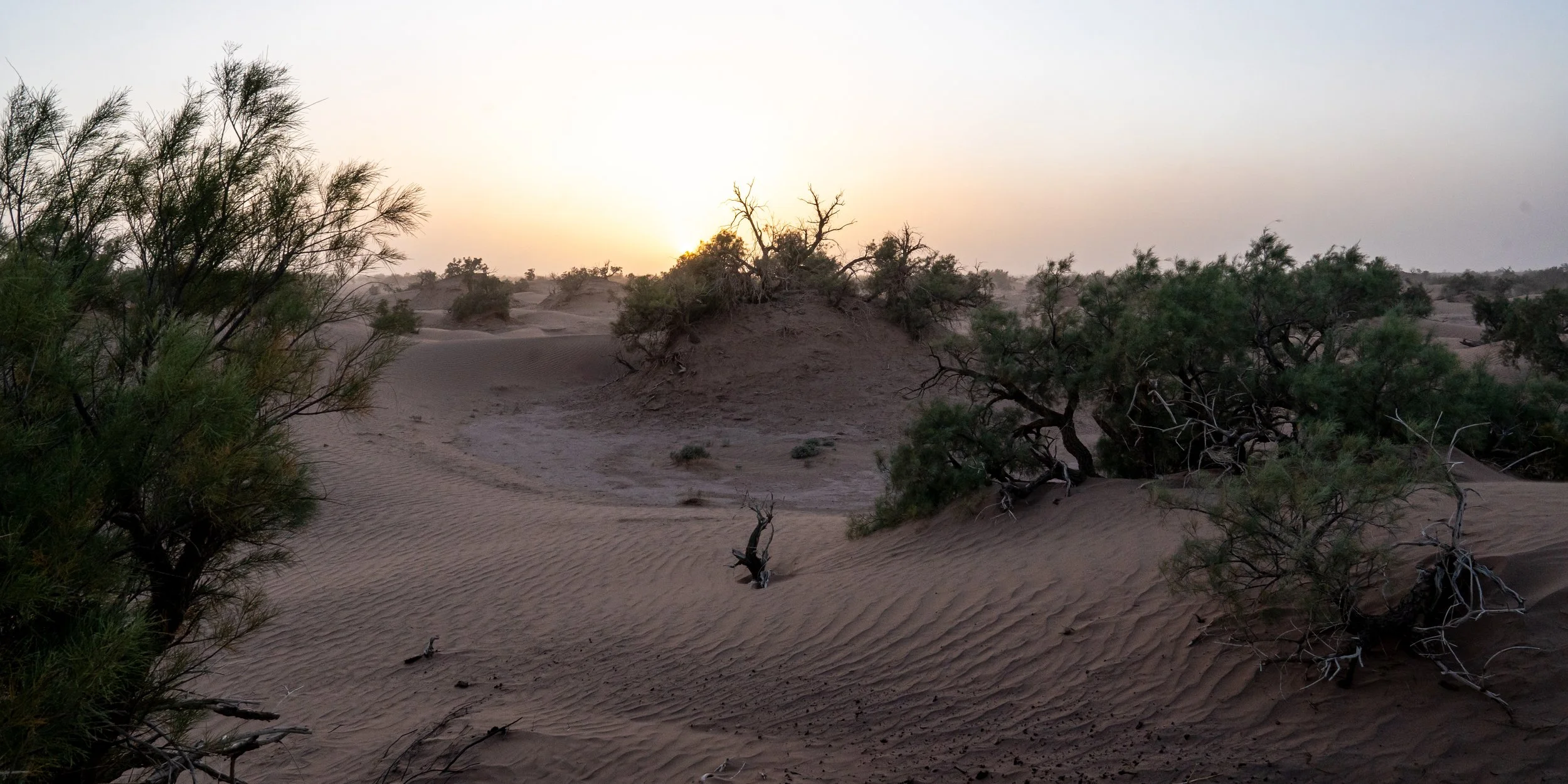
As the day waned, the smaller dunes of Tilhatine glowed under the fading light. The storm’s memory lingered, but the desert softened, its ridges painted in gold and crimson. Shadows stretched long across the sand, each line etched by the wind now deepened by the sun’s descent. Watching the sunset, Tilhatine felt less like trial and more like sanctuary, a reminder that even after storms, the Sahara offers moments of quiet beauty.
At Tilhatine, as the sun’s glow faded and the desert quieted, I gathered my thoughts. The journey—storms endured, bread shared, dunes crossed—was summarized in my mind, though it was not yet complete. Each moment carried weight, each trial shaping the caravan’s story. With the day’s memories settled, I returned to camp. The tents stood firm against the silence, the camels resting nearby. I lay down, the shemag still carrying traces of sand, and let sleep take me—knowing tomorrow the desert would call us forward again.
The next morning, the desert air was calmer, carrying only faint traces of the storm that had tested us. We set out on our return journey, the caravan moving steadily across the dunes. The camels swayed with familiar rhythm, their shadows stretching long in the early light.
On the return, the horizon shifted—lines of green broke the monotony of sand. The palm grove stood ahead, its fronds shimmering against the late desert light. After storms and silence, the sight carried relief, a promise of shade and life hidden beneath the dunes.
As the palm grove shimmered in the distance, I lingered too long, caught in its beauty. The caravan moved ahead, their silhouettes fading into the desert’s haze, and suddenly I was alone. I sat down upon the sand, the silence pressing in, thinking of direction. The dunes stretched endlessly, each ridge resembling the other, and the dry riverbed offered no guidance. In that moment, the desert demanded choice—whether to follow faint tracks, trust the wind’s whisper, or wait for the caravan’s return.
Then Ven appeared—calm, steady, his watchful presence breaking the solitude. He pointed out the right path, his eyes tracing the faint tracks that the caravan had left behind. In that moment, the weight of choice lifted. With his guidance, the desert’s vastness no longer felt overwhelming, and the journey could continue.
Beyond the dunes and the scattered palms, outlines emerged—walls of clay, rooftops shimmering in the distance. A human settlement revealed itself, quiet yet unmistakable against the vast emptiness. The sight carried a sense of arrival, of life persisting where the desert seemed endless. Smoke rose faintly from a hearth, and the geometry of homes broke the monotony of sand. After storms, silence, and wandering paths, the settlement stood as proof that even here, humanity had carved out continuity.
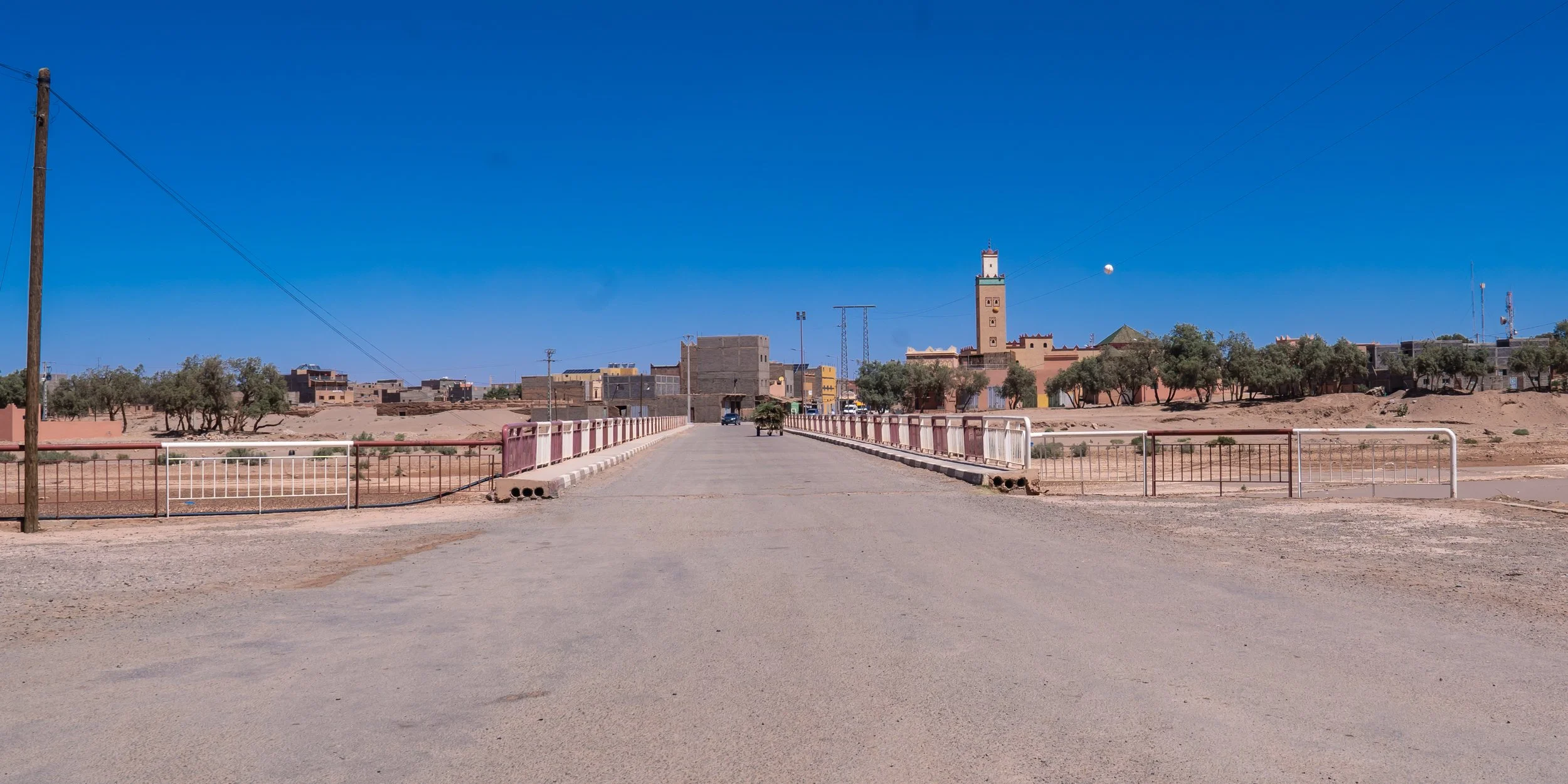
By late day, the dunes gave way to signs of settlement, and soon we reached Mhamid. The village stood at the edge of the desert, its clay walls and narrow alleys shaped by centuries of resilience. Palm groves framed its outskirts, and the faint hum of life replaced the silence of sand.
After storms, dunes, and long wandering paths, Mhamid felt like a threshold—where the Sahara’s vast emptiness met human endurance. The journey had carried us through trial and reflection, and in arriving here, it offered both rest and continuation.
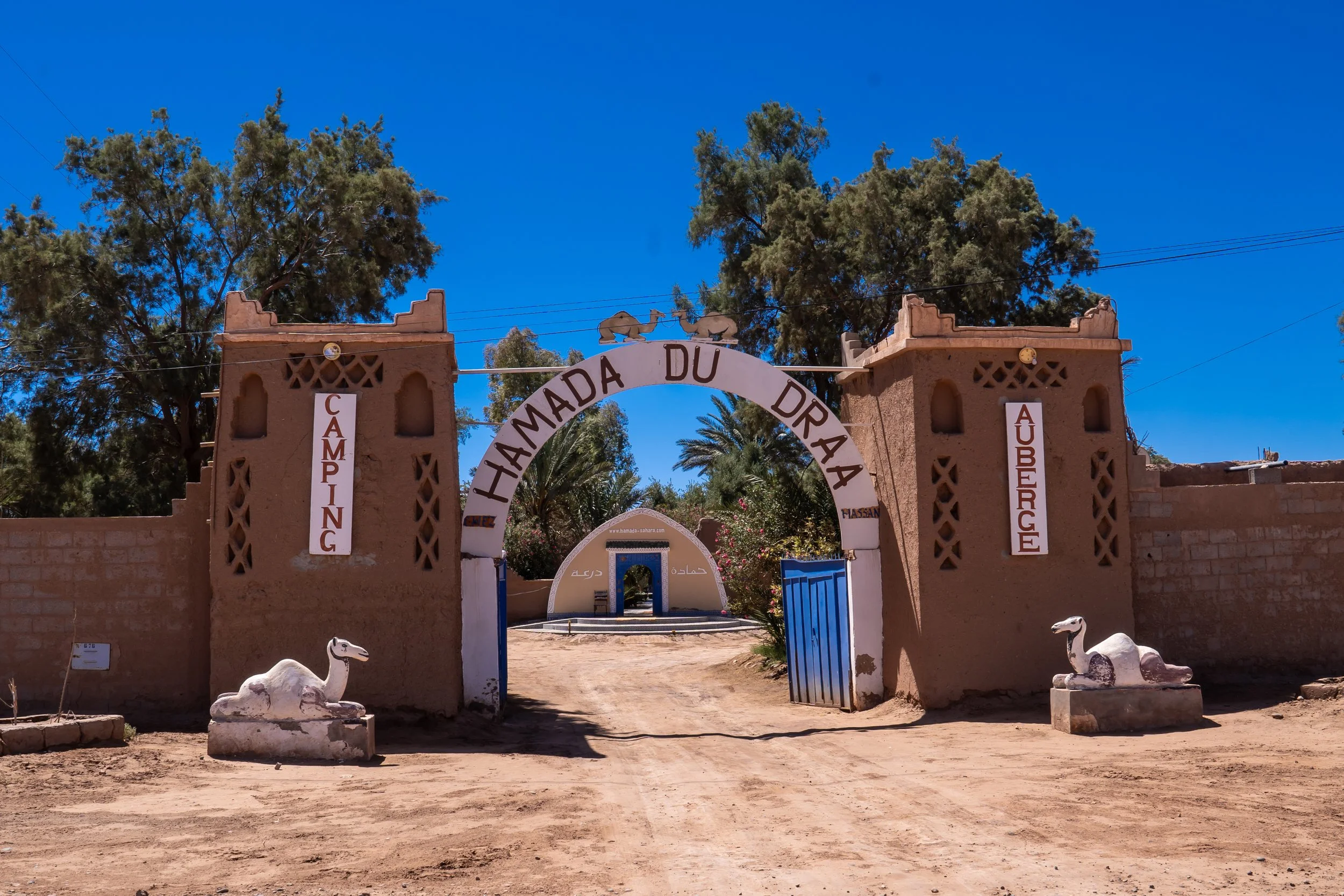
As we crossed into Mhamid, the desert’s silence gave way to signs of welcome. Scattered among clay alleys and palm groves stood the guest houses—simple auberges with mud-brick walls, family lodgings with starlit terraces, and small riad-style stays where tea was poured slowly into glass cups. Each doorway seemed to carry a story: travelers resting before the dunes, hosts offering bread baked in sand ovens, voices weaving together under the night sky. In their presence, Mhamid felt less like an end and more like a passage—a place where the Sahara’s vastness met human warmth.
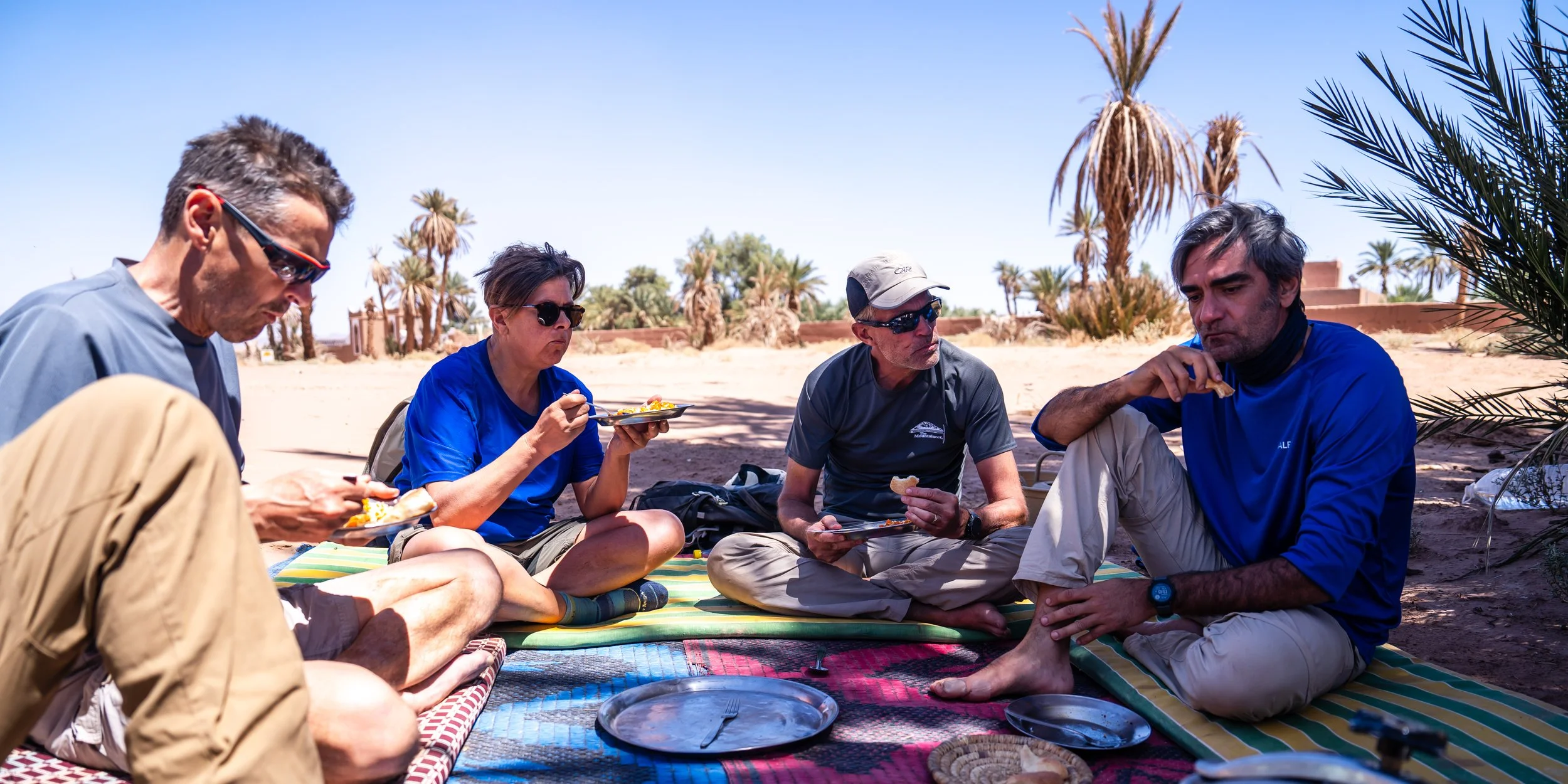
We spread our meal in the open, beneath the tall palms whose fronds whispered against the desert wind. It was our final lunch in the Sahara—bread and simple fare laid out on the sand, the shade softening the heat. Paul and Doug ate quietly, their eyes drifting toward Matteo. He sat apart, still deep in thought.
After our last lunch beneath the palms, we made our way back to the Berber camp. We relaxed there, letting the weight of the journey ease. The camp carried a sense of belonging—stories shared, thoughts lingering, and the desert itself watching quietly as we settled into calm.
The next morning, we crossed back over the Atlas, the winding roads carrying us from desert silence into the pulse of Marrakech. The city welcomed us with its souk—lanes alive with color, spices, and the hum of bargaining voices. Some of us slipped away to the hammam, letting steam and ritual wash away the desert’s dust. By evening, we gathered once more, sharing laughter and memories. Goodbyes were spoken with warmth, each farewell carrying the weight of the journey we had lived together. Marrakech became not just a return, but the closing frame of a story etched in sand and stone.